For dark mode users,
Hello, reader! Today, we are covering: Cultural Insight: Games in the Hit Netflix Show Squid Game, Explained Slang: 깐부 (gganbu) This Week's Recommendation music video “My Universe” Don't forget to leave your feedback below!
Games in the Hit Netflix Show Squid Game, Explained
Writer: Haram Lee, Chaewon Park Editor: Aleya Sharif, Sunny Um Editor-in-Chief: Fred McNulty Researcher: Daeho Park * Disclaimer: The following article contains spoilers for the Netflix show “Squid Game”.
Source: Unsplash The Korean drama, Squid Game (오징어게임) has gone viral on Netflix worldwide after a successful screening on September 17th. It marked the first place with the highest viewership in both Korea and 83 other nations worldwide. There have been many Korean dramas that gained international popularity, however what makes Squid Game more interesting is that the drama incorporated Korean traditional games into its plot. The popularity of the drama also led to the increased recognition of Korean culture amongst global audiences. Plot Summary People that have a heavy debt are invited to play the Squid Game, a series of survival games, for a chance to win the grand prize of ₩46.5 billion. The participants are asked to compete against one another in several games, and the ones who lose each round are faced with a severe punishment: death. Gi-hun, the main character, played by Lee Jung-jae (이정재), is chased by creditors after accumulating a large amount of debt while also losing a large sum of money through gambling. One day, the game recruiter, played by Gong Yoo (공유), comes to Gi-hun suggesting he play a game by betting money. After playing the game and finally winning a round, Gi-hun gets an invitation to join the official Squid Game. Korean Traditional Games Appearing in Squid Game 📨 딱지치기 (Ddakji Chigi) “Ddakji Chigi” is a game that is played by two players with two folded paper tiles, known as Ddakji. One Ddakji needs to be placed on the ground and the other Ddakji needs to hit the Ddakji on the ground to flip it over to win. When the Ddakji does not flip, the other player has the chance to flip the Ddakji that has failed to flip. 🌺 무궁화 꽃이 피었습니다 (Red Light Green Light) The game “Red Light Green Light” is derived from hide-and-seek. It is a game where the tagger faces the wall and shouts “Hibiscus flowers has bloomed (무궁화 꽃이 피었습니다)” before turning around to face the players, and immediately catches anyone who moves after shouting the slogan. 🍭 설탕뽑기 (Dalgona) “Dalgona” is a game in which a stencil is used to create shapes from caramelized sugar and baking soda mixture called Dalgona. The game then requires the players to carve out the different shapes perfectly using a needle without breaking the shape. If the shape cracks or breaks while carving, the player loses the game. For your information, shapes with more curves and lines (e.g. a star) is more difficult to carve out perfectly compared to simpler shapes, such as a triangle.
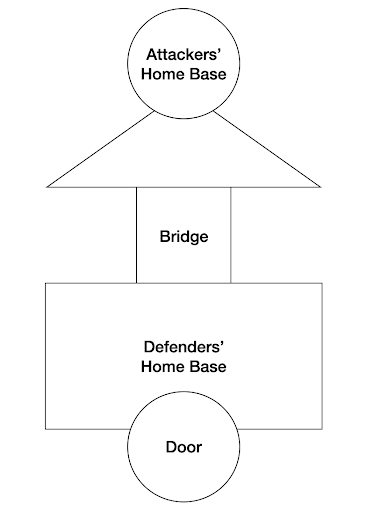
Source: Getty Image Bank 🦑 오징어 게임 (Squid Game) The game is called “Squid Game” because players run on a squid-shaped playing field. Depending on the number of players, the size of the field will be different. The squid drawing should be big enough to fit all players. To decide who is the attacker and who is the defender, the players have to play rock, paper, scissors. The winners can choose which role they will play in the game, but they often choose to be attackers. The attackers’ home base is the circle located at the center of the squid’s head. The defenders’ home base is the squid’s square-shaped body. The attackers must jump with only one foot, but can hop around with two feet if they have crossed the “bridge” (다리), a long rectangular-shaped zone that connects the head and the body of the squid field. Not to let the attackers move around freely, the defenders should prevent the attackers from crossing the bridge by pushing them out of the zone or making them collapse. The attackers win when they get to exit the squid’s body through the “door” (문), another circular zone at the bottom of the squid’s body and return to their home base. Defenders can also win if they manage to stop them from exiting through the door and eliminate all attackers from the game. Players who lose their balance and fall or step on the field’s lines get eliminated. Eliminated players cannot return to the game until the next round starts.
Source: 에듀아이 :: ㄹ자 놀이 / 오징어 놀이 하는 방법 🔮 구슬치기 (Marble Games) There are a variety of games played with marbles. The following variations were showcased in Squid Game: -Aim for the Pit: Players with marbles dig a pit hole. Taking turns, they throw a marble aiming for the pit. Whoever succeeds in throwing their marble into the pit first wins. -Even or Odd: Players guess whether their opponent is holding an even or odd number of marbles in their palm. The winner who guesses right can then take the opponent's marbles from them. -Aim to the Wall: Also in turns, players throw a marble to a wall. Whoever throws a marble closest to the wall wins. 💪 줄다리기 (Tug of War) It’s a game in which players divide into two teams and pull the ends of a rope. The side that pulls the rope all the way to the back wins. In Korea, it is traditionally played on Chuseok (추석) and Full Moonset (정월대보름). Traditionally, Koreans used to test their luck and harvest yield of that year by playing the “Tug of War” game. For example, people believed that the amount of harvest yield will increase when the team on the east side (or right) wins. If the team on the west side (or left) wins, that means there will be a hopeful future for the players and their families. While these games are all playground games for children, Squid Game transformed them into suspenseful challenges with life-or-death results. Other Things to Expect from This Show 1) Criticism of Capitalism Squid Game portrays a dystopian capitalist world in which viewers can agree on the dichotomy of money: good and evil. Money itself is not evil, but the extent to which people can go when it comes to earning money for a better life is bitterly portrayed in the drama. Some commentators have likened Squid Game’s themes to that of Parasite (기생충), a 2019 hit film that similarly garnered international recognition. 2) Actors The stellar lineup of actors in Squid Game played a major role in drawing people's attention to the show. These include actors Lee Jung-jae (이정재), Lee Byung-hun (이병헌), Gong Yoo (공유), and Jung Ho-yeon (정호연). Lee Byung-hun, who is familiar to viewers through Hollywood movies such as Terminator Genisys and G.I. Joe, has gained a lot of interest. As for Gong Yoo, he was well known for his role in the drama Guardian: The Lonely and Great God (쓸쓸하고 찬란하神 – 도깨비) and made a remarkable appearance in the show as well. Finally, another great rookie actor that gained a lot of attention for her role was model Jung Ho-yeon (정호연). 3) Korean’s “Jeong (정)” The show depicted the power of Jeong, or emotional bondage, in challenging conditions. The drama shows some scenes where characters act based on altruism and solidarity over their own survival. It also teaches the lesson of caring for others, including social minorities, as they have the right to be at an equal pace with others. 4) Absence of Individuality Squid Game addressed a critique of modern society, which posits that individuality has been missing and people have started to conform too fully to social standards. This was shown through the outfits of the participants, soldiers, and the administrator. They were all dressed in designated uniforms and expected to follow strict dress codes.
Slang 깐부 (gganbu)
Gganbu (깐부) has been used by children to describe the “same team” when playing with marbles and Ddakji-chigi games. Some say that gganbu originated from “combo”, which was the name used to call a small group of jazz bands within the 8th United States Army Band stationed in Korea around 1945. Another influence may have come from the pronunciation of the word Gwanpo (관포, 管鮑), meaning a deep friendship.🤜🤛 Example: A: 그러면 우리 깐부부터 맺어야지? B: 깐부요? A: 아니, 구슬치기좀 한다면서 깐부도 몰라? 동네에서 구슬이나 딱지랑 같이쓰는 친구 말이야. B: 아, 깐부, 기억나네요! 제 동네에 한놈 있었어요 저랑 제일 친했던 놈. A: Then, let’s make ourselves a pact and become gganbu. B: Gganbu? A: You said you played Marbles, but you don’t know what gganbu is? You know, the friends you share your marbles and Ddakjis with. B: Ah, that gganbu, I remember! There was one dude in my neighborhood. The one that I was the closest with. This Week's Recommendation
On September 30th, the music video “My Universe” which is a collaboration between BTS and Coldplay was released on global music platforms. With a stellar collaboration and futuristic music video, the song consequently became a huge hit amongst international audiences, proving once again the popularity and growing interest in Korean culture and entertainment globally. The music video was directed by U.S. filmmaker Dave Meyers, and included a genre-driven, futuristic sci-fi concept that is common in Korean pop culture but relatively new in the western music industry. The music video is set in a futuristic time in which music is banned, but both BTS and Coldplay come together, joined with a fictional alien group called Supernova7, and perform their song. The theme of the song is about overcoming boundaries, as is evident from the collaboration of two bands that come from different parts of the world. You can watch the short documentary of this collaboration on YouTube.
|