For dark mode users,
Hello, readers! Today, we are covering: Cultural Insight: Will “With Corona” System Return Korea to Normalcy? Slang: “Hwag-jjin-ja” (확찐자) This Week's Recommendations Happiness (해피니스, 2021) Don't forget to leave your feedback below!
Will “With Corona” System Return Korea to Normalcy?
Writer: Yeon Woo Lee, Solwon Pyeon Senior Editor: Sunny Um Editor-in-Chief: Fred McNulty Researcher: Yul Jun Illustrator: Ah-young Kim
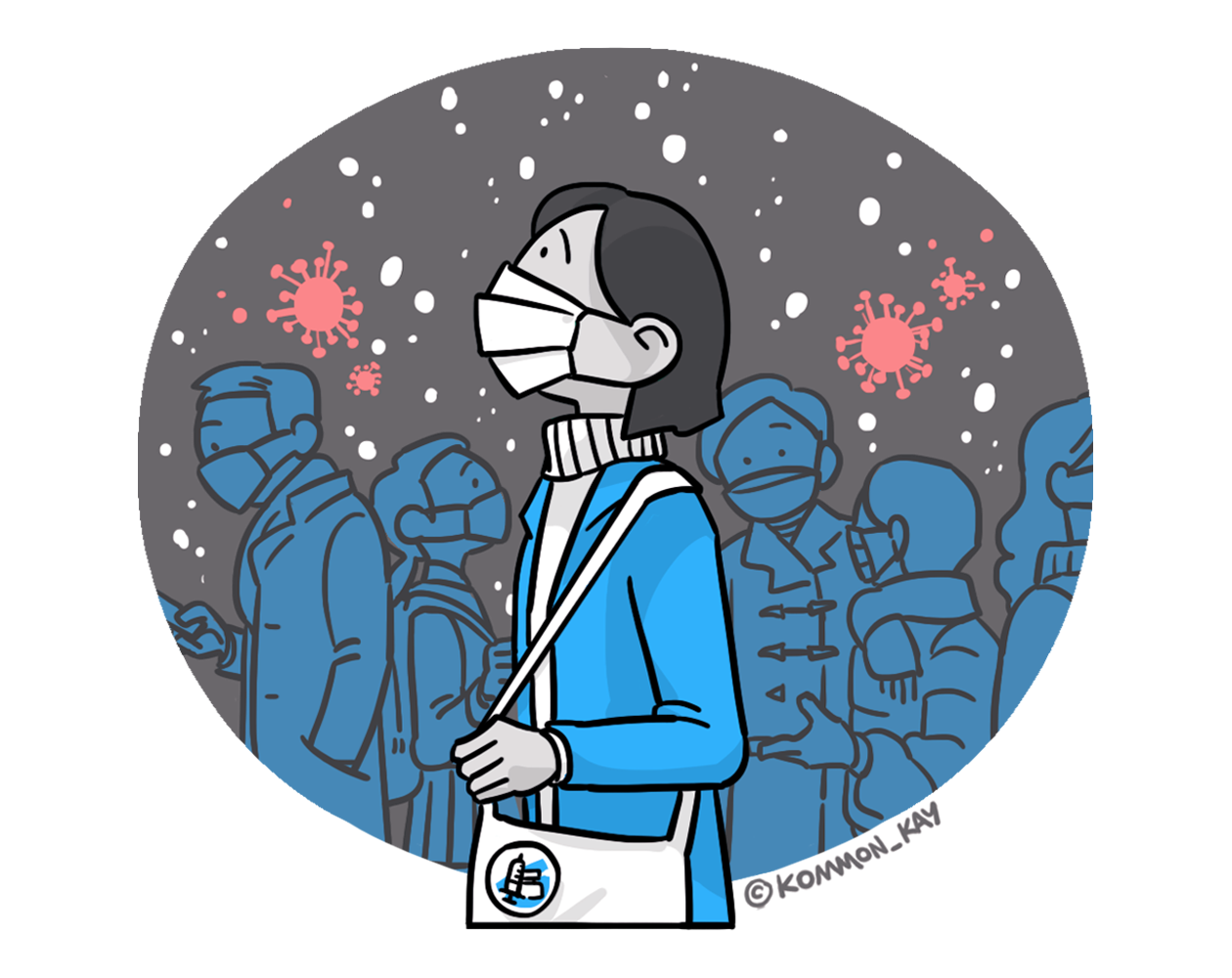
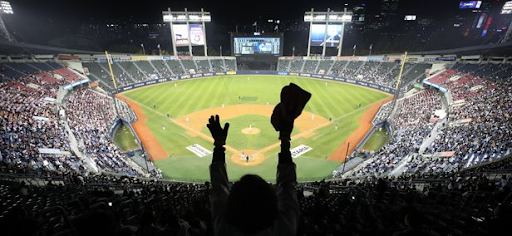
[Illustration by Ah-young Kim] Starting in early November, social distancing rules in Korea have been relaxed for people to meet up for a meal and have gatherings like they used to before the outbreak of COVID-19. The government’s new disease control policy is called “With Corona” (위드코로나), which is short for “Living With Corona” “With Corona” is a new system that relies on the wide distribution of vaccinations and the development of potential cures that can reduce the number of confirmed cases and deaths. Unlike the previous disease control system that depended on self-isolation and strict regulations to contain the virus, With Corona prepares the public to return to their “normal lives”. (Korean Link) The system will benefit small enterprises and self-employed business owners who have endured financial difficulties since the pandemic. However, this system faces criticism saying that it is too early to put our guards down against the contagious virus. On November 1 (Korean Link), the first day of With Corona, more than 12,400 spectators visited Jamsil Stadium to watch a baseball match between Doosan Bears and Kiwoom Heroes, two of the most popular baseball teams in Korea. BBC reported that the number of people at the bleachers that day was the highest record for a professional baseball league match since COVID-19 in Korea.
Spectators cheering during the match between Kiwoon Heroes and Doosan Bears on November 1st, 2021. Source: 프로야구 WC 1차전, 관중 ‘1만2422명’…코로나 시대 최다 What Is the “With Corona” System and How Does It Change Our Daily Lives? The Central Disaster and Safety Countermeasure Headquarters (중앙재난안전대책본부) plans to relax social distancing rules in three separate phases. Each phase will last two weeks before the government moves on to the next phase. The government will also evaluate whether it is safe to move to the next phase based on the number of confirmed cases and fatalities. In the first phase, business hours of workplace facilities (다중이용시설) will be extended. Large-scale gatherings will be allowed in the second phase and most of the restrictions on private gatherings will be lifted in the third phase gradually. For example, restaurants, cafes, public spaces like museums, and gyms will be opened to the public with much fewer restrictions during the next phases. Schools will open their gates and hold completely offline classes starting November 22. Under the new system, outdoor sports events can accommodate thousands of crowds as long as 30 percent of the crowds are fully vaccinated. However, high-risk facilities, where people cannot keep a far distance from each other, such as bars and nightclubs, are required to ask their customers to have the Vaccine Pass before letting them in. Visitors of such high-risk facilities are expected to show their vaccine certificate or negative PCR test result to enter. In addition, wearing facial masks is still mandatory and vaccination is still highly encouraged even though Korea achieved its initial target of fully vaccinating 70% of the population. The government said that With Corona is their plan to allow people to “gradually return to normalcy” in the long term. Is the “With Corona” System Discriminatory? At the same time, the With Corona system has been criticized for “discriminating” against unvaccinated people. The system requires people to present negative PCR test results to enter high-risk facilities, such as indoor sports facilities, public baths, and bars if unvaccinated, which some view as an undue burden. However, the test result is valid for only two days, which means that a person who needs to go to high-risk facilities every day should go through the PCR test almost three times a week. While Korea does not force its citizens to be vaccinated by law, people say that the new disease control system pressures people to get vaccinated with its “stringent”, “unrealistic” regulations. Some people revealed their personal experiences of being “discriminated” against for not getting the vaccine. For example, on November 2, an internet user nicknamed “Dogchwisin-ib (독취신입)” wrote on Dokchisa (독취사), an online community for job seekers, that they have been fired for not being vaccinated. Another internet user claimed that they managed to pass the job interview but was informed that their employer did not decide to hire them since they were not vaccinated. Regarding the companies proceeding with only vaccinated candidates (Korean link) in the hiring process, Lee Bu-yong, the head of Fair Recruitment Infrastructure Division of the Ministry of Employment and Labor, said that companies can state that they are looking for candidates who are fully vaccinated in their hiring advertisements because it is their “choice” and “preference”. However, Oh Yeong-min, the head of the Labor Standards Policy Division of the Ministry of Employment and Labor, said that companies cannot withdraw a job offer that was already provided just because the candidate was not vaccinated. Candidates who failed to proceed in the hiring process because of not getting the vaccine can ask for compensation from the companies they applied for. As a result of these controversies around discrimination, Prime Minister Kim Bu-gyeom said that the With Corona system should not “discriminate” against anybody (Korean link) and the government will listen to various opinions to keep its relevant regulations and policies balanced and fair. Does With Corona Discriminate against Non-citizens? A crucial component of the With Corona system is the Vaccine Pass, which allows entry to many previously-restricted venues. When anyone–Korean citizen or not–is vaccinated in Korea, their Vaccine Pass will accurately display their information. If a Korean citizen is vaccinated abroad, they are able to use their proof of vaccination to have their Korean record updated. However, if a non-citizen is vaccinated abroad, there is currently no way to update their vaccine record in Korea–unless one has a quarantine exemption certificate, which is only given in special urgent cases. The Korea Disease Control and Prevention Agency confirmed that they were aware of the problem, but failed to provide a date by which it will be fixed. Will the With Corona System Increase the Number of Confirmed Cases? Since the practice of the “With Corona” system, the number of confirmed cases remained above 2,000 for the five consecutive days until November 7. Dr. Chun Eun-mi from Ewha Womans University said she was concerned that the number could reach 5,000 or more a day at this rate. Hospitals have prepared more beds expecting a rise in the number of confirmed cases after the introduction of the new disease control system. However, they did not hire more medical staff which may push patients who don’t have COVID-19 further on the waiting list. Under the relaxed social distancing rules, experts say that the number of COVID-19 cases will definitely increase as more people will go out for outdoor activities or attend private, public gatherings. Son Young-rae, a senior epidemiological strategist at the government’s Central Disaster Management Headquarters, said that the “second wave of COVID-19 is inevitable”. However, he added that the government hopes to slow down the virus spread and confine the cases down to small, sporadic numbers with constant monitoring and screenings. The government may have to discuss more on what is the safest, the most efficient, and the fairest policy to return people’s lives to normal. However, the new With Corona system is definitely another step forward to get back to “business as usual”. Although some have claimed “discrimination” against the unvaccinated, the adaptation of the new system is a silver lining for small, self-employed businesses and many other industries that have been long closed.
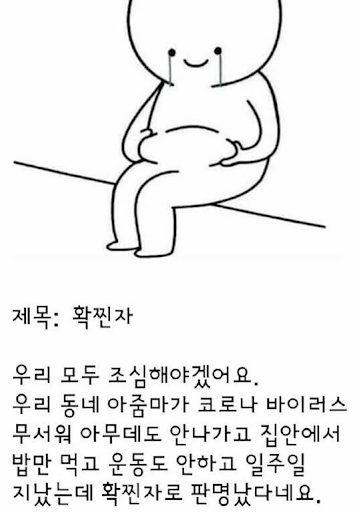
Slang “Hwag-jjin-ja” (확찐자) Due to the prolonged COVID-19 situation and social distancing rules, people have stayed behind their doors longer for the past two years. Without many outdoor activities, some started to gain weight while eating and chilling at their homes. In Korean, a patient with a positive COVID-19 test is called “hwag-jin-ja (확진자)”. On the other hand, a person (ja, 자) who suddenly (hwag, 확) became little chubbier (jjin, 찐) than before due to their extended indoor hours is called “Hwag-jjin-ja”
Source: 의협신문 Title: 확찐자 (Hwag-jjin-ja) You guys, we should all be careful! The lady in my neighborhood was confirmed as a hwag-jjin-ja(확찐자) after staying at home while eating and not exercising for a week since the COVID-19. This Week's Recommendations Happiness (해피니스, 2021) Available on TVing In a thrilling setting where infectious viruses are part of the norm, residents of an apartment building are faced with a dilemma during the onset of a new deadly virus that takes over the city. The series highlights ongoing psychological warfare as people of different social classes struggle to survive.
|