For dark mode users,
Hello, readers! Today, we are covering: Index Zoom In Cryptocurrency Boom in Korea Today's Vocabulary 영끌/빚투 (Young-ggeul/Bit-too) This Week's Recommendations The Age of Money Don't forget to leave your feedback below!
💌Editor’s Note Since KOMMON’s debut, we have consistently put out high quality English content about Korean culture, politics, and history. KOMMON, an organization, operates virtually, but we have still felt the effects of the on-going COVID-19 global pandemic on our ability to recruit new members and solicit donations. While we are lucky to work with a team of talented individuals, we have learned the hard way that talented individuals are in high demand. Volunteer staff with KOMMON have gone on to pursue work at noted publications such as The Korea Times, JTBC, and The Korea Herald. We are proud of all of our former staff members, and believe that this speaks to the level of talent at KOMMON. However, in the instance of transparency, several amicable staff departures in 2022 have left us with a smaller-than-optimal staff. As a result, KOMMON is planning on taking a brief hiatus until Friday, July 29 to give our staff time to recharge, reflect on the good work we have done, and plot out the future of KOMMON given these tough realities. If you wish to help out with a donation, you can do so here; if you are interested in joining the KOMMON team, you can apply here. We are particularly keen on bringing on new writers to help our current writing team. Thank you.
Cryptocurrency Boom in Korea Writer: Daeho Park, Jiyoung Kang, Aleya Sharif Editor: Aleya Sharif Senior Editor: Regine Armann Editor-in-Chief: Fred McNulty Researcher: Yul Jun Illustrator: Ah-young Kim
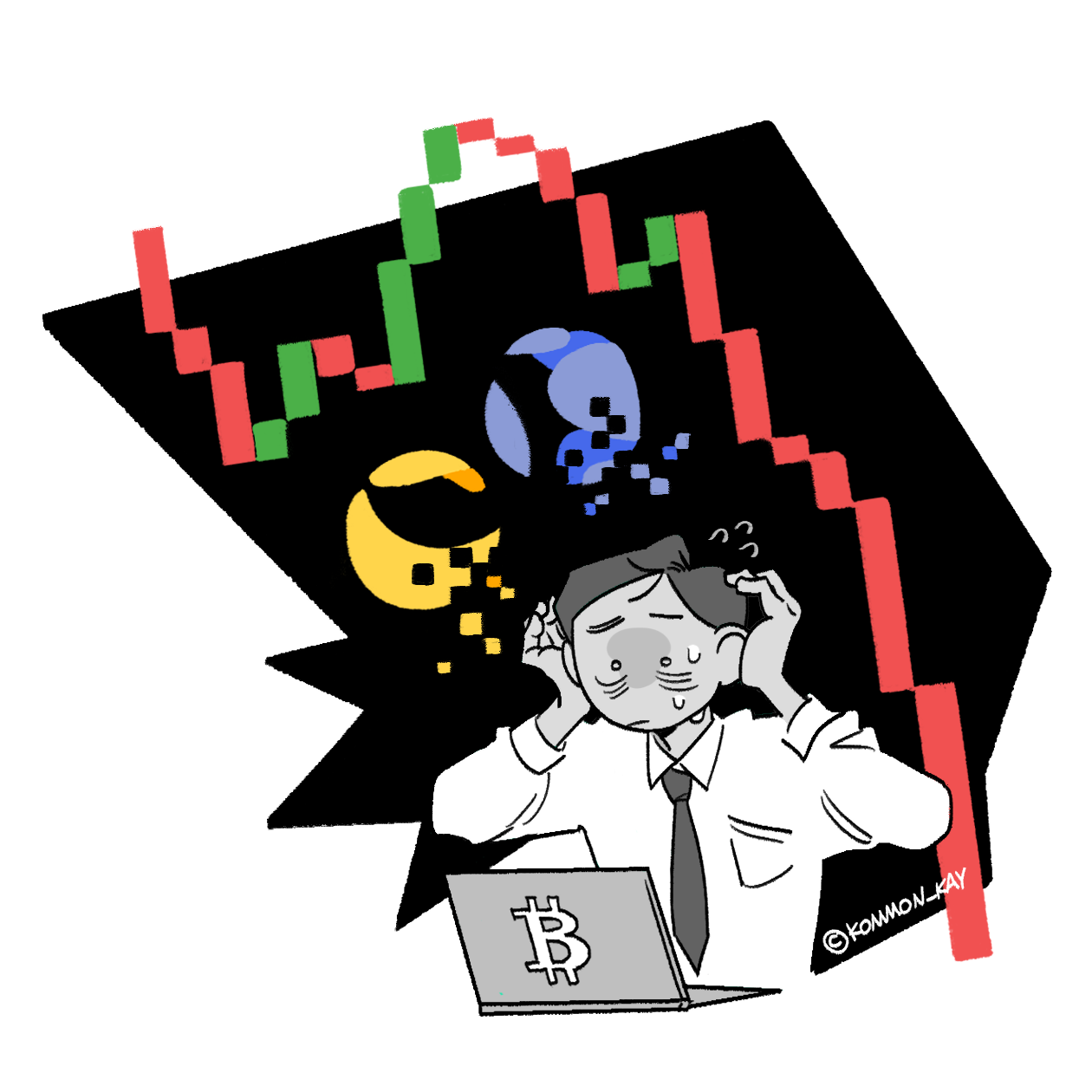
[Illustration by Ah-young Kim] The collapse of Korean-made cryptocurrencies Cryptocurrency is like a modern-day casino—some people make it big overnight, while others lose big. Currently, there are more than 19,000 virtual currencies and hundreds of blockchain platforms. However, last month, the collapse of the Korean cryptocurrencies “Terra (테라)” and “luna token (LUNA, 루나)” has sent an extreme shockwave to the entire market. Doubts have arisen about whether other cryptocurrencies will be able to survive in the future. If you are unfamiliar with the Korean “crypto” market, you might wonder what Terra and LUNA are. These two cryptocurrencies were some of the largest by market capitalization in South Korea. Unlike other so-called “stable coins”—which have their worth chained to a real currency, such as the United States dollar—Terra was different in that it was linked to another currency. If Terra dipped below USD $1, users were allowed to exchange their holdings for USD $1 worth of LUNA—and vice versa. However, this system failed on May 7, when the algorithms that are in-built to the platform to track demand and supply and balance the systems fell apart due to large investors in Terra and LUNA selling their stocks. The price of Terra suddenly nosedived to less than USD $1, a massive panic selling ensued, and LUNA, the only backup for Terra, since it is not secured by cash, treasuries, or other traditional assets like other stable coins, was unable to meet the required demand. The collapse of Terra and LUNA (which had, in fact, long been predicted by critics of the risky concept) led to many observers in Korea questioning the future of cryptocurrency altogether. Bertrand Perez, the CEO of the Web3 Foundation, said, “One thing that is problematic regarding the current issue of Terra is that there are too many blockchains and cryptocurrencies.” He added, “This not only confuses users but may also cause risks (Korean link).” Why is crypto so popular in Korea? Today, it is common to see people from different generations taking a dive into cryptocurrency. According to statistics, the “MZ generation” (MZ세대), also known as “zillennials” which refers to young adults in their twenties (generation Z) and thirties (millennials), currently account for over 60% (Korean link) of the investment scale. Among them, the age group with the highest proportion of investment in the exchange are people in their thirties, with a 44.8% share, followed by people in their forties and twenties, with 21.3% and a 17.6% share, respectively. Additionally, the number of female investors has increased over time. Compared to the end of the previous year, male investors have decreased from 82.8% to 59.8%, while female investors have increased from 17.2% to 40.2%. As a result, the recent 2.3-times growth significantly mitigated the gender imbalance in investments. The year 2020 featured a large craze for Bitcoin. However, unlike the one back in 2017, this one was hugely impacted by COVID-19. In other words, the extreme damage caused by the global pandemic led to a collapse of world economies. The world’s consumer markets and economic powers were greatly shaken. As stories of people making a lot of money from Bitcoin spread, more and more people are becoming immersed in investing in virtual currencies. There have also been recent cases of Korean college students, some of whom have no experience with investments, who have dropped classes in order to commit to full-time investing in Bitcoin. In 2021, a survey (Korean link) was conducted on the visitors of every time, the largest online community platform for Korean college students, to look into their coin investment activities. Of 2502 respondents, most answered that they had heard of coins or invested in them at least once. 95.4% said that they knew about coins, while 71.8% were actually investing in coins. The craze for cryptocurrency is particularly intense in Korea. Last September, Korea even took third place (Korean link) in the overall trading volume of Bitcoin, beating China and following the United States and Japan. Considering the size of Korea’s economy, this is staggering. Highest peak in 2021 Since the first peak in 2017, the cryptocurrency market has reached its second peak during the pandemic. In Korea, the recent cryptocurrency craze is more widespread than the last one and has resulted in the so-called “Kimchi Premium”(김치 프리미엄) that is, buyers, pay 10 percent higher prices for the same currencies in Korea compared to other countries. This is also confirmed by statistics. According to CoinMarketCap, a global cryptocurrency market watch site, on 12 May 2021, Korean cryptocurrency exchanges were listed at the top of both trading volume and weekly visitors. Korea’s Upbit exchange (업비트) ranks seventh worldwide, with about 2.9 million weekly visitors. CoinMarketCap, which collects such statistics, is owned by Binance, the world's largest cryptocurrency exchange. It counts the market price of cryptocurrency and the trading volume of exchanges every 24 hours and announces the number of visitors every week. According to the World Bank's announcement in 2019, Korea's gross domestic product (GDP) accounts for about 2% of that of the world, while its population represents about 0.65% of the worldwide population. Considering Korea's economic size and population, one can guess how strong Korea's cryptocurrency craze is. The Korean market is also characterized by stronger investments in Altcoin than more widely recognized cryptocurrencies such as Bitcoin and Ethereum. Altcoin is a word that refers to all coins but Bitcoin, and the prefix “alt” stands for "alternative". The ranking of currencies traded on the exchange reveals the speculative nature of the Korean cryptocurrency craze. As of May 12, 2021, EOS ranked first at 19.7%, Dogecoin ranked second at 13.76%, Ethereum Classic came third (6.55%), and Endo Protocol fourth (6.03%), and Ethereum fifth (4.55%). Bitcoin carries the symbolism of being the first blockchain-based cryptocurrency. Ethereum is the first runner of the second-generation blockchain and serves as a platform for other blockchain-based currencies to be used. On the other hand, in Korea, Altcoins rank at the top of the trading volume. Most of these currencies have a questionable value because their technical possibilities have not yet been verified. An example is “Dogecoin”: one year ago, a tweet by Elon Musk made Dogecoin soar and plunge several times, sparking a huge controversy. Dogecoin was originally created as a joke by programmers Billy Marcus and Jackson Palmer in 2013 to satirize Bitcoin's speculative nature. The investment patterns of overseas exchanges thus differ somewhat from those seen in Korea. The most traded currencies in Binance, the world’s largest cryptocurrency exchange, are Bitcoin (10.39%) and Ethereum (9.83%). Ethereum (18.99%) and Bitcoin (10.35%) are also at the top of Coinbase Pro, the largest cryptocurrency exchange in the United States. In Korea's Altcoin-dominated Upbit exchange, however, Bitcoin (2.59%) and Ethereum (4.1%) combined account for only 6.69%. At a time when Korea's Bitcoin price exceeded ₩74 million, it stayed at USD $59,456 on the U.S. cryptocurrency exchange Coinbase. That is a whopping 9.94% lower than in Korea. The currency’s price increase over the past week has also only amounted to USD $4,500, which is half the increase seen in Korea. Will the price bubble burst? After the pandemic, the world is facing unprecedented inflation, and Korea is no exception. The consumer price index (CPI) rose to a new high of 107.56 in May, an increase of 5.4% compared to the same month last year. The figure exceeds the Bank of Korea's 2% inflation target. In line with the U.S. and the EU, the Korean government is also preparing for tightening measures. In such a financial environment where liquidity is reduced, investments in cryptocurrencies have become a concern not only in Korea but also around the world. Eun Sung-soo (은성수), chairman of the Financial Services Commission (금융위원회) at the time, said last year that cryptocurrencies cannot be recognized as real currencies and that the government cannot protect all those who invest in virtual assets. He said (Korean link), "I don't think people who invest in cryptos should be protected" and, "I'm not confident that we should protect investing in virtual assets that sometimes rise 20% a day." As the recent LUNA incident has shown, due to the nature of the coin market, which some call an "out-law zone”, there is no way to rescue investors in the coin market. Central governments and the central banks of individual countries are also pushing for the introduction of the Central Bank’s Digital Currencies (CBDCs) which would shake the decentralized cryptocurrencies. The People's Bank of China has already officially declared the issuance of its CBDC in December 2019 and introduced it in Suzhou, Zhejiang Province, on a trial basis in April last year. United States President Joe Biden has also recently signed an executive order to research the introduction of a CBDC. The market environment is expected to change significantly if central banks introduce CBDCs to protect monetary sovereignty, thereby imposing taxes on the remaining private cryptocurrencies. U.S. Fed Chairman Jerome Powell said at a recent House Financial Services Committee hearing: "If there is a U.S. digital currency (CBDC), we will not need stable coins or cryptocurrencies."
Today's Vocabulary 영끌/빚투 (Young-ggeul/Bit-too) 영끌: Collecting one’s soul (scraping in everything as possible) 빚투: Leveraging (investing with loans) A: 이번에 난 영끌해서 코인 투자했다. B: 그래? 난 주식에 빚투했어. A: I have invested in crypto as much as I could. B: Oh really? I’ve put all my money in stocks. This Week's Recommendations
The Age of Money Available on K-play The Age of Money is an upcoming historical Korean drama produced by blockchain content creator K-Play Contents. Set during the Joseon Dynasty, the drama tells the tale of the fictional arrival of cryptocurrency in the form of an invisible brass coin.
💚 Support us! 💚
|