#LivingTips #InternetLife #Naver #KoreanITCompany For dark mode users,
We made a mistake with the title of the Cultural Insight section in our newsletter today.
We are resending the newsletter to correct the error. Sorry for the confusion. Hello, reader! Headlines Anti-child abuse law, AI sexually harassed, and more Cultural Insight Koreans don’t google it, but “Naver” it Slang How to say “Naver” without saying “Naver” Please leave your feedback at the end of the newsletter!
Human Rights New laws passed after tragic death of adopted baby Only 16 months old, Jung-in died due to complications caused by the abuse from his foster parents. A major broadcast channel SBS broke the story on its investigative documentary program, Want to Know That (그것이 알고 싶다). The wave of shock rippled across the country, causing outrage and raising awareness on the issue of child abuse. The foster parents claimed that the death was accidental and that Jung-in merely fell off the sofa. But expert analysis revealed significant evidence showing signs of physical abuse. The inaction from the adoption agency and the police was also the cause of the tragic loss. They failed to protect Jung-in despite the multiple reports from her nursery teacher, pediatrician, and a separate witness. The response was quick. A week after the program aired, a revised child abuse law passed the legislature. Following to the revision, local governments or investigation agencies that receive reports must start the investigations immediately. Corporal punishment will also be prohibited. Link (Korean) Gender
AI chatbot “Luda Lee” ("이루다") suspended after controversy over discriminative language Recently, an AI chatbot named Luda Lee was released by a social media company Scatter Lab. The AI was designed to study communication data from real couples through deep learning and so that it can engage in believable conversation with its users. The app, at first, was successful. Earlier this month, Luda's userbase exceeded 320,000, and 85% of users were teenagers. Problems emerged, however, after a male-dominated internet community started to troll the service. They found ways to turn the chat system, in their own terms, "sex slaves," by repeatedly engaging in sexual conversation with it, managing to create terms that would not be censored by the system. The system also drew criticism due to its failure to censor homophobic slurs aimed at sexual and gender minorities. What's worse, the company has collected real couple's chat logs without gaining their explicit consent. Couples voluntarily sent in their conversations hoping to get dating advice, without knowing that their private conversations would be used to develop AI chatbot. The company apologized for the controversy and eventually decided to suspend the service. Link Labor The government suggested extra payment to nurses at COVID-19 hospitals The government has recently enacted an emergency measure to pay an extra ₩50,000 per day for nurses at COVID-19 hospitals, after facing criticism concerning allegations of a huge pay gap between nurses at hospitals and nurses who have been dispatched to other areas by the government. Not only will the Central Disaster Management Headquarters give extra pay to nurses caring for critical patients, but they will also triple their nightly allowance, which will be ₩120,000. Dispatched nurses are getting paid nearly two or three times than nurses at COVID-19 hospitals. One nurse at a hospital was reportedly receiving a total of ₩3 million with a bonus of ₩200,000 while dispatched nurses are paid roughly ₩7 million. This is because dispatched health care workers normally get ₩200,000 - ₩300,000 per day. Some nurses have even quit working at hospitals and in order to go work in dispatched positions. Link (Korean) North Korea Kim Jong-un admits economic plan failure In North Korea, the 8th Congress of the Workers’ Party of Korea began on January 5. North Korean Leader Kim Jong-un officially conceded economic failure. He said “Five-year national economic plans ended last year, but most of them fell short of their goals”. Despite his acknowledgment, he put the blame on-field officials and gave notice that there will be massive punishments. What is the Congress of the Workers’ Party of Korea? It is a meeting wherein the Workers’ Party of Korea meets to determine the future priorities of the party. The Korean Workers’ Party was officially founded on October 10, 1945. Since the first congress was held on August 28th, 1946, it has been held intermittently. Link International Relations Korean oil tanker seized in the waters of Iran Under accusations of violating environmental laws, a South Korean oil tanker has been detained in Iran. There are twenty multinational crewmen including five Koreans. They are detained at Bandar 'Abbās, Iran’s southern port city. The Korean diplomatic delegation has headed to Iran to discuss the issue. Some argue that there may be another reason for detaining the vessel; the triangular relationship between South Korea, the United States, and Iran. The United States is an important ally and Iran is an important trading partner. But with the economic sanctions of the U.S. against Iran, Korea also has trouble trading with Iran. For this reason, ₩7 trillion to pay for importing Iran’s crude oil has been frozen. Iran claims that the detainment has nothing to do with this issue. Link
Koreans don't google it, but "Naver" it
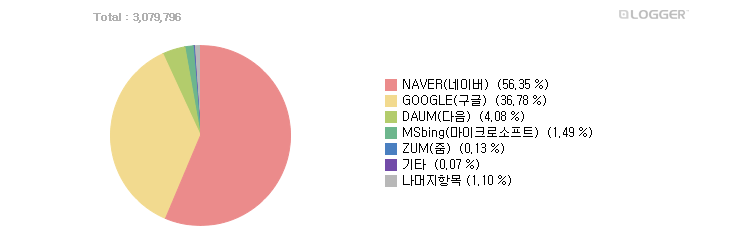
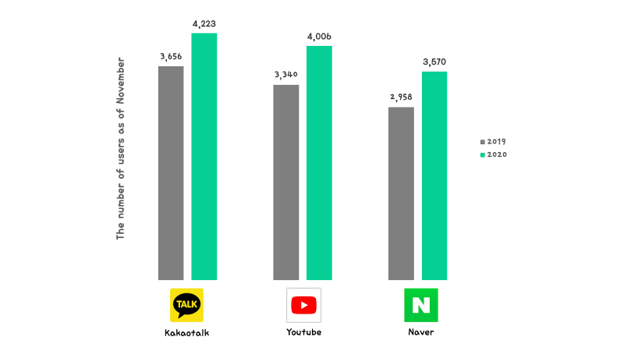
[Illustration by COCO] 1. A fictional, but representative story of Jun As soon as Jun—still half asleep—wakes up in the morning, he turns on his smartphone to check the time in order to make sure he is not late for work. Jun opens the Naver app to check his unread email, read personalized news articles, and search the weather forecast for this evening for his date with his girlfriend. At work, Jun continues to use Naver for email, and searches his way to get to the reserved restaurant for dinner using Naver Map. Throughout the day, Naver was on permanent standby to fulfill Jun’s demands. 2. What is Naver? As seen from Jun’s example above, Naver is the most beloved website for Koreans. With about 56% of the market share, Naver takes the lead of the domestic search engine market leaving behind its global competitor Google, with 36%. Naver also ranked the third most used mobile app for two years in a row, following KakaoTalk and YouTube.
Source: http://internettrend.co.kr/trendForward.tsp
Chart recreated based on http://www.digitaltoday.co.kr/news/articleView.html?idxno=256669 (2020) & http://catalk.kr/information/most-popular-apps-in-south-korea.html (2019) When it was first established in 1999, Naver was just one of the many domestic search engines, such as with Daum and Nate. However with newly launched services, Naver successfully outranked other competitors. Naver has since further broadened its services, ranging from news to shopping.
3. How to use Naver 101
Discover what’s trending in Korea: Real-time search words (실시간검색어) Real-time search words are twenty words that are searched the most frequently on Naver at that moment. That is, a list of real-time search words ranked by search frequency from 1 to 20, reflects the real-time popularity of a topic that has instantly risen. As the topic of interest of the public shifts, the list gets replaced by what attracts the latest attention of the public. But the list is not 100% reflective of reality. Although no editing is allegedly done on the list, Naver clarifies that the list is monitored according to their “standard.” Personal information, defamation, pornography, and illegal behavior are excluded from the list.
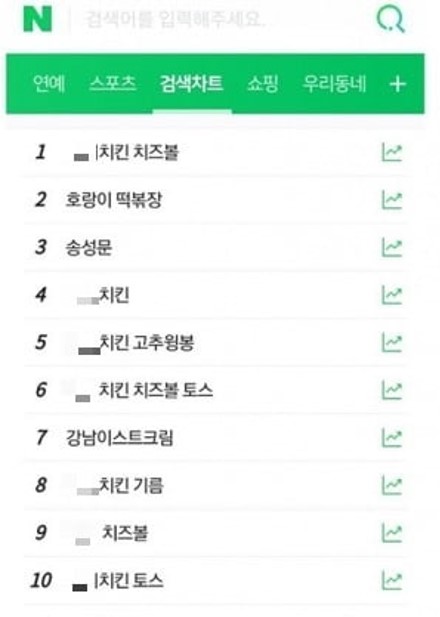
However, the application of the standard can be arbitrary and open to interpretations. Also, due to the guaranteed attention that real-time search words receive, they often become the target of a marketing strategy. Private companies sometimes conduct quiz events that require typing in their product names on Naver at a specific time. Sequentially, other more important issues are suddenly pushed out. In this case, a group of users are voluntarily changing the search frequency trend, so whether it’s a manipulation on the list or not is controversial.
Source: https://www.hankyung.com/it/article/201910247455H Naver’s 7 out of 10 real-time search words are in relation to a fried-chicken franchise, due to a quiz event.
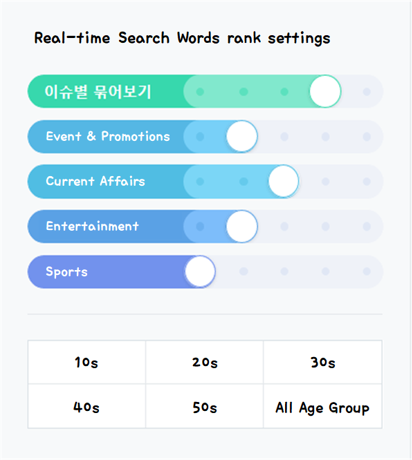
Still, suspicions gradually grew regarding the integrity of the ranking system. Recognizing the doubts, Naver extensively reformed it in 2019. Now, you can customize the display of real-time search words by choosing your own interest levels in 4 topics - Event & Promotions, Current Affairs, Entertainment, and Sports - on a five-point scale.
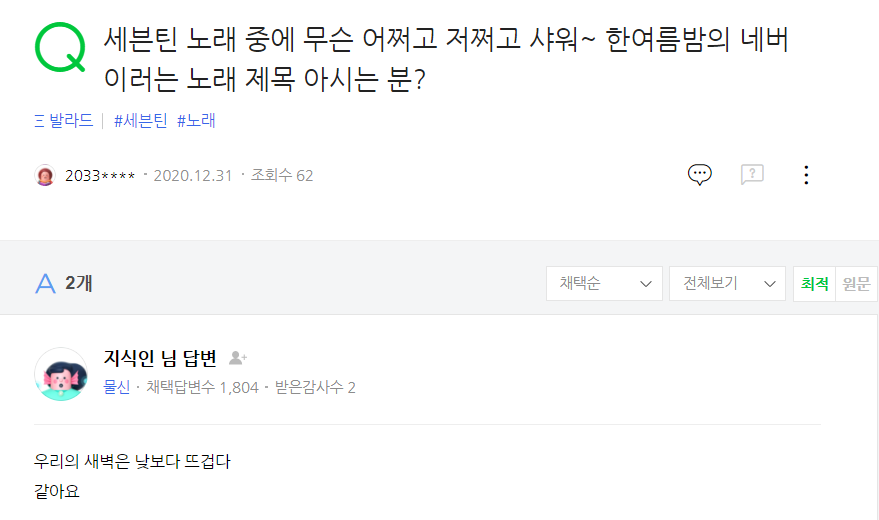
Recreated based on Naver display Earn some real life advice: Knowledge iN (지식iN) Naver’s Knowledge iN is one of the first online Q&A service platforms in Korea. You can ask whatever you want in a casual way and take practical advice. The only qualification for asking and answering is being a Naver user. Also, no grand expertise is particularly required to answer others’ questions, so the barriers are low. Therefore, you can easily consult Knowledge iN even for petty little curiosities. Like this:
Q. Among a song by boy band “Seventeen”, one goes by “something blah blah shower~ one summer night never~” like this. Can someone please tell me the title of this song? A. It’s Seventeen’s “Our dawn is hotter than a day”. Knowledge iN was popular when it was first launched in 2002. It was because despite the desperate needs, it was extremely difficult to find quality information in Korean online. Therefore, people had no choice but to resort to one on one Q&A platform of Naver, Knowledge iN. But be careful. Indeed, the benefits of Knowledge iN has faded. The situation has turned substantially these days and it is so much easier to find things with Google and YouTube. Besides, the point system, called Naegong (내공), that Naver integrated into the Knowledge iN is notable. You can get points by answering others’ questions and thanking the replier. No award but honor is really given, but still some people still engage with Knowledge iN deeply and accumulate massive amounts of points.
Have a peek at my everyday life: Naver Blog (블로그) Before there was YouTube, there existed Naver Blog. Naver Blog is one of the first platforms where the concept of influencers emerged. Anyone can create blogs and post whatever they want but there is a specific reason that Koreans go for Naver Blogs: to find the reviews of a product or a place. Let’s say your friend has recommended a cosmetic brand to you, saying that it’s popular these days. If you want to check whether it will suit you, you can simply type in the brand name and see a few detailed reviews. People would also type in “The best restaurant near △△ subway station” to look for good food places, and “What to do in ☆☆” to plan their trips. But be careful: Naver Blogs are reputedly full of advertisements. Companies often give free products and restaurants offer free food to influential bloggers for good reviews. Due to the flood of sponsored reviews that does not clarify the sponsorship, be aware of these tips to filter out so-called “fake reviews.” +) Few tips to avoid “fake reviews” of a restaurant by KOMMON editors 1. Avoid blogs that contain excessively high-quality photos: a restaurant may have given them! 2. Avoid blogs that post too much in a day: blog postings are usually based on a person’s experience. A person cannot travel that much in a day! 3. Avoid blogs that mention the region(for example, near the △△ subway station) of the restaurant too much: it is a strategy to raise exposure on the website!
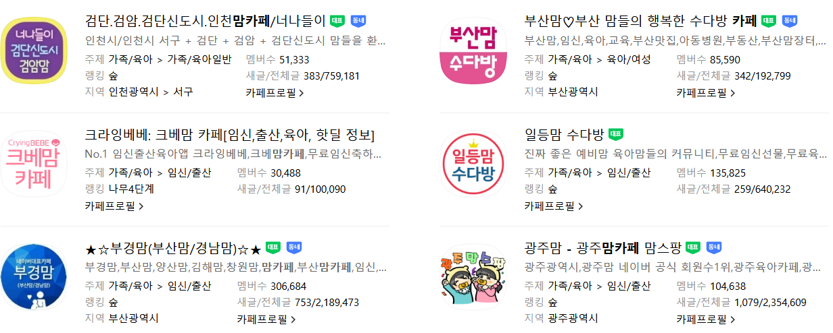
Meet the gurus of your interest: Naver Cafe (네이버 카페) Naver Cafe is a platform for people of similar interests to create an interactive online community. Interestingly, it's quite different to what is expected of a Naver blog; a blog is a personal online space in which one can freely write about one's own interests, whereas a Cafe is an online club that requires qualification in terms of the level of interest or profession. A Cafe usually has a management team that leads the club like in any other offline club, and the management team is responsible for recruitment of new members. A lot of Naver Cafe requires to fill out a small questionnaire in order to apply for the membership. For instance, some Fan Cafes (online fan community on Naver Cafe) of K-Pop singers ask about the birth date of the singer, or date of debut or some other information about the singers to test the level of interest of the applicant. Mom-cafe is an interesting type of Naver Cafe–a mother's online community–that only allows mothers to sign up. Mom-cafes are mostly district-based to share regional information. Mom-cafes, are amongst the most active Naver Cafes, are where the latest information regarding children’s education (mostly hagwons), neighboring restaurants, hospitals and services are updated the quickest. Those in need of parenting information or latest news in the region may want to sign up and join the region's mother's club.
Different mom-cafes of Incheon, Busan, Gwangju and more 4. Naver: Nav-igat-er The name Naver originated from the word "navigate" in hope to serve as a "navigator" and help the better use of the internet. As it initially intended, Naver is today responsible for various online services in demand of Korean users. Notwithstanding the absolute monopoly in Korea, Naver plans to further expand its business and keep up with the large number of users; for instance, it recently launched a Naver Membership Service, which includes an assorted set of premium services regarding webtoon, video streaming, and audio book. Indeed, in the global market, Google is dominant in terms of the market share, and those familiar with Google may use Google's assist in their everyday lives and at workspace. But in Korea, Naver can often offer better insights from the empirical reviews of the blog and the social interactions of Cafes. Naver can be a helpful navigator of your internet life in Korea.
Slang
Cho-rok-chang (초록창) Korea has strict broadcasting laws concerning what constitutes “advertising.” For example, it is not uncommon to watch Korean television shows and see laptop logos or t-shirt branding covered up to conceal the manufacturer. Therefore, despite the incredible popularity of Naver, media enterprises have had to get creative to avoid breaking the law.
You may hear people in broadcast media use the term “cho-rok-chang (초록창)” instead of “Naver.” Cho-rok means green, and chang means window. This clever workaround allows for discussion of Naver without explicitly mentioning it by name. Usage 초록창에 내 이름 검색해보기 : Let me search my name on Naver
How was this week's newsletter? Let us know below! KOMMON TEAM 수수🌾 Sans🌻 바코🌊 오티오😈 쟈🍉 기린🌴 쏘🐥 기니👑 프레드🍰 부엉🦉 타코🌮 Sunny🌞 호야🐻 코코🐦 케이☕
|