#Tradition #NewYear #KoreanZodiac #TtiCulture #동갑 For dark mode users,
Hello, reader. Happy new year! 👪 Index Headlines Abortion legalized, the military to provide vegan meals, and more Cultural Insight The year of cow? - Korean Zodiac and Tti Culture Vocabulary You are the same age as me! - “동갑” 😁Please leave your feedback at the end of the newsletter!
Human Rights Military to provide Hallal, vegan dietary options The Military is set to start offering meal options without meat for vegans and vegetarians, as well as Halal meals for Muslim soldiers starting in 2021. In preparation, they are identifying the number of soldiers who would choose a customized meal option. Also, from February, they will ask prospective enlistments if they are vegetarian or adhere to a Halal diet to provide customized meals. Link Culture [Lookback at 2020 art auctions] The rise of Lee Ufan Annual revenue for the domestic art auction market totaled about ₩115.3 billion, which is its lowest level in the past five years. Noted Japan-based Korean artist Lee Ufan took the first place for his total amount of bids, which were counted as around ₩14.9 billion. It proved that the era of ‘Lee Ufan’ has come with pushing out fellow artist Kim Whan-ki after four years of dominating the market. One of Lee Ufan’s artworks, “From Winds No.82604”, is estimated to sell for around ₩800 million to ₩1.2 billion. Link (Korean) North Korea
One in four North Korean defectors transfer money to North According to a recent study, 110 out of 414 polled defectors replied that they have transferred money to their family in North Korea since defecting to South Korea. The study also found that 38.6%of defectors still keep in contact with people in North Korea. Their main reasons for contact are checking whether money transfers were successful, asking about their family, and business-related matters. Phone calls are the main tool of contact, which accounts for about 90% of the communication. Link (Korean) Politics Elective abortions will no longer be punished in Korea As of the beginning of 2021, people can no longer be punished for seeking out elective abortions. In April 2019, the Supreme Court ruled that criminalizing elective abortions was unconstitutional, and that the National Assembly had until the end of 2020 to amend the law. When the legislature failed to do so, abortion was effectively legalized. The Korean Society of Obstetrics and Gynecology announced that elective abortions after the 22-week mark of a pregnancy will still be banned, but that abortions prior to that will be freely performed. Link (Korean) Economy Delivery Hero will acquire Baemin (배민) instead of Yogiyo (요기요) Delivery Hero, a German food delivery corporation, accepted the conditions suggested by The Korea Fair Trade Commission. As a result, DH will sell its existing business Yogiyo, a popular food delivery app, to take over Woowa Brothers, which owns Baedal Minjok (배달의 민족), known as Baemin, a rival food delivery app. Yogiyo, which accounts for 30% of the food delivery app market in Korea, will need a new owner in six months’ time. Link (Korean) Gender Seoul government’s “Gender Special Assistant” helped cover up alleged sexual harassment Former Seoul Mayor Park Won-soon made headlines for creating a new position, Gender Special Assistant, to help advise on issues relating to the status of women. Ironically, this position ended up helping Park cover up his own sexual harassment scandal. Critics charge that this misuse of a government office came at the expense of a woman alleging sexual harassment. Link (Korean) +) Mayor Park’s alleged sexual harassment: Link International Relations An ongoing dispute regarding Korean wartime forced laborers Many Koreans were forced to work in Japan during the Japanese colonization in the first half of the twentieth century. After the end of World War II, these workers have been fighting against one of the Japanese companies, which subsequently became Mitsubishi, for fair compensation. Although the Korean Supreme Court demanded Mitsubishi to give about ₩100 million to each plaintiff in 2018, the company refused to comply. Hence, as of the end of December 2020, the seizure of the company assets in Korea took effect. Mitsubishi is reportedly preparing for another appeal to stop the process. Link Environment Transparent, colorless plastic bottles to be separately collected As we reported last month, bottled water companies have started removing labels from their bottles. Starting on December 25th, another eco-friendly policy came into effect: colorless PET bottles should now be disposed of separately from other plastics. Although the alleged recycling rate of Korea is quite high (reaching 60%), Korea is still importing recycled plastics for upcycling. This is because domestic plastic wastes are thrown out without proper classification. For now, the policy is limited to big apartment complexes. Link (Korean) COVID-19 The reason for the massive COVID-19 outbreak at a Seoul prison A massive COVID-19 breakout has been reported at a prison in Seoul, with 944 confirmed cases on January 1st. Experts argue that it spread so rapidly due to overcrowding, the Ministry of Justice’s delayed response to initial reports, and the prison’s apartment-type building structure. The Ministry of Justice says that it plans to strengthen COVID testing and elevate social distancing to level 3 for the next two weeks. Link (Korean) 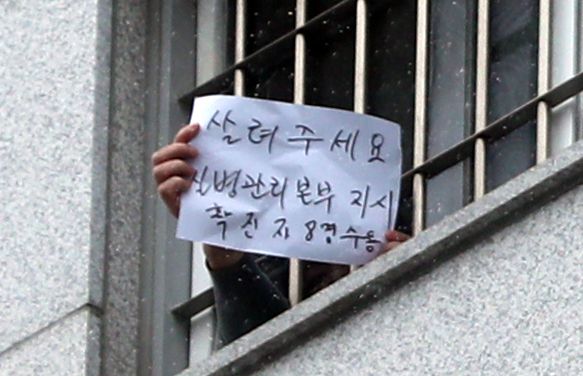
Cultural Insight : A year of “cow”? : Korean Zodiac and Tti Culture
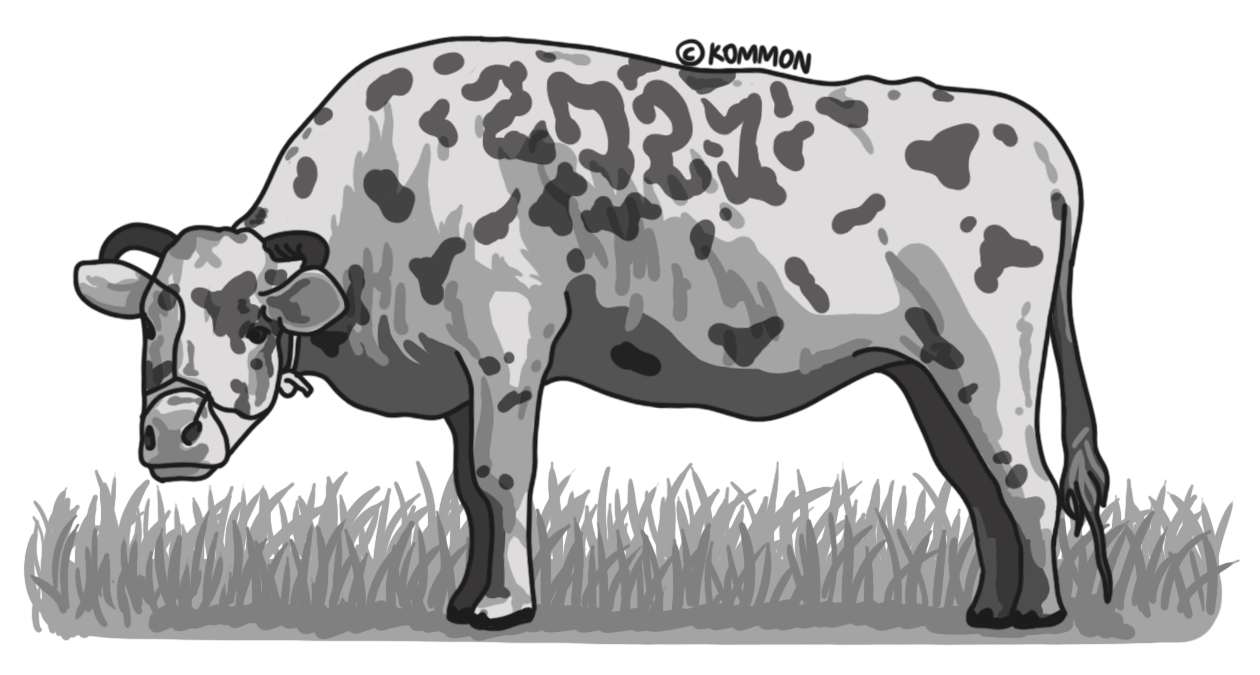
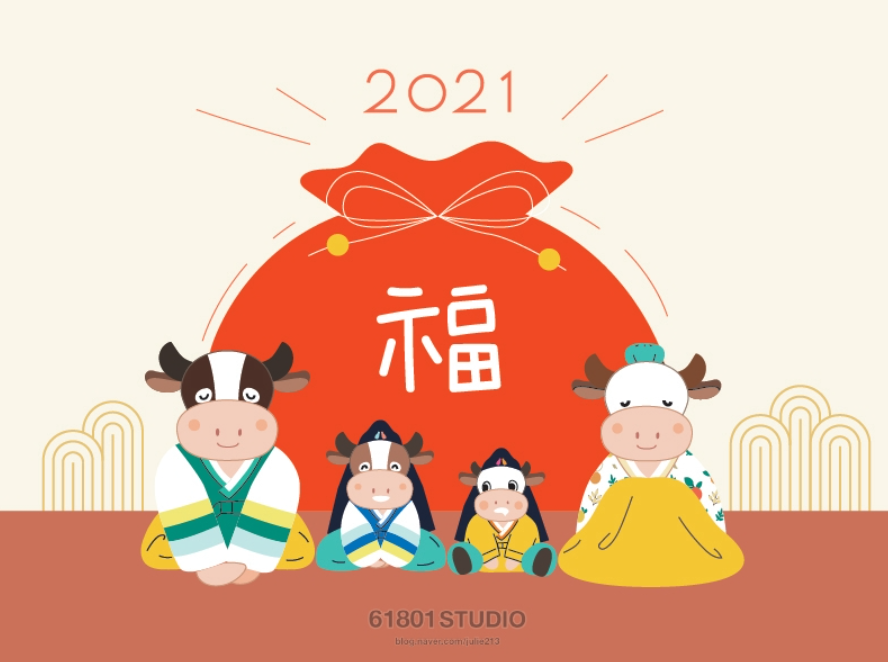
[Illustration by O.T.O] A Fictional Story of John on New Year’s Day It was John’s first-ever New Year’s holiday spent in Korea. As soon as it turned midnight on January 1st, John’s heard a text message come in on his phone. It turns out Jun, his Korean best friend, sent him a New Year’s greeting. But a picture it accompanied seemed quite odd. A cow, wearing hanbok (한복, Korean traditional clothes), was bowing!
Source: https://www.crowdpic.net/@Njulie213 John was puzzled. But shortly after, he started realizing that so many cows were already surrounding him. A New Year’s calendar he got from work, and a cup his colleague gave as a new year gift also featured a “cow” in it. Why a cow? Is it possibly a symbol of the New Year holiday in Korea? When he asked Jun about it, Jun replied that 2021 is Sinchuknyeon (신축년), the year of cow-tti. Was he not speaking English? John felt even more confused.
Another Name that 2021 Has in Korea There are two names that Koreans use to call a year. One is simply a number (for example, 2021) but the other is slightly more complicated. The latter comes from 60 GanJi (60 간지).
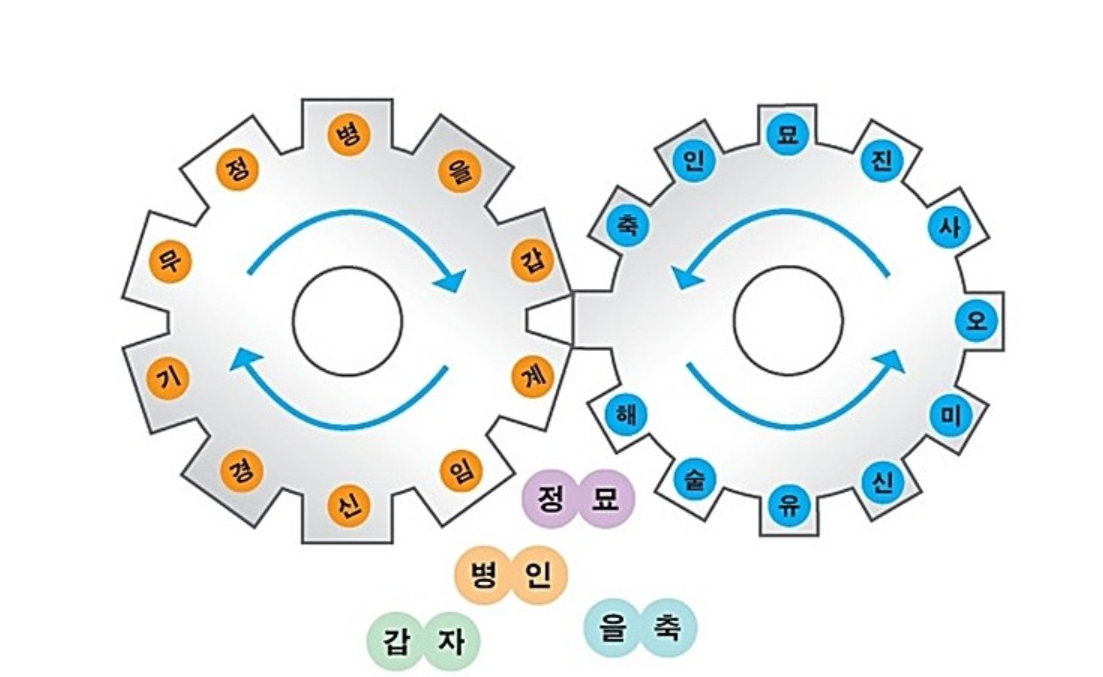
60 GanJi consists of two parts: 10 Gan (10 간) and 12 Ji (12 지). 10 Gan represents 5 colors, which are Blue, Red, Yellow, White, and Black. Two elements of Gan symbolize one color. Meanwhile, 12 Ji stands for 12 different animals.
The list of 10 Gan
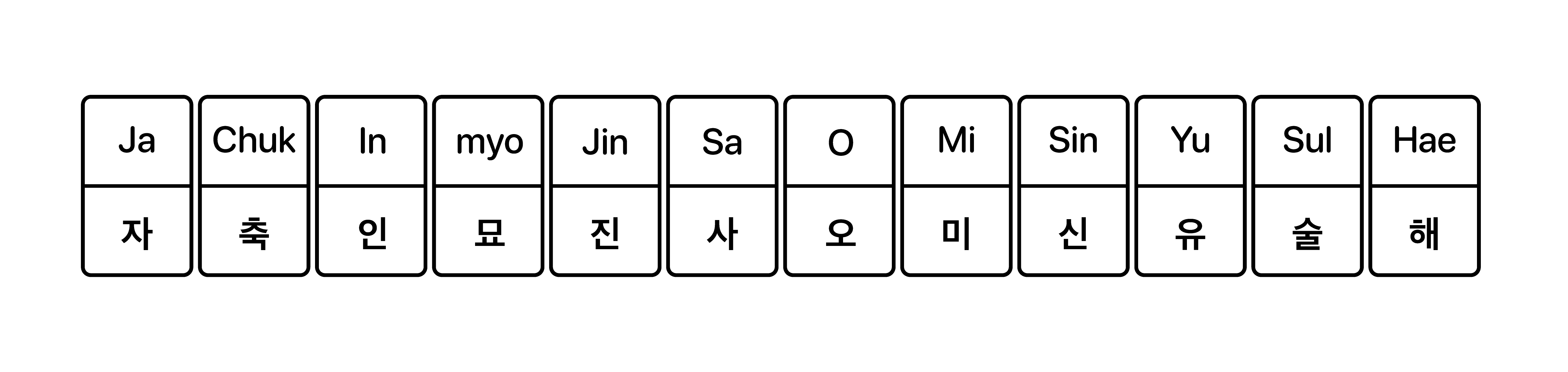
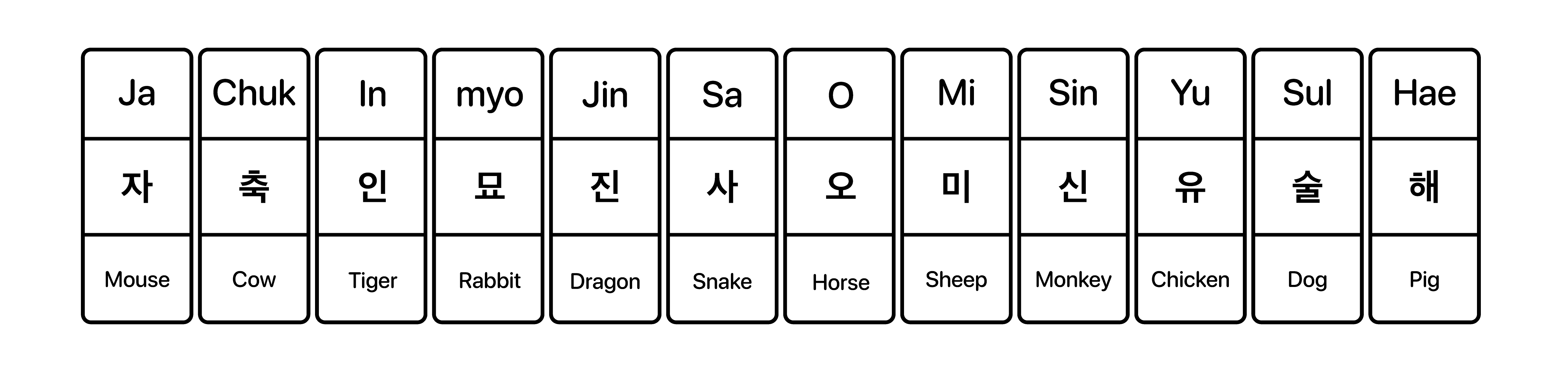
The list of 12 Ji If we place one of Gan at the front and one of Ji at the back to create a two-syllable word, it is GanJi. When nyeon (년), a Korean word that can refer to a year, is added at the back of GanJi, it becomes the second name of that year. Now, let’s do a little calculation together: what is the lowest common multiple of 10 and 12? It’s 60! 10 Gan and 12 Ji create 60 different combinations and these are called 60 GanJi as a whole. Therefore, the same GanJi reappears every 60 years. Sinchuknyeon, which refers to 2021 in Korea, is a compound word of “Sin” from 10 Gan, “Chuk” from 12 Ji, and “nyeon”. Sin stands for white color, and Chuk symbolizes a cow. As a result, 2021 is the year of the white cow in Korea.
Source: 다음 백과 (https://100.daum.net/) 12 Ji, Korean Zodiac, and Tti (띠) Culture As Sinchuknyeon’s “Chuk” symbolizes a cow in terms of 12 Ji, each Ji represents different animals. These symbolic animals are identical to the ones in Korean zodiac, which is composed of 12 Animal Gods. The order of 12 Ji, beginning with the mouse and the pig on the last, is based on a story of 12 animal gods, called 12 Ji animal god’s story.
An Interesting Story of 12 Animal Gods Long long ago, the mythical founder and the “first king” of Korea named Dangun🧔 is said to have announced, “All animals shall pay a New Year’s visit to me at this moment. You will get awarded on a first-come-first-served basis.” A diligent cow was the quickest to start off. However, a shrewd mouse🐭 secretly got on the back of the cow🐮. Right in front of the Dangun’s place, the mouse jumped off to be the first to arrive. The cow lost by a whisker and came second. A tiger🐯 dashed to make the third, a rabbit🐰 dozing off nearby was the fourth. A dragon🐲 came down from the sky to rank the fifth, a snake🐍 clinging to the dragon’s tail was the sixth, followed by a horse🐴 and a sheep🐑. A monkey🐵, a chicken🐔, and a dog🐶 appeared one by one, and the last to arrive was the pig🐷. Representations of these 12 animals are used a lot in Korea. Tti (띠) culture, too, is based on the 12 Ji. Most Koreans use the symbolic animals of their birth year to say their tti. For example, if you were born in 2021, which is the year of a cow, you can say, “I am So-tti (소띠).” “So” is the Korean for a cow. How and When to Use Tti 1) Age
Especially within the older generations, tti is used to indicate and calculate people’s age. For example, let’s say two people in the similar age group introduces themselves as “Gae-tti (개띠, Gae refers to a dog)” and “Dak-tti (닭띠, Dak refers to a chicken)”. Since Dak is in front of Gae according to the 12 Ji order, we can immediately know that Dak-tti person is older than Gae-tti. 2) Hwan-gap (환갑)
It’s a special word for the 61st birthday. Remember the lowest common multiple 60 of 10 Gan and 12 Ji? One full cycle of GanJi takes 60 years. Thus, Koreans celebrate the Hwan-gap of a person as one finishes and starts the new cycle of GanJi. 3) Tti-dong-gap (띠동갑)
It refers to a group of people who have the same tti. 12 Ji, in other words 12 animals, determine a person’s tti. Therefore, the same tti reappears every 12 years. For example, one who was born in 2021, 2009. 1997, 1985… and so on are all So-tti (소띠), and thus called tti-dong-gap. Due to the multiple of 12 years of age gap, tti-dong-gap is metaphorically used to show a big age gap or a generation gap. 4) And more...
Tti is often a tool to classify social groups. People with the same tti sometimes create online or offline groups and bond together. Moreover, people with the same tti are believed to be somewhat homogeneous. This is why fortune-telling (Korean link) based on tti is also popular in Korea. Happy 2021, or... The White Cow’s Year!
1) Marketing promotions that feature “cows” Celebrating the year of the white cow, many retailers are releasing cow-related promotions.
Convenience stores are leading the “cow” marketing. GS25 began a stamp-collecting race that gives 2.5 tons of Korean beef to 2,500 participants. 7 Eleven collaborated with Maeil Dairy, a dairy company, and is selling new milk cream-filled desserts. Lotte Mart, a big supermarket chain, began offering an up to 30% discount on Korean beef products. Cafés, including Starbucks and Angel-in-us, are launching new cow-related merchandise. Krispy Kreme’s cow-shaped New Year special doughnuts are also available. 2) Playing with the word “So (소)” “So (소)” means a cow in Korean. Now that you know it, you will be able to spot lots of clever puns.
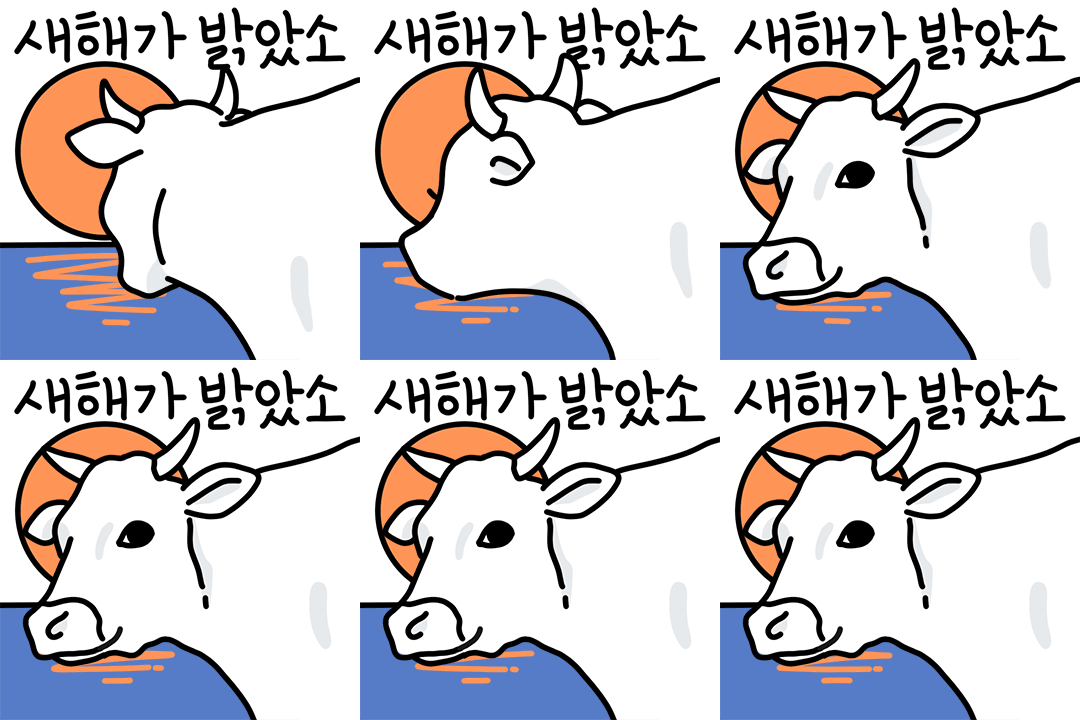
SBS, one of Korea’s mainstream broadcasting stations, wishes a happy new year with a wordplay. “새해 복 많이 받으소” means “Happy new year” but the original form is “새해 복 많이 받으세요.” The ending of the verb “세요” is changed to “소” to play with the letter “So,” which means a cow.
How to read “새해 복 많이 받으소”: [saehae bok mani badeuso]
Source: 카카오톡 이모티콘 https://e.kakao.com/t/year-of-the-white-cow Many creators have launched new emoticons related to a cow in Kakaotalk, the number one messenger of Korea. “힘내소” means “Cheer up” but the original form is “힘내세요.” The ending of the verb “세요” is again changed to “소” to play with the letter.
How to read “힘내소”: [himnaeso]
Be a part of Korea’s New Year culture with “tti”! Here’s a very quick guide to figure out what tti you have. What tti are you? Please share with us here! Remember that Ttidong-gap is calculated with the multiple of 12! :) 🐮So-tti (소띠, cow): a person who was born in 2021, 2009, 1997… 🐭Jwi-tti (쥐띠, mouse): a person who was born in 2020, 2008, 1996… 🐷Dwaeji-tti (돼지띠, pig): a person who was born in 2019, 2007, 1995… 🐶Gae-tti (개띠, dog): a person who was born in 2018, 2006, 1994... 🐔Dak-tti (닭띠, chicken): a person who was born in 2017, 2005, 1993... 🐵Wonsungi-tti (원숭이띠, monkey): a person who was born in 2016, 2004, 1992... 🐑Yang-tti (양띠, sheep): a person who was born in 2015, 2003, 1991... 🐴Mal-tti (말띠, horse): a person who was born in 2014, 2002, 1990... 🐍Baem-tti (뱀띠, snake): a person who was born in 2013, 2001, 1989... 🐲Yong-tti (용띠, dragon): a person who was born in 2012, 2000, 1988... 🐰Tokki-tti (토끼띠, rabbit): a person who was born in 2011, 1999, 1987... 🐯Horangi-tti (호랑이띠, tiger): a person who was born in 2010, 1998, 1986...
Vocabulary There is a word that you can say you are the same age as someone.
Dong-gap (동갑) Origin: The sexagenary (sixty year) cycle. Gap (갑) is a descriptor of the year you were born. Meaning: It means that when you and someone are born in the same year, then both you two are the same age. The term is mainly used when you want to respectfully express that you are the same age as your partner. With a combination of tti (띠), you can say tti-dong-gap (띠동갑) when your age has a 12-year gap between someone. Usage A: 너 나랑 동갑이네. B: 맞아 우리 동갑이야. 친구하자. A: You are the same age as me. B: You’re right. We are the same age. Let’s be friends. A: 저랑 띠동갑이네요. B: 맞아 나보다 12살 어리네. / 맞아요 저보다12살 많으시네요. A: You have a 12 years age gap between me. B: Yes. You are 12 years younger/older than me.
How was it? Share your feedback below! KOMMON TEAM 수수🌾 Sans🌻 바코🌊 오티오😈 쟈🍉 기린🌴 쏘🐥 기니👑 프레드🍰 부엉🦉 타코🌮 Sunny🌞 호야🐻 가가🍒
|