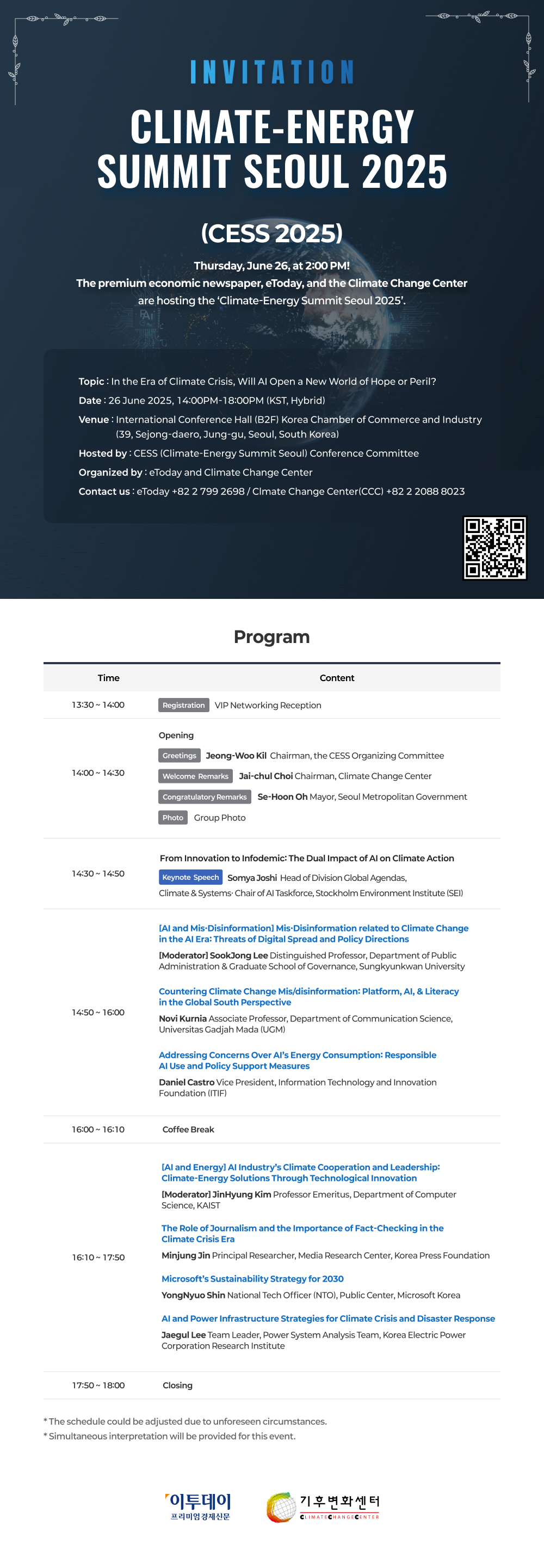
On June 26, the Climate-Energy Summit Seoul (CESS 2025) will be held, co-hosted by the Climate Change Center and EToday. Under the theme 🤖“In the Era of Climate Crisis, Will AI Open a New World of Hope or Peril?”, this year’s conference will explore the opportunities and challenges at the crossroads of climate and technology. 🧐
In this newsletter, we focus on a key topic : 💡AI-driven innovation in climate and energy. AI is already transforming how we tackle the climate crisis. It helps improve the accuracy of climate models 📐, analyze large-scale energy use, and track carbon emissions in real time 🕵.
🌟Better predictions mean faster action⏳, which can reduce disaster impacts and boost policy effectiveness. For example, Microsoft’s Planetary Computer uses AI and satellite data 🛰️ to detect deforestation and biodiversity threats early. In Korea, KEPCO applies AI to forecast power demand and enhance energy efficiency through smart grids — showing how AI can strengthen climate action.
However, AI also raises concerns about its own carbon footprint. Training large AI models consumes huge amounts of electricity, mostly from fossil fuels🔥, adding significant emissions 👣. If unmanaged, this could counteract climate goals.✨ This is why tech companies’ sustainability strategies are now under closer scrutiny.
Microsoft is taking the lead, pledging to become carbon negative by 2030 🔊 and working towards 100% renewable energy🌱, more energy-efficient AI⚡, and greater CCUS investments💰. At CESS 2025, 🙋♀️Dr. Yong Nyuo Shin, National Tech Officier for the Public Sector at Microsoft Korea, will share more on this vision.
👩🏻🦰Dr. Somya Joshi of the Stockholm Environment Institute (SEI) also highlights that “Technology can deliver very different results depending on how it is designed and used.” She will emphasize that AI must be governed responsibly, with inclusiveness, accountability, and global cooperation 🤝, to truly support climate justice.
Technology can be 🌟part of the solution or 🚨a new risk. CESS 2025 invites you to explore how we can turn AI’s potential into real climate solutions. Join us on this journey toward a sustainable future.