Third IPO attempt, this time truly the 'Last' KOSPI ▲4,056.41│ KOSDAQ ▼911.07│ KRW/USD▲1,479.32 |
|
|
As of 3:30 p.m. on the previous trading day |
|
|
✴ Wanted Lab Partners╎The firm is considering introducing an “early filter” for investment review that uses hiring and job-change data to identify industries and companies before financial performance becomes visible. As part of differentiation at the sourcing stage, it reflects a move to supplement finance- and meeting-based reviews with non-financial data.
✴ Koentec╎Koentec, which is pursuing a sale, is struggling to select a preferred bidder as price offers from potential buyers have fallen short of expectations. As domestic PEFs show signs of pulling back, Geo Capital, with stronger price competitiveness, has emerged as a leading candidate, although project financing remains a variable.
✴ Align Partners╎Align Partners, which is conducting a tender offer for Aplus Asset, officially stated it will not further raise the offer price. With expectations for a price increase cut off, the tender offer closed as scheduled at $6.17 per share, and the outcome now depends on shareholder participation.
✴ BNH Investment╎BNH Investment multi-closed its deep-tech life science fund at $73.7 million, forming its second fund in the $68.6 million range in three years. By broadening LPs to include a fund of funds, mutual aid funds, local governments, and strategic investors, its AUM grew to about $274.3 million, and its capacity for anti-aging focused investment next year increased.
✴ E&F Private Equity╎E&F Private Equity signed a binding MOU to sell Koentec to Geo Capital, confirming an exit in the mid-$514.4 million range. While it is lower than initial expectations, it added an earn-out structure to leave room for additional returns, and the recovery after five years provided a foothold to restart new fundraising.
✴ ADEL╎ADEL signed a worldwide exclusive development and commercialization license with Sanofi for its Alzheimer’s treatment candidate ADEL-Y01, completing a technology transfer deal worth up to $1 billion. With the non-refundable upfront payment alone exceeding $68.5 million billion, it was one of the largest domestic biotech deals, and entry into global clinical and commercialization stages began in earnest.
✴ Acryl╎On its KOSDAQ listing day, Acryl jumped more than 240% versus its IPO price, confirming strong market demand. As a result, FIs including the Tigris Investment and Jin & Invest consortium that joined the pre-IPO were assessed to have entered an exit phase with an expected multiple of more than five times.
✴ Hahn & Company╎The firm aggressively acquired semiconductor and industrial assets and continued major exits in Hanon Systems, Solmix, and SK Eternix. As investment, realization, and portfolio normalization produced results at the same time, its operating capability as a top-tier domestic PEF is being reaffirmed.
✴ Aon Investment ╎Aon Investment was selected twice as a blind-fund GP in a fund of funds program, forming three funds in the second half alone. Its AUM increased to about $89.1 million, and IPO exit visibility increased for its pre-IPO, AI, and security portfolios.
|
|
|
Hong Seok-jun’s Bogwang Invest
High-Interest Lending Using a Fund of Funds Lever? |
|
|
⭑ What kind of investment was it?
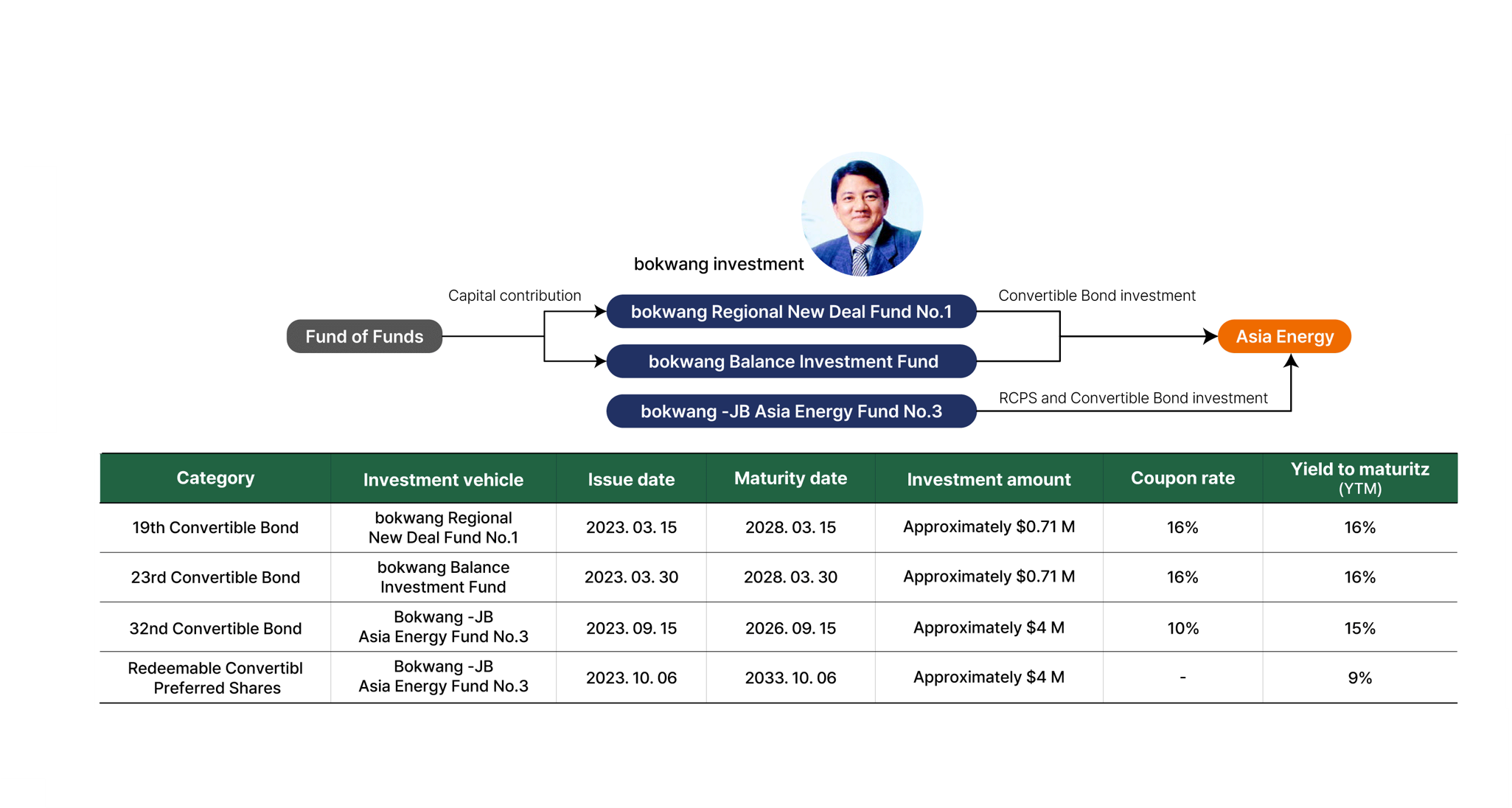
Bogwang Investment invested a total of $9.1 million in Asia Energy around 2023 through a structure combining CBs and RCPS. Three funds were used for the investment: Bogwang Regional New Deal No.1 Investment Fund, Bogwang Balance Investment Fund, and the Bogwang–JB Asia Energy No.3 Fund. Among them, Bogwang Regional New Deal No.1 Investment Fund and Bogwang Balance Investment Fund are blind funds formed with capital from the Fund of Funds.
Looking at the structure, the two blind funds each invested $0.7 million in CBs, totaling $1.4 million. The project fund jointly managed with JB Woori Capital invested $3.8 million in CBs and $3.8 million in RCPS. Of the total investment, $5.2 million was allocated to CBs and $3.8 million to RCPS.
The CBs that triggered the controversy were executed through blind funds backed by the Fund of Funds.
⭑ CB terms
The core of the controversy lies in two CBs purchased by the blind funds.
The two CBs, issued as the 19th and 23rd series, set both the coupon rate and the yield-to-maturity at 16%. This is high compared with the 6–8% CB interest rates commonly seen in the market.
For CBs issued by Asia Energy after March 2023 to NH Investment & Securities, Mirae Asset Securities, IM Co., Kyungdong High-Tech Sales, Dow S&T, and Green Fuel Personal Investment Association No.1, the coupon rates ranged from 0–10% and yields from 9–15%. Even by this comparison, Bogwang Invest’s terms were the highest.
In the case of the project fund jointly managed with JB Woori Capital, the coupon rate was set at 10% and the yield at 15%, relatively lower. Instead, the conversion price was set at $86.4 per share (₩125,884), about 5–10% lower than that offered to other CB investors, and the lowest among CBs issued in 2023–2024.
⭑ Early redemption agreement and reversal dispute
Asia Energy requested the exercise of a put option for early redemption, citing the high interest burden, and Bogwang Invest agreed earlier this year to partially cash out the CBs. On February 7, Asia Energy sent an official letter titled “Request regarding CB and RCPS redemption,” formally documenting discussions that had been verbally conducted since late last year.
The letter specified May 31 as the redemption date. For the CBs, it stated that principal and interest calculated at the coupon rate would be paid from the final interest payment date to the redemption date. For the RCPS, principal and returns calculated using the yield-to-maturity from the initial issuance date to the redemption date would be paid. In response, Bogwang Invest replied on February 26 agreeing to redeem $700,000, equivalent to half of the CBs it held. The document bears the corporate seals of co-CEOs Hong Seok-jun and Park Jin-beom.
Subsequently, Bogwang Invest conveyed its position that interest through the originally set CB maturity date, rather than up to the redemption date, must be fully guaranteed. Asia Energy views this as a reversal of the agreement. Asia Energy said it had secured new investment from Hyundai Motor Securities–Timebridge Energy Association No.1 on the premise of CB early redemption, but as that premise was not met, it now faces the possibility of paying penalties to the new investor. Asia Energy has sent a legal notice stating that it will pursue both civil litigation and criminal charges if there is no immediate compliance. Attempts to obtain Bogwang Invest’s position have so far received no response.
|
|
|
The reason this issue is escalating is not solely due to the interest rate figure itself. The controversy has taken on a different dimension as it involves a blind fund partially backed by Fund of Funds capital setting a 16% annual CB rate, combined with claims that an early redemption agreement based on that burden was reversed after formal documents had already been exchanged. Some in the market are questioning whether this reflects a venture investment structure that shares growth risk, or a financial transaction that effectively secures fixed interest, blurring the line between the two.
Another key issue concerns the interpretation of the “initiating party” for the early redemption. Bogwang Invest argues that because the redemption was triggered by a put option exercised at the request of the investee company, interest through maturity must be guaranteed. Asia Energy, however, maintains that the agreed terms were already finalized in written form. This difference in interpretation is not merely a calculation issue, but one that could affect broader practices related to CB early redemption going forward.
The issue is further complicated by investor protection concerns involving follow-on investors. New investment was executed on the premise that the existing CBs would be redeemed early, and if that premise collapses, the resulting losses would fall entirely on the investee company and the new investors. Ultimately, this case is not just about who receives how much more, but about how far the responsibility of funds backed by public capital extends, and how much trust can be placed in agreements within the venture investment market. Until a legal judgment is made, the questions this controversy raises for the industry are likely to linger. |
|
|
Third IPO attempt, this time truly the 'Last' |
|
|
⭑ Valuation cut by $686 million, goal is “Success”
K Bank filed a preliminary review request for a KOSPI listing in November, launching its third IPO attempt. The post-listing market capitalization proposed this time is about $2.26 billion to $2.61 billion, roughly $686 million lower than in its previous attempt last year.
The peer group was simplified to include only KakaoBank, excluding overseas internet banks, reflecting an effort to align more closely with market expectations. The number of shares offered was reduced to 60 million, which has been interpreted as a clear message that the focus is on completing the listing rather than maximizing price.
⭑ Why this is being called The Last Chance
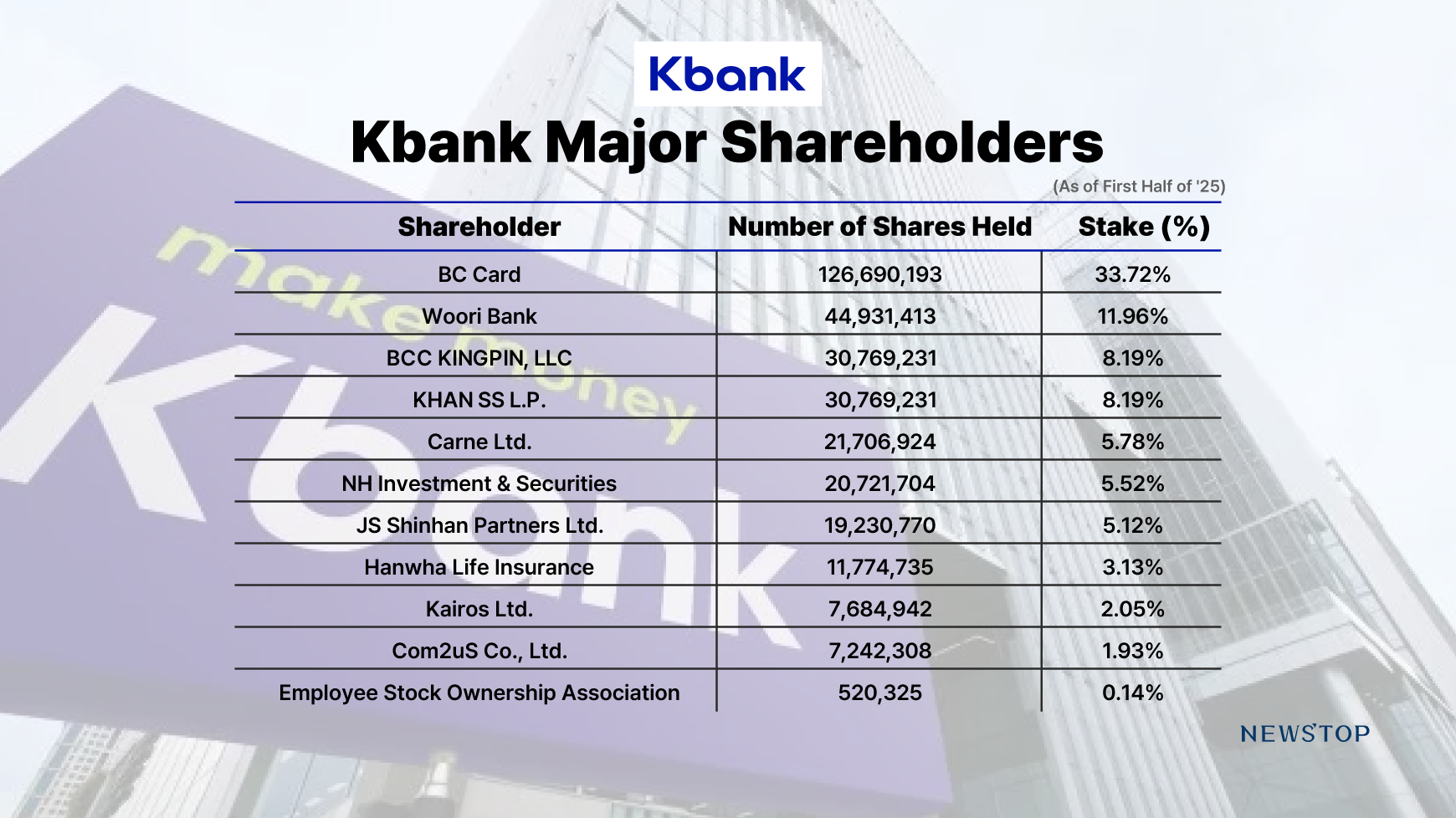
This attempt appears particularly urgent due to agreements with financial investors. In 2021, K Bank raised about $497 million from Bain Capital, MBK Partners, and others, accepting terms that allow investors to force a sale of their stakes if the company fails to go public by July 2026. Another failure could therefore leave K Bank having to absorb those stakes itself. As a result, the market view is that there is no room left to delay, making this a make-or-break attempt.
⭑ Regulator review and investor returns, the final hurdles
Challenges still remain. Beyond the exchange’s preliminary review, the more demanding step is the Financial Supervisory Service’s review of the securities registration statement, where many IPO candidates this year have gone through multiple rounds of revisions.
Another burden is the investors’ required internal rate of return of at least 8 percent per year. The current IPO price band of about $5.69 to $6.52 per share overlaps with that threshold, making post-listing share price performance especially important. Still, with virtually no viable exit other than an IPO, some analysts say investor interests have ultimately converged on pushing the listing through.
Lowering its valuation and simplifying its objective, K Bank is making its third attempt. Whether this proves to be a realistic compromise or leads to a successful listing is now up to the market.
|
|
|
🧑⚖️One-Minor Organization?╎Damages Lawsuit Against Team Bunnies
Belift Lab filed a damages lawsuit seeking $68,600 against Mr. A, the operator of NewJeans fandom group “Team Bunnies,” and his parents, citing defamation and business losses based on false claims. During the proceedings, scrutiny has focused on why Team Bunnies shifted its position from a “team of multiple fans” in the past to a “one-minor organization” recently. The possibility of renewed review into adult involvement has also been raised in connection with an alleged violation of the Donations Act, as controversy over the fandom’s actual nature moves into the courtroom.
|
|
|
💊Control Dispute╎Move to Block New Share Issuance
Youngpoong and MBK Partners filed for a court injunction to block the issuance of new shares following Korea Zinc’s board resolution on a third-party allotment capital increase. They argue the issue is not the U.S. smelter investment itself, but that the new share allocation was intended to maintain Chairman Choi Yoon-beom’s control amid a management dispute. Questions have also been raised over whether board convening procedures and information disclosure were sufficient, bringing potential breaches of the duty of care and loyalty into focus. |
|
|
💸Financial Pressure╎The Weight of $205.7 million
HS Hyosung Advanced Materials decided to execute funding totaling $212.3 million for Umicore anode material investments and the acquisition of stakes in a Vietnamese subsidiary. As the funding will be sourced from cash on hand and borrowing, Korea Ratings warned of a short-term increase in leverage and downward pressure on credit quality. While new business growth and internalized dividend effects are expected, financial management has emerged as a key variable amid slowing profitability and the possibility of additional investments.
|
|
|
⛓️💥Breaking Subscription Habits╎Subscription Economy Shaken in the U.S.
In the U.S., 42% of consumers said they canceled at least one subscription service within the past six months, highlighting growing “subscription fatigue.” Even core services such as Netflix, Disney+, and Amazon Prime are being reassessed due to declining perceived value for money, delivery delays, and fragmented features. This is seen not as simple belt-tightening but as selective consumption focused on essentials, a signal that Korea may also be entering the early stage of a similar shift. |
|
|
💼Year-End Lawsuits╎M&A Sentiment Shaken by Insurance Sector Disputes
Lotte Insurance filed an unusual administrative lawsuit against the Financial Services Commission over corrective action measures, warning of pension outflows and erosion of market trust. Heungkuk Life Insurance also launched legal action, accusing unfair bidding in the sale of Aegis Asset Management and filing complaints against major shareholders and global investment banks. A series of lawsuits is underscoring regulatory risk across the insurance sector, emerging as a burden on year-end M&A activity. |
|
|
🤖Google-Style Expansion╎From Auto Security to Robots and Drones
FESCARO announced a strategy to evolve into a comprehensive security platform company spanning robots, ships, and drones, beyond automotive cybersecurity, following its KOSDAQ listing. CEO Hong Seok-min defined cybersecurity as a “battle of documentation and operations,” emphasizing 0.5-tier competitiveness through a CSMS portal that digitizes certification and operations linking automakers and suppliers. By widening the gap through operational systems rather than technology alone, the company aims for $20.6 million in revenue and a 30% profit margin in 2026, pursuing mid- to long-term growth.
|
|
|
Does the company remain if an influencer fails? |
|
|
Why has Baek Jong-won risk increased?
The defining characteristic of TheBorn Korea is that the engine of its success and the channel of its risk were the same. Its television image, consumer trust, franchise expansion, and even its IPO narrative were all concentrated in one individual. That concentration enabled rapid growth, but it also created a structure in which even minor controversies could shake the entire company.
The success of Black and White Chef reinforced the listing story, and when subsequent issues triggered stock volatility, the debate naturally shifted to a different question: “Can this company operate without Baek Jong-won?” This question keeps resurfacing not because of moral judgment, but because of structural judgment. It is not about whether he did right or wrong, but whether the system functions when he is removed.
Why the controversy is perceived as excessive, and why that explanation falls short
Some view the current debate as an overreaction relative to the actual issues involved. Certain matters were resolved without charges, and issues of differing severity were bundled together and amplified by a post-IPO share price decline.
However, this perception alone does not fully explain the controversy. Failures in management, insufficient explanations, and weaknesses in internal controls were real, and franchisee dissatisfaction and declining consumer trust cannot be dismissed as mere framing. As a result, the debate is no longer about whether the criticism is excessive, but about how much of the company’s structural risk it is willing to acknowledge.
A Reversal With Black and White Chef Season 2?
This naturally leads to the next question: is there a card that can reverse the current momentum?
This is why many people point to Black and White Chef Season 2. It has the proven success of Season 1, and more importantly, it is one of the few options capable of shifting the focus of the debate back from corporate risk to content performance. With its ability to quickly generate both buzz and visibility, it is being viewed as a symbolic card that could turn the current situation around.
|
|
|
Meaning of Multi-closing and Club Deal |
|
|
✴ Multi-Closing
Multi-closing refers to a fundraising method in which a fund does not raise all capital at once, but instead conducts fundraising in multiple rounds. The fund manager can begin investing with the capital raised in the first closing, while continuing to attract additional investors over time. Each closing represents a cutoff point at which the investors participating up to that moment are confirmed.
For example, some LPs may join at the first closing, with additional LPs participating in a second closing several months later. To ensure fairness between earlier and later investors, interest adjustments or changes in terms are typically applied.
The key advantage of this approach is that investments can be executed immediately without waiting to reach the full target fund size. From the investor’s perspective, it also allows flexibility to decide whether to commit early or wait. As a result, multi-closing is commonly used in alternative investments such as venture capital and private equity funds.
✴ Club Deal
A club deal refers to a structure in which multiple investment institutions form a consortium and jointly invest in a single target. In simple terms, two or more institutions enter the same deal together. In a club deal, each participant’s investment amount, equity stake, and role are agreed in advance. Risks and returns are shared according to those predetermined ratios, enabling large-scale investments that may be difficult for a single institution to undertake alone.
Another advantage is the ability to combine the strengths of each participant. One institution may have deep industry expertise, while another may bring strong global networks, and the combination itself can enhance investment competitiveness.
However, as the number of participants increases, decision-making can slow and coordination becomes more complex. For this reason, club deals are most commonly used in large transactions such as major M&A, real estate, and infrastructure investments.
So, what is the difference?
Although the terms may sound similar, multi-closing and club deals focus on different aspects. Multi-closing is about how and when a fund raises capital over time. A club deal, by contrast, is about who participates together in a specific investment.
Multi-closing is a way of raising capital, while a club deal is a way of forming the investment team. |
|
|
Send us any suggestions you’d like to share while reading Bitter’s newsletter! |
|
|
Advertising, inquiries : viter@thevistapartners.com / Published by Newstop. Unsubscribe |
|
|
|
|