For dark mode users,
Hello, readers! Today, we are covering: Index Zoom In Disability Rights Protests at Seoul Subway Stations
Today's Vocabulary 쩍벌남 (Jjeok-beol nam) This Week's Recommendations Inseparable Bros (나의 특별한 형제, 2019) Don't forget to leave your feedback below!
Disability Rights Protests at Seoul Subway Stations Writer: Haram Lee, Daeho Park, Loren Sarenas Editor: Sulagna Banerjee Senior Editor: Regine Armann Editor-in-Chief: Fred McNulty
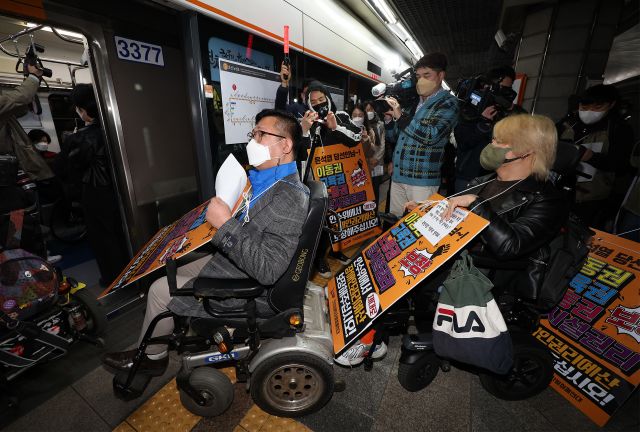
Photo by Yonhap Intro On a busy morning, on March 28th, groups of people with disabilities gathered at major subway stations around Seoul to advocate for the implementation of better policies for others with disabilities. However, this was met with criticism rather than support, because the protests caused disruption for other riders. Especially Lee Jun-seok (이준석), the leader of the People's Power Party (국민의힘) that will soon be in power when president-elect Yoon Suk-yeol (윤석열) takes over, condemned this protest as uncivilized and illegal. However, Solidarity Against Disability Discrimination (전국장애인차별철폐연대), the group that organized the protests, strongly criticized Lee and urged him to apologize for making “rude” comments. In this week’s newsletter, we will fill you in on all the details about the protests. The Cause: Transportation Accessibility Looking at the reality of the accessibility of public transportation, room for improvements surely exists. Subway stations are now fairly well equipped with all the necessary facilities that people with disabilities need, which include elevators, wheelchair lifts, and information in braille. However, buses are not well equipped in comparison. Even though the government has deployed low-floor buses equipped with wheelchair-accessible slopes, many drivers are unaware of how to operate them and are, in fact, reluctant to help passengers on board, mainly because it takes a long time for people in wheelchairs to get in and out. As a result, people with disabilities are discouraged from going out and often forced to isolate themselves from public life at home. A video by a disabled YouTuber named Weracle (위라클) shows the harsh reality of Korean public transport for handicapped people as he attempts to get into buses in Seoul. Because such barriers have been prevalent for quite some time, people with disabilities have constantly voiced their opinions, and protests have periodically been held at subway stations since last December. What They Want Solidarity Against Disability Discrimination, the group advocating for the rights of the handicapped, has been voicing its opinions for a long time. They have been insisting on improved public transportation to assure handicapped people can also get around in Seoul. Even though the government has constantly made efforts to improve public infrastructures to ensure accessibility for those in wheelchairs, the advocacy group believes that more should be done by the government and thus recently decided to get their voices heard once and for all by protesting at major subway stations in Seoul in the midst of morning rush hour. Conflict with politicians Arguments with the ruling party leader Lee Jun-seok, leader of the People's Power Party, criticized the Solidarity Against Disability Discrimination for holding the subway protest during rush hour on March 28, saying, "They are continuing illegal protests in an uncivilized way (Korean link)." Lee mentioned the problem at the party leadership members’ meeting held at the National Assembly earlier in the day, saying, "Various organizations are preparing to strengthen rallies and protests ahead of the inauguration of the Yoon Seok-yeol administration." Pointing to the SADD, Lee claimed, "They weren’t making these requests during The Moon-jae In (문재인) and former Seoul Mayor Park Won-soon’s (박원순) governments, and now they suddenly demand these things from Yoon Seok-yeol president-elect while carrying out illegal and dangerous protests." Regarding the rally organized by the SADD, he argued, "This is not really a matter of mobility rights, but the group's requirements have been changed to demand a budget for the operation of lifelong education facilities for the disabled and an overall budget of ₩622.4 billion." In particular, he said, "Line 3 (3호선) and 4 (4호선) are subway lines that connect various residential areas of Seoul (서울) with the city center," urging, "Don't put conditions on it and stop the incomprehensible protesting." Lee went on to say, "It is difficult for a specific group's requirements to be fulfilled 100% in our society. However, the method of delivering one’s message by causing inconvenience to the largest number of good citizens is difficult to accept in a civilized society." He also said, "If this is tolerated, society will not have reasonable discussions and dialogues on all issues, but an abnormal competition will cause the greatest fear and inconvenience." Earlier, Lee had posted a message on his Facebook page the previous day, saying, "SADD should abandon self-righteousness” and “they can not make unreasonable demands holding Seoul citizens hostage." As a result, the Democratic Party of Korea (더불어민주당) immediately launched strong criticism, and Lee’s statements were also met with disagreement within his own party. Democratic Party lawmaker Ko Min-jung (고민정) pointed out on Facebook, "Lee said he did not make hateful remarks, but we need to know why so many people criticize him and are displeased." Prior to Lee's remarks, Rep. Kim Ye-ji (김예지), a proportional representation for the People’s Power Party who is also blind, knelt down at Gyeongbokgung Station (경복궁역) earlier in the day, participating in SADD’s protest to ensure the right to move and reflect a budget for the disabled. Prior to participating in the demonstration, Kim said to officials of the Korean War Research Institute, "As a politician, I feel responsible. I apologize on behalf of the political community for not being able to sympathize and use appropriate words. I'm really sorry." In other words, she expressed regret over Lee’s remarks. Ongoing resolution/possible solutions Amid the debate between the SADD and Lee Jun-seok, Korea's policies regarding society's participation of the disabled are listed at the bottom of a ranking (Korean link) compiled by the Organization for Economic Cooperation and Development. This analysis was included in a paper published in the latest issue of the academic journal "Critic Social Policy" (비판사회정책), on the 4th of this month, by Joo Young-ha (주영하), a researcher in the Department of Social Welfare at Ewha Womans University (이화여자대학교). The paper focuses on discrimination legislation, income security policy, and employment policy. The analysis targeted these three areas and assessed 18 OECD member countries, while excluding 19 countries that have no anti-discrimination laws related to people with disabilities or unclear income security policies. The analysis shows that Korea remains at the bottom of the 18 countries. Regarding the area of "discrimination legislation," the study evaluated whether a country has a law that stipulates the prohibition of direct and indirect discrimination against people with disabilities, and Korea received a score of 0.51 out of 1 (standardized), similar to Italy and Spain. Japan (0.00 points) and Australia (0.25 points) received lower ratings than Korea. Korea also received a low score of 0.05 points in the area of "income security policy," which focused on factors such as salary levels and duration of benefits, for example, sick allowances received by the disabled. The United States (0.00) was the only country that scored lower than Korea in terms of income security. In terms of "employment policies" such as employment programs and work incentives for the disabled, Korea was the only country to receive 0.00 points, the lowest among all 18 countries. Based on these scores, the paper classified the analyzed countries into 5 types: ▲ Realization of ideal disability policies ▲ Income security and employment emphasis ▲ Discrimination legislation and employment emphasis ▲ Discrimination legislation emphasis ▲ Multidimensional shortage type. Germany, Norway, and Sweden were included in the "ideal disability policy realization" category of countries that received evenly high scores in all three areas. According to the analysis, the high social awareness of the ban on discrimination against people with disabilities in these countries leads to effective income guarantee policies and stable employment programs for the disabled. The following categories of countries with an "income security and employment emphasis" and also a "discrimination legislation and employment emphasis" included Finland, the Netherlands, Austria, and France. Spain, Portugal, and Italy were classified as "income security-oriented" countries, because they had long payment periods and high income replacement rates, while Denmark, the UK, and Australia were classified as "employment-oriented" and Canada and Belgium as "discrimination legislation-oriented." Along with the United States and Japan, Korea was classified as a "multidimensional shortage” type of country, with low scores in all aspects, including discrimination legislation, income security policy, and employment policy. In terms of discrimination legislation, the three countries have regulations prohibiting direct and indirect discrimination, and labor incentives for recipients are high in terms of employment policies, but the regulations are insufficient to prohibit disadvantageous measures for the disabled. They also received low scores in terms of income replacement rates and payment periods in terms of income security. Regarding the implications of the research results, Dr. Joo said, "It is necessary to increase the budget for welfare spending for the disabled. In terms of the proportion of public spending on disability benefits relative to GDP, Korea's welfare budget for the disabled is the lowest in the OECD, he said. "It is necessary to increase welfare budgets dramatically and strengthen income security policies for the disabled." He also stressed, "We need to strengthen the flexibility of jobs for the disabled and support employers," adding, "An open system should be in place for the disabled to work in the jobs they want, and national financial support should be provided to actively expand employment for the disabled." Outro While Seoul Metro apparently tried to jump on the bandwagon that Lee Jun-seok offered them and emphasized the "intentional obstruction of metro operations" by the protesters and the "underdog effect" that allegedly helps them win the public's sympathy, the SADD eventually reached an agreement with the presidential transition committee, which promised to meet their demands in exchange for a suspension of the protests. The SADD members vowed, however, to continue the rally symbolically, by shaving their heads one by one every day until April 20. Doing so, they hope to keep the public's attention on the issue and remind the new government to finally draw up a budget for the support of the disabled as well as new bills that protect their rights.
Today's Vocabulary 쩍벌남 (Jjeok-beol nam): manspreading Abbreviation of 다리 (legs) 쩍 벌린 (wide-spread) 남자 (man). Even on normal days in the subway, people inconvenience each other and get on each other’s nerves in various ways. One of these is infamously known as “manspreading”, the practice of (usually) a man sitting with his legs spread wide apart and thereby intruding on the space of other passengers. The expression has also made it into the Korean mainstream. If a woman were to do this, it would be referred to as 쩍별녀 (jjeok-beol nyeo). Example: A: 지하철에서 다리 좀 오므려! 쩍벌남 소리 듣겠다. B: 미안해. A: Can’t you please close your legs?😑 You don’t wanna be called 쩍벌남. B: Oh, I’m sorry. This Week's Recommendations
Inseparable Bros (나의 특별한 형제, 2019) Available on Watcha (113 minutes) The brotherhood of Se-ha and Dong-gu is unlike any other. Despite not being related by blood, the two have grown more than fond of each other, attending to each other’s needs unconditionally and being each other’s happiness. Se-ha, who is quadriplegic and thus physically challenged, seeks help from Dong-gu when performing his daily tasks like brushing his teeth, eating his meals, and moving from one place to another. Dong-gu, on the other hand, is mentally challenged and learns from Se-ha how not to be taken advantage of by other people. Their brotherhood is put to a test when Dong-gu’s mother shows up to suddenly take legal custody of her son—thereby threatening the separation of Se-ha and Dong-gu. Does Dong-gu’s mother, who left her son at a public pool as a little child, deserve to take custody of him 20 years after abandoning him? Will Dong-gu recognize his relationship with his mother, or will he choose to stay inseparable from Se-ha?
💚 Support us! 💚
|