#real estate #irregular workers in Korea #vocabulary
Hello, reader. From this week, we are sending a letter every Tuesday and Friday. This Friday, we are covering two issues: 1) the recent real estate market policy and 2) the strike of irregular workers in school. With these issues, we will discover what Koreans are dreaming of. Do not miss vocabularies and content recommendations related to each issue🍂.
Why Are Koreans in Love With Real Estate? 🍀5 Minute Read
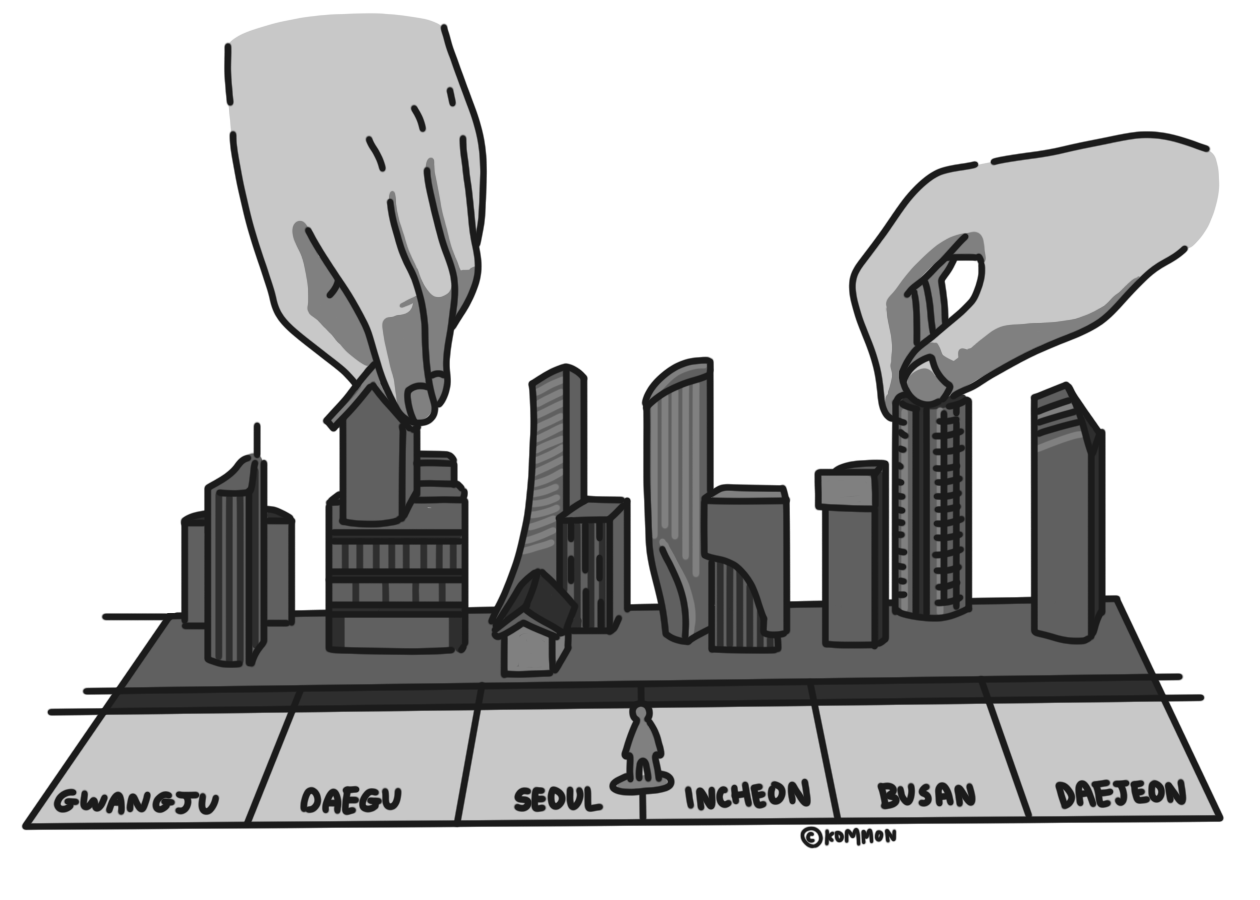
[Illustration by O.T.O] Real estate policy angers Koreans In recent days, the Korean government announced that it will raise officially assessed land prices. The officially assessed land price (OALP) is the official price of property values determined by the government. It is used as an index to tax land and house owners according to their property. Raising the OALP therefore means that the property taxes will be also raised. Many Koreans were enraged by the news, and the conservative media harshly criticized the government's policy. However even if the OALP increases, property taxes will not increase by a lot. The government decided to lower the property tax rate for those who have only one house worth less than ₩600 million. Why, then, are Koreans so furious about the government raising the OALP? It is because many Koreans are wild about real estate and extremely sensitive to all kinds of issues affecting real estate. "My dream is to be a building owner" According to a 2018 survey conducted by a job-search website, some 30% of respondents answered that their greatest wish is to be a building owner or to buy their own house.Not only that… 💎 Koreans' net asset is concentrated in real estate assets. According to a 2017 survey(Korean), the proportion of real estate among Korean’s household assets stands at 75.4% (US 34.8%, Japan 43.3%). 💎 Competition for housing applications(Korean) has intensified. Last month, many places recorded a three-digit competition rate for housing applications in Seoul and Gyeonggi-do. Housing applications are called a 'Lottery Application' since it is hard to win a house. However, as apartment prices in Seoul and some major metropolitan areas surge, Koreans gathered at the application that can earn more than hundreds of millions of won. 💎 Have you ever heard of real estate clubs(Korean) at universities? As Korean university students gradually came to the conclusion that being knowledgeable about real estate is helpful at job searching and increasing their assets, many real estate clubs have been established on campuses across Korea. Why are so many Koreans so obsessed with real estate? There are two reasons why Koreans are fixated on real estate: 1) real estate's high profitability 2) Korea's rapid suburban development and real estate boom 1. High profitability Koreans consider real estate an easy way to earn a lot of money. Real estate prices have been rising but the property taxes are very low. House prices on the rise: House price statistics from 2003 to 2018 reveal that most regions in Korea have seen house prices double(Korean). In Seoul, North Jeolla Province, and North Chungcheong Province, house prices rose by about 120%. Considering that real estate is much more stable than stocks and bonds, it seems unwise to many not to invest in real estate in Korea. 2. Rapid suburban development and real estate boom Can you imagine the Gangnam area in Seoul without all those buildings? In fact, the area was just a paddy field just 50 years ago. However, in the 1970s, the Korean government initiated a large-scale development program in Gangnam to disperse the exploding Seoul population. After that, the real estate prices in the Gangnam region rose 17500% between 1963 and 1977, and those who owned land in the area suddenly became rich. This real estate boom led to the perception among many Koreans that real estate is an effective way of raising their socio-economic status. The word 복부인 (bok-bu-in, house agency wife) illustrates this well. During the 1970s rapid real estate boom, it was common to see housewives of affluent families searching for real estate. Many Koreans like to lampoon wealthy wives and families who earn enormous wealth from real estate. But at the same time, they often envy their wealth, and many have also started to invest in real estate. Side effects of real estate concentration 1. There is no house I can afford As most of Korea's wealth converges on the housing market, houses have become expensive. Seoul's house prices are higher than those in major cities in other countries. It usually takes more than 29 years to buy a house in Seoul with an average income. As housing prices have risen further recently, the phenomenon of "panic buying"(Korean) has emerged among many young Koreans. Panic buying refers to buying a house out of fear that it will not be possible to buy it in the future due to rising prices. However, as most young Koreans do not have the necessary assets to afford a house, they get into enormous debt to buy one. 2. "If I cannot even afford a house, so how could I raise a child?" As the younger generation buys houses on debt, they suffer from high prices and, as a consequence, lack the resources for marriage and parenting. Sociologists have repeatedly established that expensive houses are one of the reasons(Korean) for the low fertility rate in Korea. In fact, many studies show that the higher the house prices, the lower the fertility rate. 3. "Why should we invest in the stock market? Real estate is our best & only option!" Due to the excessive concentration of capital in the real estate market, investment in other essential economic or innovative fields in Korea is insufficient. Korea's financial assets account for only 20%(Korean) of all assets combined (US 70%, Japan 64%). As a result, emerging Korean companies do not usually receive investments from Korea, and instead, rely on non-Korean capital(Korean). What measures should be taken to solve the real estate problems? The government is also aware of the problem of real estate concentration. The Moon Jae-in administration has implemented more than 20 new real estate policies so far. However, house prices have not stabilized. Some have claimed that the real estate problem is related to various other sectors such as labor and education and that changes throughout society are necessary to stabilize house prices.
Today's Vocabulary 1. "The slug generation" "The slug generation"(Korean) is another name for a young one-person household. Unlike snails, slugs do not have their own shell. Therefore slug is used as a metaphor for young Koreans who have difficulties buying a home. The self-deprecating expression "Why don't I have a home while a snail has one?" illustrates the hardship of young Koreans trying to own a house. 2. 재테크 (財tech) [Jae-tekeu] Meaning: Financial techniques. Ways of increasing property without working. Origin: Abbreviation of "재무(finance) 테크놀로지(technology)". But everyone uses "재테크" instead. Usage: "그 남자는 어떻게 돈을 그렇게 많이 벌었대?" "재테크를 잘 한대." "How did he make such a lot of money?" "He knows a lot about investment." Wanna know more? Korean drama: <Because This is My First Life> (tvN, 2017) Young People's Dreams? Being Regular
Workers. 🍀4 Minute Read
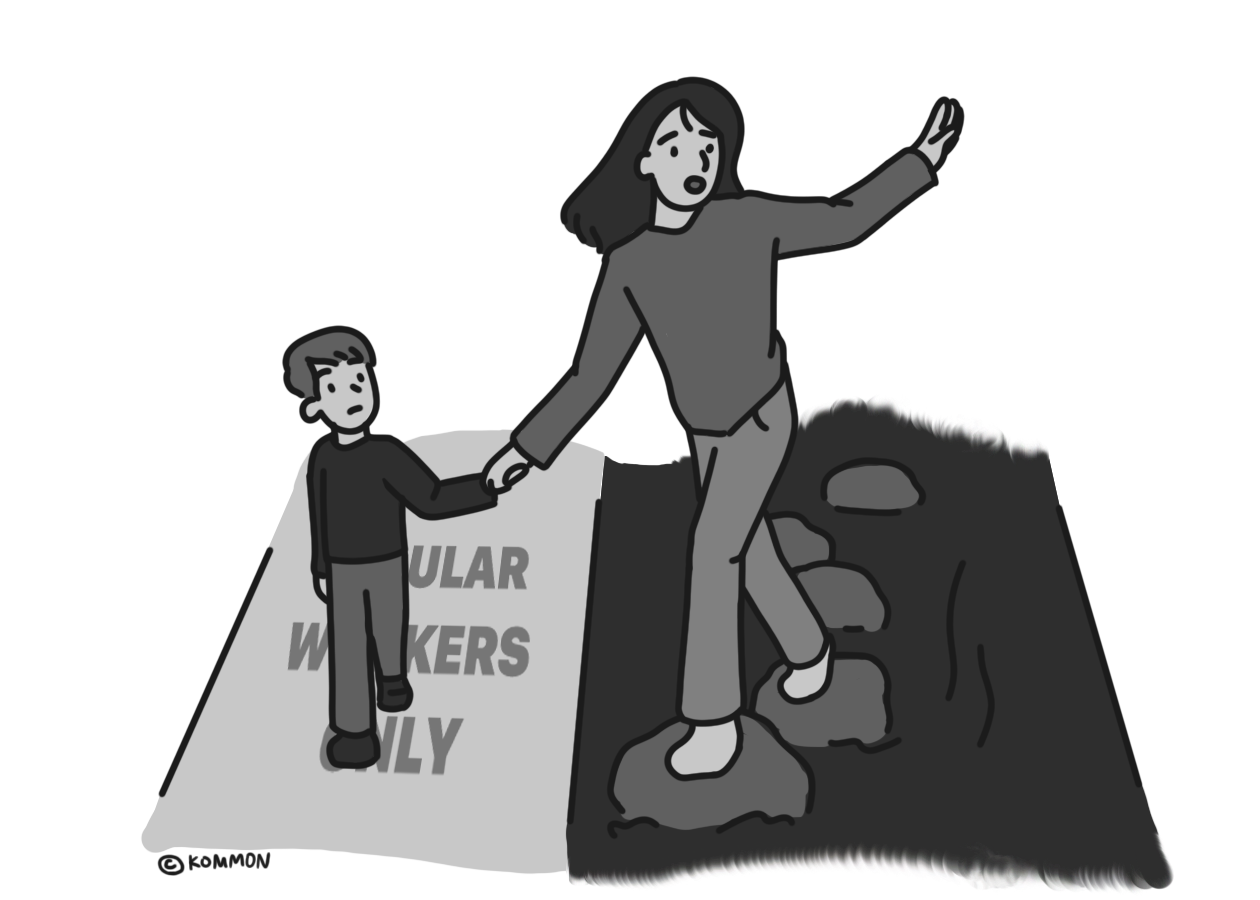
[Illustration by O.T.O] Irregular workers are striking
Elementary school care workers went on a general strike on November 6. They are calling for improvements of their poor
working conditions and the withdrawal of a new bill that will make their
employment situation more unstable. The ultimate reason for their strike is that all elementary school care workers are irregular workers with precarious employment contracts. Other irregular workers in schools will also go on strike. The Seoul School Irregular Workers’ Union (서울학교비정규직연대회의)-in which school lunch workers, nutritionist, and other irregular workers are joining-announced that they will go on a strike from November 19 to 20. They are calling for an improvement on severance pay. That is not all. Almost 1,500 irregular workers in the public sector in Seoul sued the government to fix welfare benefit discrimination between regular and irregular workers on November 11. Are there many irregular workers in
Korea?
Let us take a look at Baco's (fictional) day here. Baco woke up in the morning and ordered a salad 🥗 for breakfast. She left her house to meet her friend in new clothes that arrived last night by courier 📦. She said hello to the apartment security guard 👮 and drank coffee ☕ waiting for her friend at a cafe. After having a meal with a friend at a restaurant 🍴, she came home and tried to clean up, but the vacuum cleaner she bought a few days ago at the store 🏢 did not work. She called the customer service center 📞 and was told that the vacuum cleaner will be replaced. Then she fell asleep watching non-regular workers 👥 go on strike on TV. How many irregular workers did you count here? All the workers represented by emojis are irregular workers! 😱 The number of irregular workers in Korea stood at 7.42 million as of August this year, accounting for 36% of all wage earners. One out of every three workers we meet in our daily life is an irregular worker. Compared to the average rate of 11% for irregular workers in the OECD, we can see that the rate is very high. Regular workers: Workers guaranteed to be employed until retirement without a fixed
working contract period.
Irregular workers: Part-time workers or contract workers. "Irregular
workers" in Korea is mostly used to refer to contract workers. They are
treated worse or paid less than regular workers, even though they do the same
work in the same position as regular workers.
Indefinite contract workers: Since the introduction of "fixed-term legislation", if someone works
more than 2 years as a contract worker, they will be hired as a regular or
indefinite contract worker. Although indefinite contract workers are guaranteed work until retirement age
without a set contract period, they are still treated differently than regular
workers in terms of wages, welfare, and promotions.
Why are there so many irregular
workers in Korea?
The increase in irregular workers in Korean
society has become a social problem since the IMF crisis in the 1990s. As the
economy becomes unstable, labor costs are reduced, and non-regular workers are
more likely to be hired and fired.
Another reason is that domestic investment
has turned conservative since the IMF crisis while domestic labor demand has
decreased, due to large investments in overseas industries. "내꿈은 정규직!" (My dream is to be a regular worker!)
A game called "My dream is to be a
regular worker (Don't get fired!)" that was recently released illustrates
the hopes of young people to become regular workers. In fact, there is a lot of
discrimination against irregular workers. 1. Employment is unstable. After 2 to 4 years on a contract, irregular workers cannot
continue working unless their contract is renewed. The length of service differs
between regular and non-regular workers by 5 years and 8 months. 2. They cannot benefit from welfare. The employment insurance and health insurance coverage rate of non-regular
workers are only about half that of regular workers. The same goes for
retirement benefits, overtime payments, and paid holiday benefits. This is
because there are many companies that do not guarantee their workers' welfare
to save on labor costs. 3. The wage gap is big. As of 2020, the average monthly wage of regular workers is ₩3.23 million,
compared with ₩1.71 million for non-regular workers, which is a ₩1.52 million
difference. The wage gap is widening every year. 4. They cannot join the labor union. Only 3% of irregular workers are joining the labor union, which means their labor environment can hardly improve.
There was an attempt to solve it.
But several factors prevented this.
Public institutions
The Moon Jae In administration has come up
with a policy that is intended to regularize the conditions of irregular
workers in public institutions. In fact, only 14% of non-regular workers in public institutions become real regular workers in
the same organization. More than 40% become indefinite contract workers that
are rehired by public institutions, while another 40% move to subsidiaries of
public institutions. Private enterprises
If an employer has hired
a contract worker for more than 2 years, he or she must hire them as a regular
or indefinite contract worker. However, most companies use tricks such as
notifying non-regular workers of the expiration right before the renewal of contract.Opinions on the treatment of
irregular workers
😠 "Differences are fair!"
It is very difficult to get a full-time job as a regular worker in Korea, where it is getting harder to get any job. (Check out our past issue: "Mom and Dad Chance") Therefore, there is an
opinion that the treatment of irregular workers should be different from that
of regular employees since they have entered the company under different
conditions. It is "fair" to acknowledge the numerous requirements
that need to be met and efforts that need to be made to become a regular
worker. 😖"Equal pay for equal work"
On the other hand, there are growing calls
to improve the treatment of irregular workers and convert them to regular
workers. Their slogan is "Equal pay for equal work". The same wage should be paid for labor that produces the
same value, whether it is done by regular or irregular workers. Also, some argue that resolving discrimination can improve productivity. If irregular workers are undervalued just because they are irregular workers no matter how successful they are, their productivity will decrease, some argue. How will things change?
The government is seeking policies that can
reduce conflicts and improve the treatment of irregular workers. The Gyeonggi provincial government said it plans to implement an "irregular workers' fair
allowance" from 2021. The government will pay temporary workers at public institutions
in Gyeonggi-do from 5% to 10% of their basic salary in proportion to their job
insecurity.
Today's Vocabulary 1. 취준생 [chwi-jun-saeng] Meaning: Job seekers. Origin: Abbreviation of "취업 준비생". 취준생 spend the majority of their
time preparing to meet specific requirements for joining a company. English
grades such as TOEIC scores, external activities, and internship experiences
are the main qualifications for getting a job. Usage: "요즘 뭐해?" "그냥 취준생이죠 뭐." "What do you do recently?" "Just job seeking." 2. OO고시 [go-si] (OO examination) Meaning: "고시" refers to exams that you can get certain qualifications or job after getting passed. The most representative example is a civil service examination. However, since the exams called "고시" are usually difficult to pass, it is also used to refer to fiercely competitive tests in general. Usage: -사법고시: Bar exam -임용고시: Teacher certification examination -고시생: 고시 + 학생 (student). Someone who studies to pass 고시 -고시촌: 고시 + 촌 (town). A town where a lot of 고시생 live. Usually, everything is relatively cheap here. (고시촌 in Seoul: Noryang-Jin or Daehak-dong near Seoul National University) Wanna know more? Korean dramas <Misaeng> (tvN, 2014) 👉Netflix Here are some dramas and movies about the difficulties and conflicts that irregular workers face. They are famous for their perfect illustration of the situation.
Let's call it a day! We changed our layout a bit; we provided vocabulary and content recommendation this week. How was it? KOMMON TEAM 수수🌾 Sans🌻 바코🌊 오티오😈 쟈🍉 군밤🌰 기린🌴 쏘😺 기니👑 프레드
|