For dark mode users,
Hello, readers! Today, we are covering: Cultural Insight: Welcome Back, Park Geun-Hye? Slang: 503 (오공삼, O-gong-sam) This Week's Recommendations The Man Standing Next (남산의 부장들, 2020) Don't forget to leave your feedback below!
Welcome Back, Park Geun-Hye?
Writer: Yeon Woo Lee, Solwon Pyeon Senior Editor: Regine Armann Editor-in-Chief: Fred McNulty Researcher: Yul Jun, Daeho Park The Moon Jae-in administration’s last special amnesty list, a list of incarcerated people to be pardoned under the president’s authority, included Park Geun-hye (박근혜), the former president of Korea who was impeached in 2016 and subsequently removed from office, and caused controversy. Park was accused of corruption and illegal connections between politicians and chaebol (재벌) conglomerates and sentenced to 22 years in prison. The Ministry of Justice announced that 3,094 prisoners including Park will be released on the last day of December 2021. This decision was made against the opposition from the Ministry of Justice, civil society organizations and the public. Why did President Moon make this sudden decision against the public? And how does the public feel about it?
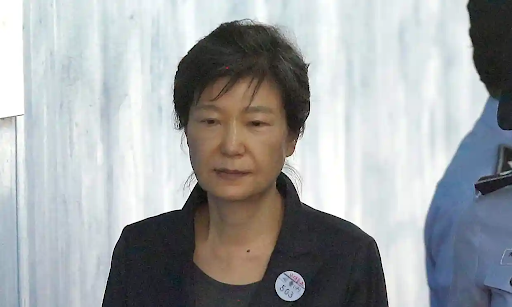
Former President Park Geun-hye Source: Former South Korean President Park Geun-hye pardoned for corruptionWhat Is “Special Amnesty”? Special amnesty (Korean link) means that the president suspends the validity of a prisoner’s sentence. The list of people to be subjected to special amnesty is passed on from the Ministry of Justice to the parliament, and finally confirmed by the president. Hence, the president is the ultimate decision-maker on this agenda. As most of the previous special amnesties targeted political prisoners, the planning has to be carried out with utmost caution in order to not offend the public. Korean governments traditionally see this affirmative action as a way to emphasize harmony among the people and increase “social wellness”. This also applies to President Park’s case, according to President Moon’s statement at the Blue House press conference on December 24th. The Korean government practices this type of special amnesty every year, but mostly around National Liberation Day, August 15. In 2008, President Lee Myung-bak (이명박) pardoned Chung Mong-koo (정몽구), Choi Tae-won (최태원), and Kim Seung-yeon (김승연), the presidents of the Hyundai Motor Group, SK, and Hanwha, respectively. In 2016, President Park Geun-hye pardoned Lee Jae-hyun, then-President of CJ Group, and thousands of other prisoners with minor charges. Why Was President Park Sent to Prison? Considering her previous political status as the “Queen of the Election” (a name she was given due to her ability to attract a high number of voters who saw her as the successor of her father, Park Chung-hee (박정희), the dictatorial leader of Korea from the early 60s to the late 70s) and the first female president of Korea, it is quite surprising how Park Geun-hye ended up in prison. However, she was not only blamed for her incompetence as the leader of the country, but was also accused of bribery, power abuse, and leaking state secrets for her own sake. Her closest friend, Choi Sun-sil (최순실), became her biggest trouble. Even though she was a regular citizen who had not explicitly engaged in political activities, she had access to exclusive state documents and abused the presidential power to force conglomerates, including Samsung Group, to support her non-profit foundations. She gradually involved herself more with President Park’s political decision-making. To learn more about the scandal, please take a look at some of the following news articles that covered Park and Choi’s corrupt acts: 👉 South Korea's presidential scandal - BBC News👉 Park Geun-hye, South Korea’s Ousted President, Gets 24 Years in Prison - The New York Times (nytimes.com)
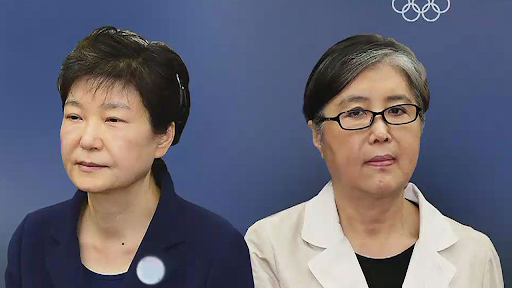
Park Geun-hye (Left), Choi Sun-sil (Right). Source: SBS 뉴스 After the existence of Choi was revealed to the public, most people lost faith in the Park administration. People gathered on the streets of Seoul with candlelights to protest against President Park’s wrongdoings and to demand righteousness. She was the first president who was ousted from a South Korean democratic regime, and was sentenced to 22 years in prison in 2017. Public Opinion Toward Park’s Pardoning JTBC, a Korean nationwide broadcasting company, presented a survey (Korean link) about Park’s special amnesty to 1,000 people. They found that the number of people in favor (40.5%) of releasing Ex-President Park from prison was 8% lower than the number of people who opposed (48%) the idea. President Moon distributed a lengthy message to share his thoughts around the current controversy. He said that there is a “desperate need for national unity and humble inclusiveness” and that it is time to move forward. “Park’s deteriorating health was taken into consideration”, presidential spokesperson Park Kyung-mee (박경미) told reporters. People who are in favor of Park’s pardoning are mostly from the traditional conservative party, who often urge people to feel pity for her because of her deteriorating health. However, the Ministry of Justice was originally not planning to pardon Park, and had not put her name on the list for this year’s special amnesty that was suggested to parliament and ultimately the president. Even Park’s lawyer, Yu Young-ha (유영하), stated in an interview (Korean link) to the Joongang Il-bo that there was no prior notification before the public announcement from the Ministry of Justice. This suggests that it was President Moon’s personal decision to include Park in the special amnesty and release her from prison.
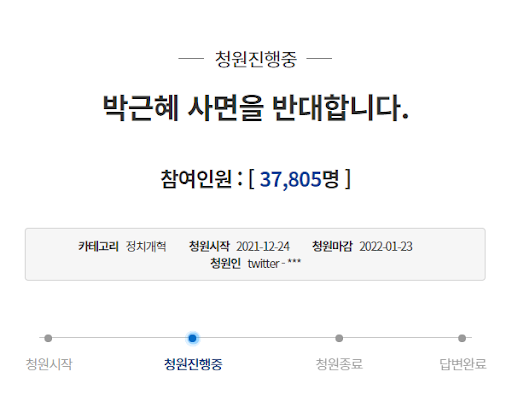
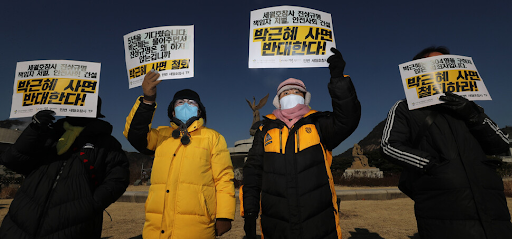
The presidential petition opposing Park’s pardoning After the final decision, a presidential petition opposing Park’s pardoning has surpassed over 37,805 signatures in four days. The Civil Society Organizations Network in Korea (시민사회단체연대회의) made a public statement and criticized President Moon as he promised to restrict the number of individuals who benefit from special amnesty, especially of those who were convicted for bribery and corruption, in the last presidential election. Moreover, over 1,000 civic groups protested (Korean link) in front of the Blue House on December 27 and held a press conference criticizing President Moon’s decision.
Civic groups protesting against Park’s pardoning in front of the Blue House Source: Hankyoreh Although the Moon administration argued that Park’s health and “national unity” were the reasons for the pardon, others have speculated that it might have been a political decision to attract more votes from Park’s supporters for the upcoming presidential election. One argument for that view is that President Moon did not put Ex-President Lee on the list, who was accused of embezzlement and taking bribes and was sentenced to 17 years in prison in 2020. Moreover, some say there might be a hidden intention (Korean link) to sabotage the opposition party’s presidential candidate, Yoon Seok-yeol (윤석열), a former prosecutor who led the investigation into Park at the time. The assumption underlying this speculation is that if Park is released and starts openly criticizing Yoon, there might be a chance for the ruling party to get more votes from Park’s supporters. The controversy surrounding Park’s pardoning will not easily die out. Even Democratic Party allies who support President Moon doubt this decision and some openly oppose Park’s pardoning. Her pardoning has officially been confirmed by the President and cannot be canceled or reversed. Therefore, her influence in the upcoming presidential election will be another interesting point to observe.
Slang 503 (오공삼, O-gong-sam) This term was used online as some started to refer to Park by her prisoner number, 503. Even though the press does not use the term, it is commonly used in online comments who criticize Park and want to emphasize her wrongdoings. This Week's Recommendations
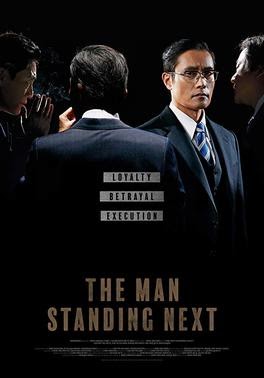
The Man Standing Next (남산의 부장들, 2020) Available on Netflix The story follows Kim Gyu-pyeong, the director of the Korean Central Intelligence Agency (KCIA) during Park Chung-hee’s presidency, as he attempts to prevent a catastrophe from happening after learning about the former KCIA director’s confession. After the former director, Park Yong-gak, gets sentenced to exile, he testifies to the U.S. Congress against the South Korean government’s illegal operations, hence opening the investigation into what is known as the “Koreagate scandal”. Kim is therefore tasked with stopping Park’s manuscript against the regime from being published. After accomplishing his mission, he is then faced with new challenges as many political members clash over who gets into power. Year in Review: 12 Biggest Stories of KOMMON in 2021 KOMMON had a happy year thanks to you all subscribers and readers. We now have more than 2,000 followers on Facebook and almost 800 newsletter subscribers! We really could not have come this far without your support and love for KOMMON’s coverages. To review our good year, we wanted to highlight 12 stories, one story per month, that garnered big attention from you readers. Take a look for a quick recap of Korean issues this year. *Note: The articles selected and listed below are the ones that received the highest open rate in their corresponding months. February: Emo Culture in Korea? Cyworld is Back! March: PC Bangs in Korea July: Fake News in Korea August: Sorry, Merge … What? September: Afghanistan Refugees to Korea October: How Starbucks Took Over Korea November: The A to Z of Korean Education December: Are There Anti-Vaxxers in Korea, Too?
|