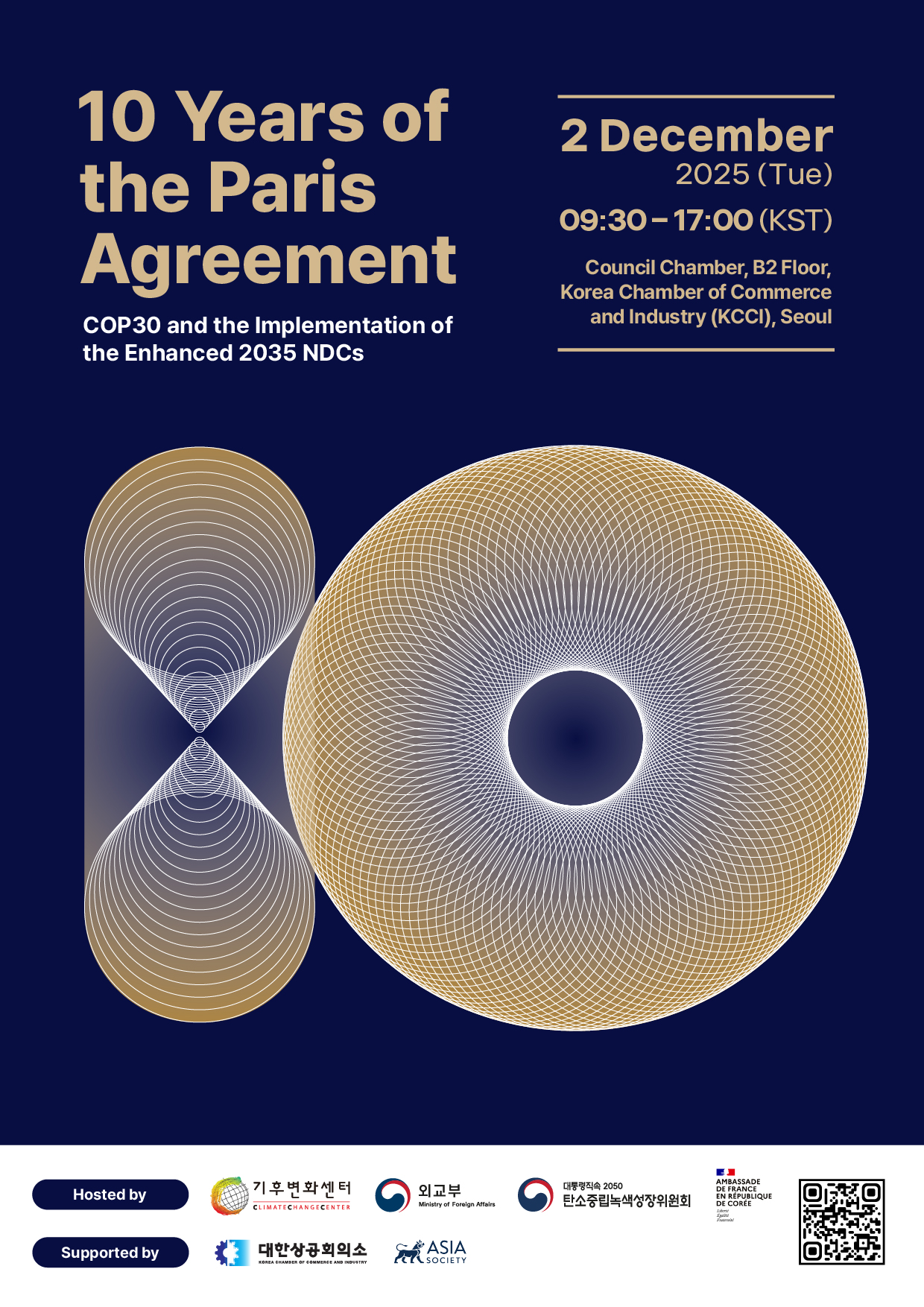
The Climate Change Center (CCC), in cooperation with the Ministry of Foreign Affairs, the 2050 Carbon Neutrality and Green Growth Commission, and the Embassy of France in the Republic of Korea, will host the “International Conference Commemorating the 10th Anniversary of the Paris Agreement” 📍on Tuesday, December 2, at the Council Chamber of the Korea Chamber of Commerce and Industry (KCCI).
This conference will take place immediately after COP30 in Belém, Brazil, at a pivotal moment when countries around the world have submitted their enhanced 2035 Nationally Determined Contributions (NDCs)—marking the beginning of a new era of implementation.
In 2015, the world came together in Paris to make a shared commitment to confront the climate crisis. Now, the next decade marks the start of implementation—turning that commitment into reality. To reflect on this historic transition, key figures who played central roles in the negotiation and implementation of the Paris Agreement will deliver congratulatory remarks.
👉 Speakers include:
- Ban Ki-moon, 8th Secretary-General of the United Nations, who elevated climate change to the core of the global diplomatic agenda and helped secure the political consensus that led to the adoption of the Paris Agreement;
- Philippe Bertoux, Ambassador of France to Korea, representing the birthplace of the Agreement and underscoring the importance of sustainable diplomacy and multilateral cooperation;
- Hoesung Lee, former Chair of the Intergovernmental Panel on Climate Change (IPCC) and current Chair of the Carbon-Free Alliance, who has dedicated his career to linking scientific evidence with climate policy;
- The 2050 Carbon Neutrality and Green Growth Commission, leading Korea’s national vision and policy framework for carbon neutrality and NDC implementation.
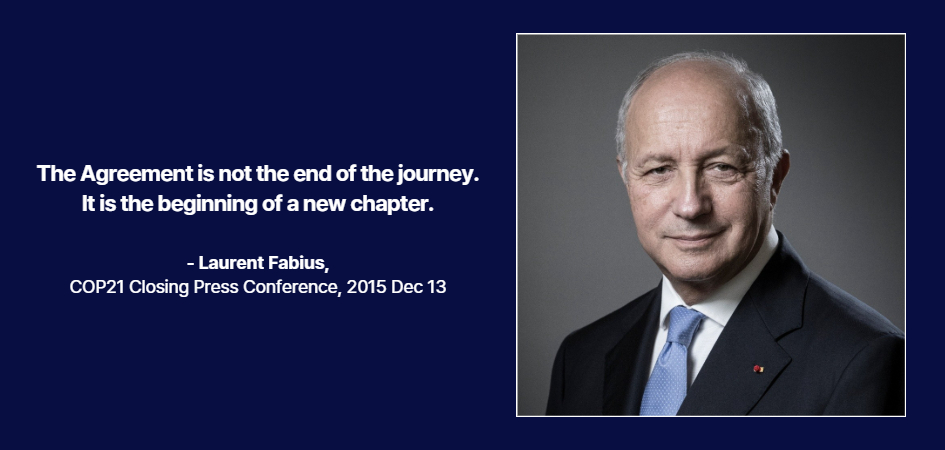
Laurent Fabius, former Prime Minister of France and President of COP21, will deliver a pre-recorded keynote address, offering insights into the evolving global climate order following COP30 and presenting a vision for the next phase of climate governance under the theme, “From Commitment to Implementation.” *Laurent Fabius, Former Prime Minister of France and President of COP21, will deliver a video keynote address at the conference.
Ten years ago, the words “The Paris Agreement is adopted” echoed through the plenary hall in Paris. In 2025, that spirit of cooperation continues—this time, in Seoul.
|
|
|
The First Global “Climate Agreement” of Humanity: The Meaning of the Paris Agreement |
|
|
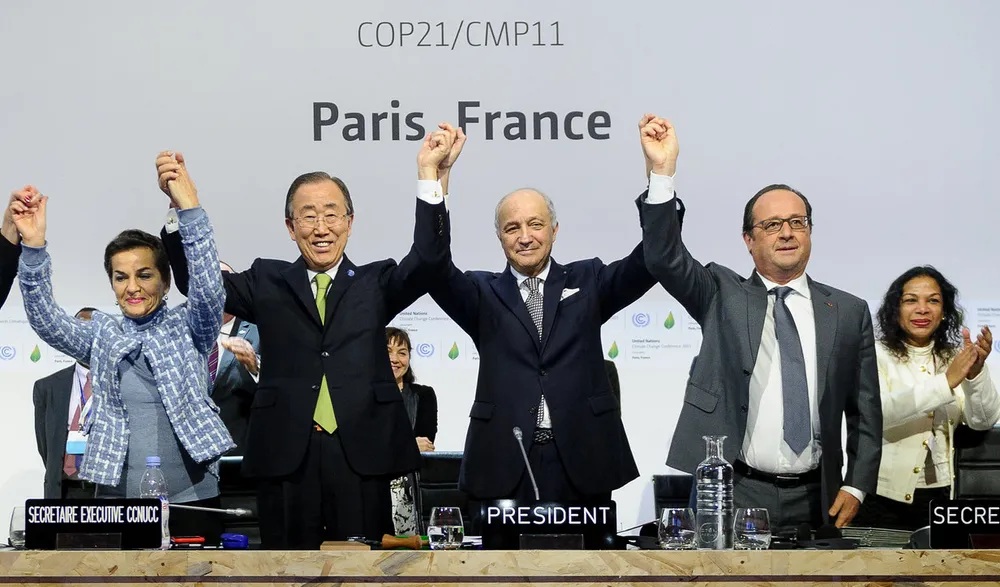
On December 12, 2015, at the Le Bourget Conference Center in northern Paris, the plenary hall of the 21st Conference of the Parties to the UN Framework Convention on Climate Change (COP21) erupted in applause. That day, 195 countries unanimously adopted the Paris Agreement—a historic milestone marking the first universal accord of humanity to confront the climate crisis together.
The Paris Agreement set forth, for the first time, a long-term temperature goal: to “hold the increase in the global average temperature to well below 2°C above pre-industrial levels and pursue efforts to limit the temperature increase to 1.5°C.” It also established a system under which all countries set their own greenhouse gas reduction targets (NDCs) and strengthen them every five years. As a result, the Paris Agreement became more than just an environmental treaty; it laid the foundation for the first truly global climate governance framework in which all nations participate.
It presented core principles that continue to underpin today’s international climate policy—Climate Finance, Adaptation, Loss and Damage, and the Transparency Framework—earning the title of a “Charter of Climate Action.” |
|
|
“The Paris Agreement is adopted.” The Architect Behind the Declaration: Laurent Fabius |
|
|
At the heart of the historic negotiations that produced the Paris Agreement stood Laurent Fabius, then Minister of Foreign Affairs of France and President of COP21. Amid intense political interests and complex diplomatic calculations, he proved himself a true “architect of consensus.”
In a room where 195 delegations gathered, Fabius moved tirelessly between bilateral, small-group, and plenary meetings, mediating key conflicts—particularly over Climate Finance and the Principle of Common but Differentiated Responsibilities and Respective Capabilities (CBDR-RC)—that had long divided developed and developing nations. He also introduced the South African–style “Indaba” negotiation format, designed to increase transparency and trust, helping overcome the gridlock through an inclusive negotiation process that engaged all parties.
His greatest accomplishment was the meticulous coordination of the text itself—word by word, line by line. Under his leadership, the final agreement included the 1.5°C target, the five-yearly enhancement mechanism, and the Global Stocktake (GST) framework—elements that shaped the very structure of the Paris Agreement. At 7:26 p.m. on December 12, 2015, Fabius raised his gavel and declared: “The Paris Agreement is adopted.”
That moment entered history amid global applause, and Fabius has since been recognized as “one of the most successful COP Presidents.” His careful mediation, diplomatic precision, and inclusive leadership have become enduring examples in the history of climate diplomacy. |
|
|
From Promise to Implementation: The Question Laurent Fabius Poses Once Again |
|
|
Ten years ago, in Paris, Laurent Fabius opened a “new era of collective climate action.” Now, as the “Decade of Implementation” begins in earnest, his upcoming keynote address at this international conference will revisit the changes and achievements of the past decade and offer new insights into the political and policy implications of the 2035 NDCs submitted by countries after COP30.
- The Role of Science and Markets in Building Trust for Implementation: He will emphasize the need to move beyond mere target-setting toward data-driven, technology-based, and transparent implementation systems that deliver measurable outcomes.
- The Evolution of an Inclusive Climate Governance Framework: Following COP30’s proposal of the Globally Determined Contribution (GDC) concept, he will explore how non-state actors—including businesses, cities, and local governments—can be structurally integrated into national and global climate frameworks.
- East Asia’s Responsibility and Leadership: He will highlight how East Asia, home to more than half of the world’s emissions, must now move from being at the center of the problem to becoming the center of solutions, balancing both responsibility and opportunity.
Now, the promise that began in Paris continues through COP30 in Belém, Brazil, and moves forward to Seoul. The “International Conference Commemorating the 10th Anniversary of the Paris Agreement,” to be held on December 2, will go beyond the past decade of agreements to serve as a turning point for rebuilding trust and strengthening the structure of global cooperation.
We invite your participation in this gathering, where the direction of global climate implementation will be discussed and the path from commitment to tangible change will be charted together. |
|
|
✨Save the Date: Tuesday, 2 December 2025 | 09:30–17:00 (KST)
📍On-site: Council Chamber, Korea Chamber of Commerce and Industry (KCCI), Seoul
💻Online: The conference will be live-streamed on YouTube for those unable to join in person. Pre-registration is required via the link below.
👉Contact: Policy Research Team, Climate Change Center (CCC)
- Tel. +82-2-2088-8023
|
|
|
Climate Change Center
T. 02-766-4351 | E. info@climatechangecenter.kr
No. 306, Bldg 1, 22, Teheran-ro 7-gil, Gangnam-gu, Seoul, Korea, 06130
|
|
|
|
|