For dark mode users,
Hello, reader! Today, we are covering: Index Zoom In Korea Rolls out the Fifth COVID-19 Relief Fund Today's Vocabulary 꽁돈 (ggong-don) This Week's Recommendations Money (돈, 2019) Don't forget to leave your feedback below!
Korea Rolls out the Fifth COVID-19 Relief Fund Writer: Haram Lee, Chaewon Park Editor: Aleya Sharif Senior Editor: Regine Armann Editor-in-Chief: Fred McNulty Researcher: Yul Jun, Daeho Park On September 6th, South Korea rolled out its fifth disaster relief fund, supplying ₩250,000 to everyone except those in the upper 20% income bracket. Compared to the four earlier disaster relief funds, of which the first was provided to every citizen but the second, third, and fourth only to small and middle-sized business owners who saw their profits fall due to the prolonged pandemic, the fifth disaster relief fund has been met with a lot of interest, as it targets a larger group of individuals. The government believes that this will encourage spending, which can in turn help small and medium-sized enterprises (SMEs). However, some are more pessimistic about the rollout and wonder how large its effect will be, on what basis eligibility is determined, and whether increased spending could potentially contribute to spreading COVID-19. Today, we will look at how exactly the fifth disaster relief fund is distributed and how it can be used. Selecting the Recipients of the Disaster Relief Fund During the first week of the relief funds’ release, people can apply on a certain day according to the last number of their birth date, if they meet the eligibility criteria. For example, people on the 2nd, 12th, or 22nd day of any month in any given year all apply on the same day. Disaster relief funds of COVID-19 usually apply to the bottom 80% of the household income bracket. This time, however, single-person households and dual-income households are included but evaluated according to special criteria, which brings the total percentage of individuals eligible for receiving the fifth disaster relief fund up to 88%. The allocated amount depends on the total of health insurance contributions each household has paid this June. For example, within a four-person household, those subscribed to employee health insurance who have paid less than ₩308,000 and those on individual plans who have paid less than ₩342,000 are eligible for the disaster relief fund. Dual-income households receive additional payments, and single-person households that earn less than ₩50 million a year are also eligible for the disaster relief fund. Based on their health insurance contributions, a single employee who pays less than ₩143,900 in insurance contributions and a single individual subscriber who pays less than ₩136,300 are both eligible for the fund. If one member of a household pays more than ₩900 million in property tax, or if the household’s income (including interest and share) exceeded ₩20 million last year, the household is not eligible. Permanent residents of foreign nationality (those on F5 visas) and marriage migrants (F6 visas) are also eligible for the subsidy, but most of the foreign population of Korea will not receive the relief money. How and Where to Use the Relief Funds How it is issued South Korea issues the COVID-19 relief funds via electronic currency. Once a person applies for the program, the allocated amount is transferred into their personal bank account the day after. People who prefer a local business support voucher (지역사랑상품권) can apply for it through the designated provincial civil service website of their region.
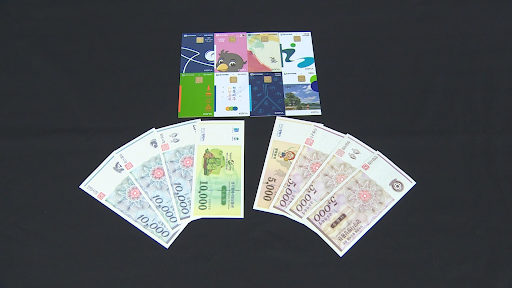
Samples of local business support vouchers/gift cards (지역사랑상품권) How Registration Works For all types of relief funds, both online and on-site registrations can be made according to the last digit of one’s birth year (see the chart above for reference). Where the money/vouchers can be redeemed
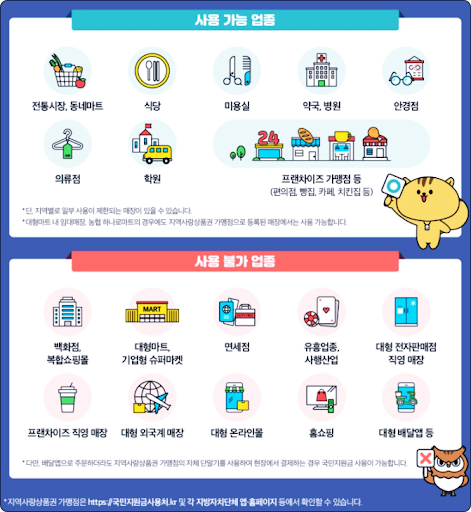
As the chart above shows, relief funds can be redeemed at the following places:
These are the businesses where the money/vouchers cannot be used:
As all the major department stores and grocery stores have been excluded from the list, convenience stores have become a popular shopping location for people who want to spend their relief money. Some people have started searching for outlets that sell specific electronic devices including Apple AirPods (Korean link), as only some convenience stores are selling electronics. Acknowledging the surge in demand, convenience stores have come up with ambitious marketing strategies such as new types of promotions, deals, and products, to encourage people to spend their relief fund money. According to GS25, one of Korea’s major convenience store brands, payments with relief funds in May of 2020, after the first rollout in March 2020, had increased by up to 86.2% compared to the two months before. The categories with the highest records in sales were meat, electronic devices, and even home appliances, which are high-priced, given the convenience store standards. Forecasting a similar trend for the 5th rollout this month, convenience stores have launched special marketing tactics to attract customers caused by a surge of demands upon the distribution of relief funds. Convenience stores have begun selling products that even they have not anticipated selling: 1. Home appliances-refrigerators, air purifiers, TVs, etc. 2. Electronic devices-drones, video game consoles, and iPhones/IPads, and 3. Books.
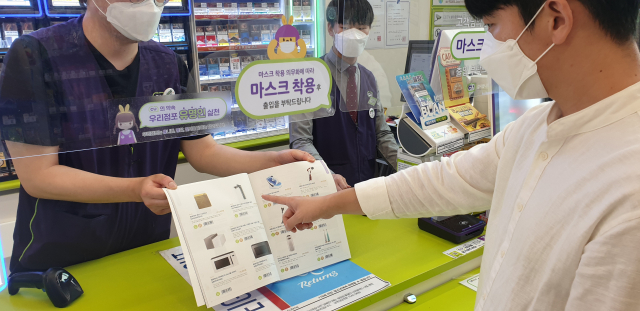
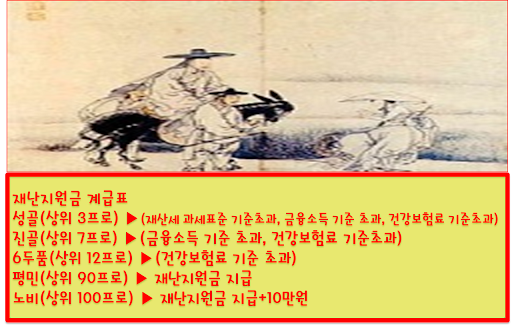
A customer purchasing a home appliance at a convenience store. What Koreans have bought so far with their relief money According to the Ministry of the Interior and Safety (행정안전부), the money distributed during earlier rounds of the Covid-19 relief funds in 2020 (Korean link) was overall spent at the following places: Restaurants: 25% Groceries: 24% Small businesses: 64% The ministry also mentioned that until May 31, 2020, ₩5.6 trillion out of the ₩9.5 trillion that was distributed until then had already been spent, which is 59.3% of the total budget. These are the specific types of businesses where people spent their relief funds in June 2020: Restaurants (24.8%) Groceries (24.2%) Hospitals/pharmacies (10.4%) Gas stations (5.4%) Clothes/accessories (5.3%) Increases in sales in May 2020 were observed at the following places: Optometrists (66.2%), Hospitals?pharmacies(63.8%) Hagwons (37.9%) Bookstores (34.9%) Fitness centers/hairdressers (29.4%) Based on the past trends, it is expected that relief fund-triggered sales this year will follow the same pattern. Criticism Inaccurate Income Classification In order to receive the funds, a person has to earn an income that is below the 80% income bracket. However, this definition has caused some confusion within Korean society, as some who think they should be eligible did not receive the money. Seoul Economy Daily (Korean link) reported a story on such a person, who is quoted as saying “I’m unemployed, but the government said I wasn’t included. There are those who live in expensive flats receiving the funds but a person like me who is struggling to pay monthly rent cannot receive the fund. I wonder if it’s really for those in the 88% bracket. I'm sure I’m not within the top 12% of earners.” As a result, some people are appealing the government’s eligibility classification. According to JoongAng Ilbo (Korean link) on September 9th, On the third day of registration, 25,800 appeals were filed within a single day. The National Assembly responded that it is considering extending the groups of eligibility even further. Also, the ruling party, the Democratic Party, stated that they would raise the income cut from 88% to 90%. Addressing this matter, The Ministry of Economy and Finance (기획재정부), a government organization in charge of distributing the funds, announced that they are going to accept the appeals as many as possible, and would plan to raise the income cut to 90%. However, this changed. According to an Asia Economy report posted on Medigate News (Korean link) on September 13th, The Ministry of Economy and Finance (기획재정부) stated that there will be no changes to the originally planned policy-the 88%. Restriction on Places to Shop For many people, the current system is inconvenient as they cannot spend their relief funds at their most-frequented stores like major department stores. Also, they can only use their funds in the region where they are registered. According to a story reported in Asia Economy (Korean link), this has posed problems for some commuters. For example, 34-year-old Mr. Kim said, “I live in Seoul, while my hometown is Cheongju, which is registered as my official address. This is problematic because I have to travel down to Cheongju, which takes me 2 hours, to spend the relief funds.” It’s the same story for a college student who is in his 20s. Mr. Park, whose official hometown is Anyang, cannot spend his funds in Cheonan, where he lives most of the time. The same report by Asia Economy cited the response of the government as: “We wanted to support the local economy, so we limited it to people’s official hometowns. Those who changed their place of residency after June 30th can submit a request for a change. All other recipients have to spend their relief funds in their hometown where they are officially registered.” Is it Really Effective? The government says that the relief funds are helping small business owners. Some said that the benefits would hardly be tangible as few small business owners anticipated more visitors. However, the negative forecast proved to be false, according to a report covered by Newspim that claims that while the exact amount of extra income is difficult to determine, one can hardly claim that the relief funds were not helpful for small business owners, especially given the fact that the relief funds need to be spent within 3 months and that 99.5% of the money given out during the first round of the relief funds was indeed spent, according to the Ministry of the Interior and Safety’s data. The report further emphasizes that all forms of relief funds - electric currency and vouchers - convert into cash, which, after all, goes back to businesses as profits. Stigmatization based on Income: A Modern Social “Caste” Issues On an online community, an apparently anonymous post called “Relief Funds Tier Chart” has been shared and soon went viral. Based on the government’s relief funds program, the poster, which has not been identified, divided the population into social classes, using ancient words that existed in the archaic era of Korea the “caste”. As the relief funds are meant to be for the bottom 88% of the population based on income, this post is mocking the new Korean “social status system” based on people’s eligibility for the COVID-19 relief funds.
A new “social caste” system drawn up by an online community user, using labels of ancient social classes in Korea according to eligibility to the COVID-19 relief funds. The poster used the following labels:
As this was produced by a random online community user, posts like this are not representations of what Korean society thinks. However, they illustrate how rank - and competition-oriented Korean society is - even when it comes to reviving the local economy that is suffering from a global pandemic.
Today's Vocabulary 꽁돈 (ggong-don), free money Money received for free with no expectations or work. Example: A: 아, 이번에 재난지원금 25만원 꽁돈 들어왔다! B: 우와, 오늘 비싼 거 사먹어! A: Hey, I’ve got myself ₩250,000 of ggong-don from the relief funds! B: Nice, go treat yourself! This Week's Recommendations Money (돈, 2019) Available on Netflix (115 minutes) Jo Il-hyun, a rookie stockbroker, joins a major financial firm in Yeouido (여의도) with hopes of becoming rich. Due to his strict moral compass, he struggles to assimilate to the job environment at first, but all of this changes once he meets a mysterious figure known by the alias “The Ticket” through a colleague from work. He is presented with an offer that requires bending a few rules, and Il-hyun takes up the job after some deliberation. But how will the gamble play out, with the watchful eyes of Han Ji-chul from the Financial Supervisory Service tracking his every move? “Our clients are fund managers, and managers tend to leak information at any time, so the customers' words are money” - Jo Il-hyun, Money
💚 Support us! 💚
|