For dark mode users,
Hello, readers! Today, we are covering: Cultural Insight: Does Korea Need More Audition Programs?
Slang: Devil’s Editing (악마의 편집) This Week's Recommendations Episode of Workman (워크맨) Don't forget to leave your feedback below!
Does Korea Need More Audition Programs?
Writer: Yeon Woo Lee, Sunny Um Senior Editor: Regine Armann Editor-in-Chief: Fred McNulty Researcher: Yul Jun Illustrator: Ah-young Kim
[Illustration by Ah-young Kim] Korean music channel Mnet (엠넷), the master of audition programs in Korea, is currently aiming to regain its old fame with Street Woman Fighter (스트릿 우먼 파이터), a dance survival program among eight female dance crews. Even though Mnet describes itself as “Asia's No. 1 music station”, its diverse survival audition programs such as Superstar K (슈퍼스타 K), Show Me The Money (쇼미더머니), and Produce 101 (프로듀스 101) are more popular than its music curation shows. These audition programs discover talent among contestants from the general public and even contribute to making some of the celebrities. However, these programs do not always lead to positive results. The main producer of Produce 101 was accused of manipulating the numbers of viewer votes and accepting bribes from several entertainment agencies for favors. More controversies have arisen around Mnet’s audition programs and often left the public appalled. After Street Woman Fighter’s release in August 2021, the program has definitely generated a lot of buzzes. The video clips of the program have been watched more than 45,796,000 times (Korean link) overall as of September according to Smart Media Rep (SMR), which provides major broadcasting companies’ video-on-demand services to online platforms such as Naver and Youtube. The dancers who appear on the current show are seeing remarkable growth in the number of followers on their social media accounts, too. Street Girls Fighter, a spin-off of Street Woman Fighter, also premiered on December 1 on Mnet, and shows teenage girl dance crews competing to become the best girls dance crew in Korea. Mnet’s Successful Audition Programs 1) Superstar K
Source: CJ ENM Superstar K is a talent show series that was held yearly from 2009 to 2016. Seo In-guk (서인국), John Park (존박), and Jang Beom June (장범준) were discovered through this program. The program came as a sensation to the cable broadcasting companies at that time, recording a viewing rate of 7.7% (Korean link), the highest among all cable channel shows. The final episode of season 2 even recorded a viewing rate of 19%. Inspired by its success, the three major Korean broadcasting companies, KBS, MBC, and SBS, premiered their own audition programs right after Superstar K season 1 ended. However, these shows were not as successful as Superstar K. In these shows, until the final episode, judges decide who gets a pass and goes to the next round. However, in the final, the winner is decided based on the total scores from the judges and the public. 2) Produce 101
Produce 101 is a survival reality show where the survivors can debut as a group, based on votes from “public producers”. That means the public "produces" an idol group by choosing members from a pool of 101 trainees from different entertainment companies. The winners of the first seasons were I.O.I (아이오아이), Wanna One (워너원), and IZ*ONE (아이즈원). However, the winners of the last season could not debut after all, due to the vote manipulation scandal. 3) Show Me The Money
Show Me The Money is a rap competition show. Since its premiere in 2012, it has been credited for increasing the public's interest in hip-hop culture. Throughout the missions that the rappers go through, they create their own music. The songs that come out of this show always secure the top positions (Korean link) on music streaming charts for months. In the final, the public can vote for the rapper they support, either on-site or by text. The rapper who gets the most votes from the public is declared the winner of the show. Why Do People Love Audition Programs? Mnet’s adoption of viewer voting in its audition program has fascinated the public from the start. At a cost of ₩100 per vote, viewers can send text votes to the contenders and thereby contribute to the score of the contender they are rooting for. Unlike in the traditional music scene where professionals are the ones who discover talents and make their debut, viewers of such shows can take part in the competition and experience helping their favorites debut. For example, Produce 101 season 2 garnered more than 1.2 million viewer votes only during the final episode and thereby earned ₩120 million (Korean link). Moreover, the public is often captivated by the personal stories of the contenders, most of whom went through some difficulties to pursue their musical careers. The Dark Side of Audition Programs 1) Manipulative Editing Mnet is infamous for its manipulative editing, in other words, for taking negative reactions out of context and putting them into a totally unrelated scene to create tension on the show. For example, rapper Swings (스윙스) who appeared on Show Me The Money season 9 made a public complaint toward Mnet’s way of editing. At the end of episode 2, the production crew showed some parts of Swings’ performance stage and edited them in a way that gave viewers the impression that Swings made a huge mistake on stage. However, in the next episode, this turned out to be wrong (Korean link) and Swings successfully finished his performance. This type of editing can create “victims on false charges” and further encourage conflicts between viewers who are rooting for different contenders. 2) Questions regarding the impartiality of audition programs Produce 101’s producer Ahn Joon-young (안준영) and chief producer Kim Yong-beom (김용범) were convicted of manipulating vote outcomes to make certain contenders debut as members of an idol group. They were also found guilty of taking bribes from management agencies that sent their artists as contenders to the show. They were sentenced to two years in prison and forfeiture of ₩37 million by the Seoul Central District Court. These accusations outraged the public as Produce 101 began with the promise to give trainees from small entertainment agencies a fair opportunity to make their debut. While the show did create a chance for young trainees to make appearances on a major TV channel, it left devoted fans and trainees who had sincerely participated in the competition with a feeling of betrayal. As a result, Mnet lost the public's trust in the impartiality of its audition programs. 3) Repetitive format The public recently seems to get tired of Mnet’s repetitive format of audition programs and its deceptive way of editing episodes. Even if new events and twists are added to these shows, the basic format is essentially the same. According to the culture critic Ha Jae-geun (하재근) who recently gave an interview on the topic to the Korea JoongAng Daily, audition programs represent an already crowded market and it will become harder and harder to make them successful without coming up with something new. What’s Next? To attract the public again to audition programs, the most urgent task for producers is to come up with transformative formats. Street Woman Fighter’s recent success was based on such a new concept, by casting street dance crews who have a long history in the female dance scene, not contestants from the general public who want to become celebrities. Even though Street Woman Fighter ended up selecting one crew as the winner, the public tends to enjoy the different personalities and performance styles of different teams rather than the competition itself. Given the number of similar programs, only shows that promote different styles and offer unique formats will be able to survive in the future. Now is the time for producers to reconsider what message they want to send to the public and stop churning out similar audition programs without any consideration.
Slang
Devil’s Editing (악마의 편집) The term “Devil’s Editing” means changing a scene or an entire clip in a show to draw dramatic reactions from the viewers. Directors and writers can cut, edit, and insert unrelated, negative clips between certain scenes to create tense moments. For example, in episode 6 of Produce 101, Jeong Se-woon (정세운) and Kang Dong-ho (강동호), better known as Baekho (백호), argued about their upcoming team performance. Jeong wanted to play his guitar on the stage and Kang said it might not be the best idea to play an instrument alone while the rest of the team cannot. Their argument ended smoothly and they extended sincere apologies to each other. But the director, Ahn Joon-young, highlighted the “heated moment”, which led the show's fans to criticize Kang's "disrespectful" attitude toward his fellow trainees. Later, several news reports said that Kang was a victim of Devil’s Editing and the argument seemed worse than how it actually was at the studio. As criticism of the production team grew, Ahn said in a statement that his editing style was to promote the show, and “the trainees had no problems with the editing”. He added that “It’s upsetting that I have to talk about this.” This Week's Recommendations
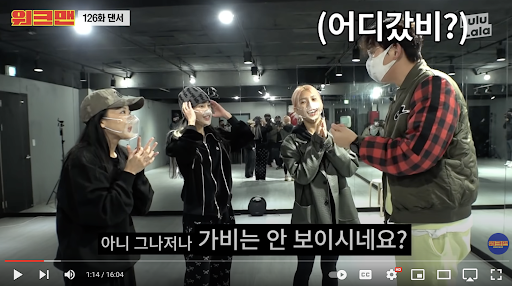
Workman (워크맨) is a quirky and entertaining YouTube variety show featuring Jang Sung-kyu as he navigates the demands of the workplace as a one-day part-timer. In this episode, he spends the day as a rookie dancer at LACHICA's studio and learns all about the recruitment process while enjoying some creative time with the crew as they assemble a dance performance for a Kpop girl group. You can watch this episode of Workman on YouTube.
|