For dark mode users,
Hello, readers! Today, we are covering: Index Zoom In Are There Anti-Vaxxers in Korea, Too? Today's Vocabulary Anaki: Raising Children without Using Medicine (안아키) This Week's Recommendations Going to the Blue House Like This (이렇게 된 이상 청와대로 간다, 2021) Don't forget to leave your feedback below!
Are There Anti-Vaxxers in Korea, Too? Writer: Daeho Park Editor: Aleya Sharif Senior Editor: Regine Armann Editor-in-Chief: Fred McNulty Researcher: Yul Jun
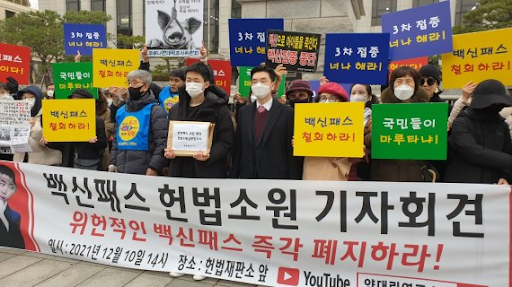
Source: https://www.fnnews.com/news/202112101513594560 Intro Korea has a very high vaccination rate so far: More than 83% of the population have had their first dose, and 81% are fully vaccinated. These figures are a reflection of the widespread awareness of the importance of vaccines throughout the country. Nevertheless, it seems that an anti-vaccine movement has been emerging as of late. Opposing the current government policies, student Yang Dae-rim (양대림) in their third year of high school, along with 452 others, filed a constitutional petition against the government and 17 cities and provincial governors last week to seek confirmation of the vaccine pass’ alleged unconstitutionality (Korean link). At 2 pm on the 10th of December, legal representatives and the petitioners held a press conference in front of the Constitutional Court in Jongno-gu, Seoul, claiming that the government's policy to expand the vaccine pass violates basic rights such as the people's right to health and equality. There are more than a few people who refuse to get vaccinated, such as Yang. In addition, they protest together in solidarity, which has been garnering media attention regardless of the so far small size of the protests. So, what does the anti-vaccine movement look like in Korea, and how does the public perceive it? 1) Citizens Rejecting to Be Vaccinated The petition (Korean link), which was posted on November 26, has garnered more than 350,000 signatures as of December 11. According to this petition, there are three main reasons for the opposition to vaccines. The first is that "there are many cases of breakthrough infections," the second that requiring vaccinations is "a violation of human rights," and the third that "unverified booster shots (additional vaccinations) are required," and that “requiring people to pay for PCR tests, is like forcing them to get vaccinated." The petitioner argues: "I personally have no intention of getting this dangerous vaccine until a safe and proven vaccine comes out, and I'm very disappointed with this Democratic regime, which is bent on expanding quarantine passes and forcing vaccinations somehow. Now, whether it's a vaccine pass or a quarantined pass, I hope they stop. These measures are a violation of human rights and also unconstitutional." 2) The Case of Small Business Owners While the government was considering introducing a "vaccine pass" that guarantees access to so-called “multi-use facilities” (such as restaurants, cafes, gyms, and movie theaters) for those who have completed vaccination, some contended that that constitutes "discrimination against unvaccinated people." Others, however, welcomed the introduction of the pass, especially businesses that have suffered long-term damage (Korean link) to their sales due to the neverending social distancing measures. According to news outlet NEWSIS (Korean link), many small business owners think that it is quite late for the government to introduce COVID-19 vaccine passes but they express expectations that sales, which had plummeted to less than half, would recover if the distancing rules and personnel restrictions were eased. Meanwhile, the Korea Federation of Micro Enterprises held a press conference at its office in Yeouido, Seoul, on the afternoon of December 9th, and criticized the new policies, saying, "Because many small businesses have very little manpower and cannot afford to hire extra staff, restaurant workers have to come out to the store entrance to check vaccine passes, and explain how to check vaccine passes to customers." The Federation also demanded that the violation policy be changed, so that the responsibility is shifted from the business owner to the violating party. Chairman Oh Se-hee (오세희) said at the press conference, "In order to avoid situations where small business owners and self-employed people are directly hit by the expansion of the vaccine pass, the violators should be held responsible for the violation, not facilities and stores, and practical cost support measures should be provided for, such as labor costs and quarantine pass infrastructure." The Reaction of the Public
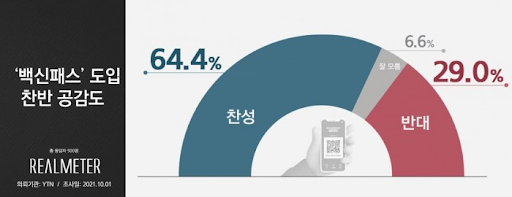
Source: http://www.realmeter.net/ About two out of three Koreans were found to be in favor of the introduction of the "vaccine pass.” When the quarantine authorities were considering introducing the vaccine pass that restricts the access of unvaccinated people to multi-use facilities, Realmeter, a polling agency, investigated the public’s response to the potential introduction. The survey shows that 64.4% of respondents "approved" (Korean link) restoring daily life and improving vaccination rates, while a bit more than 29.0% "opposed” the measures, on the basis of personal circumstances and concerns over infringement of basic rights; 6.6% said they were "not sure”. As the number of tertiary vaccinations (Korean link) (also known as booster shots) rose from around 100,000 a week ago to 700,000 a day, attention is being paid to whether the tertiary vaccination numbers will accelerate. The government stresses that tertiary vaccinations are essential to prevent variants such as Omicron, in addition to slowing the overall spread of the virus. All things considered, the general public's perception of vaccines has not been bad at all. Nevertheless, there have been concerns about risks and side effects, and the media have been criticized for spreading “vaccine fear” (Korean link) by exaggerating reports of side effects and not waiting for epidemiological investigations, and for overrepresenting the anti-vaccine movement. The Government's Response Regarding the national petition against the extension of the vaccine pass to adolescents on the 10th, Jeong Eun-kyung (정은경), head of the Korea Centers for Disease Control and Prevention, said, "The preventive effect of vaccinations is clear," adding, "We will keep investigating side-effects and the safety of the vaccines used." Regarding the vaccine pass, she said, "In the case of hagwons, many students gather indoors for more than an hour, attend classes, and spread the virus to other schools in the region by visiting various academies; we will therefore include new measures and fully listen to parents and students to reduce anxiety and any inconveniences." Commissioner Jeong said, "Encouraging vaccination and requiring vaccine passes are the minimum measures to protect our society from the COVID-19 epidemic," and appealed to the public: "Please trust the government so that we can overcome the current crisis and return to our normal daily lives." Outro Anxiety regarding the COVID-19 vaccine may be natural because it has only been introduced recently. It is the responsibility of the government and the media, however, to help ease public anxiety towards the vaccine, and it is true that broader discussions are needed. What should be avoided, however, is fear-mongering by exaggerating the public’s valid concerns as if they represented a large movement that opposed the current policies altogether. One can only hope that the media recognize that these times require careful and accurate reporting.
Today's Vocabulary Anaki: Raising Children without Using Medicine The Internet community "Raising Children Without Drugs" (hereinafter referred to as Anaki (안아키), which was established in 2013, insists on extreme naturalistic parenting methods. It recommends that children not get the essential vaccinations, and introduces questionable treatments such as "applying warm packs on burns" and "feeding children charcoal powder for stomach issues and diarrhea”. Anaki used to have nearly 60,000 members, until Kim Hyo-jin (김효진) the oriental doctor and operator of the Anaki Naver Cafe, which manufactured and sold extreme naturalistic and unauthorized herbal digestive medicine, was charged with violating the Pharmaceutical Affairs Act and the Food Sanitation Act. The group is now smaller but still exists. This Week's Recommendations
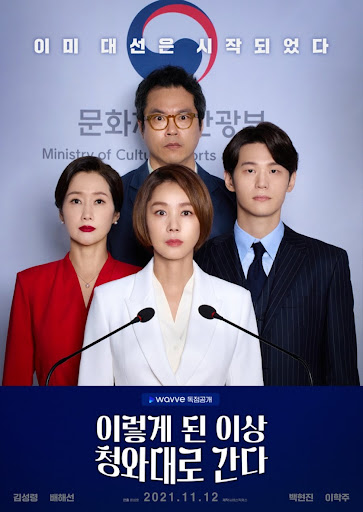
Going to the Blue House Like This (이렇게 된 이상 청와대로 간다, 2021) Available on Wavve The story follows Lee Jung-eun, an Olympic Gold Medalist turned minister, and her husband Kim Sung-nam, a political critic. Four months before the presidential election, Lee Jung-eun gets appointed as the Minister of Culture, Sports and Tourism, and the events of the show unfold during the onset of her husband's sudden kidnapping. The story unfolds at a time when the current pandemic has come to an end and also showcases scenes of anti-vaccine and anti-homosexuality rallies that take place across the country.
💚 Support us! 💚
|