#수능 #College admissions in Korea #vocabulary
Hello, reader. This Friday, we bring you about the upcoming event: "수능" and college admission - and why Koreans are absorbed in college entrance. Do not miss the vocabulary section as well! For headlines and cultural insight, check out our Tuesday issue!
Even COVID-19 Cannot Stop the Korean College Entrance Exams
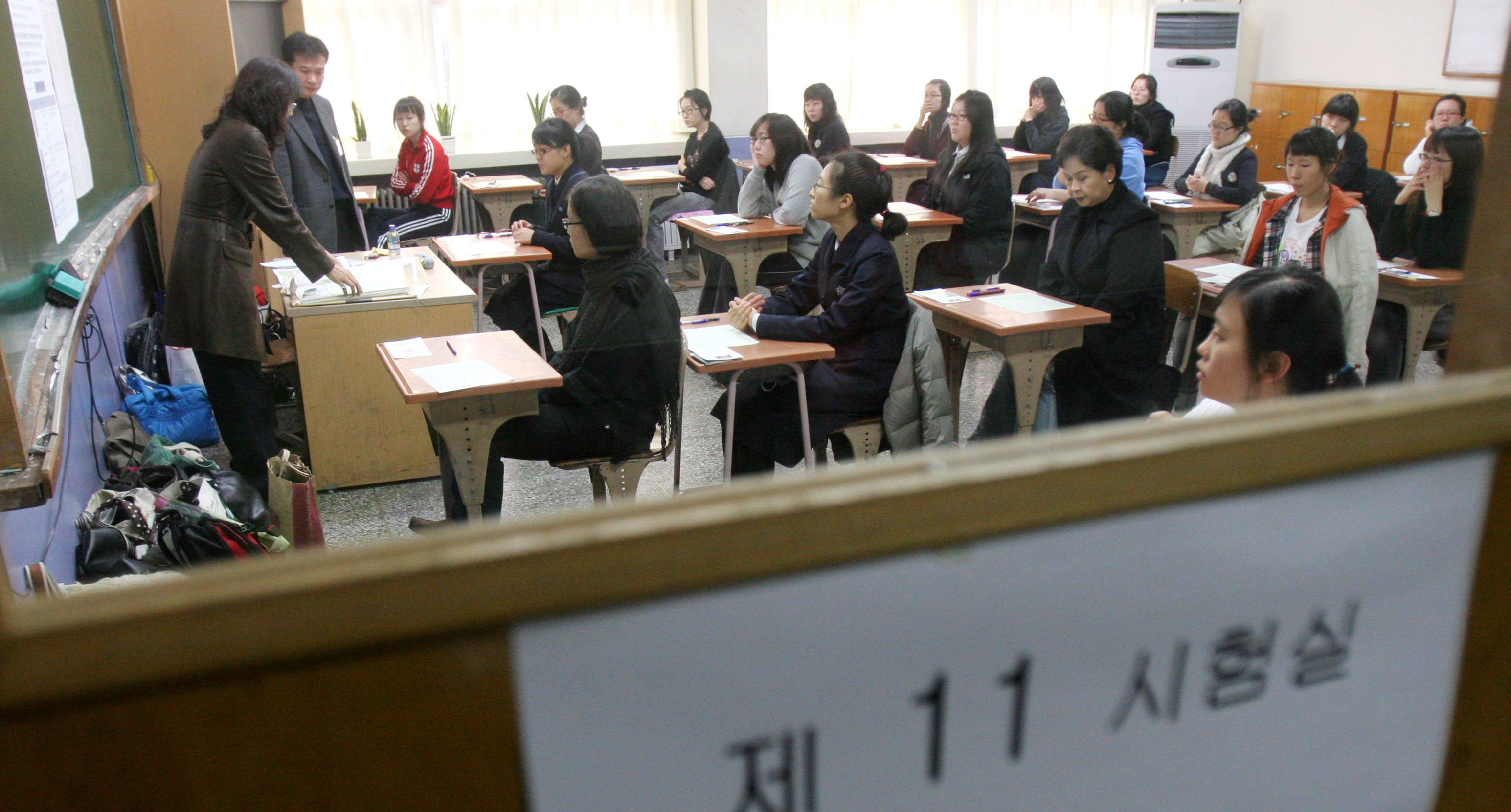
[Photo by Yonhap] COVID-19 infection rates have been increasing again for the past few days. This has led to the government upgrading the social distancing level to 1.5 on the 19th. Hundreds of new confirmed cases are emerging every day, so all large-scale gatherings are being canceled or postponed. However, Minister of Education Yoo Eun-hae stressed that the 수능 [suneung], Korea's College Scholastic Ability Test, will be held on December 3 as scheduled. It is usually held every November, but it was postponed for a month this year because of COVID-19. Many hold concerns because students would be vulnerable to infection gathering in classrooms together taking tests. The Ministry of Education (MOE) said they would prepare to prevent infection spread with thorough quarantine guidelines. How will the 수능 change after COVID-19? 수능 testing sites affected by COVID-19 The MOE announced the following guidelines(Korean link): 👉1. Reduce the number of examinees per class from 28 to 24. The number of test sites for this year's 수능 is 23,318, which is 4,318 more than in 2019. 👉2. Isolate examinees with fever symptoms Test takers with fever on the day of the 수능 should take the test in a separate test room. The distance between test takers should be at least 2 meters, and the proctor has to wear a protective suit. 👉3. Provide thorough training and protective equipment for supervision The number of supervision (and quarantine) personnel for the 수능 reached 129,000 this year - which is 30,000 more than in 2019. Thorough pre-training to test management personnel and masks, gowns, goggles, and facial protection will be provided. Additional measures 😷 Starting 2 weeks before the 수능, the MOE is planning special quarantine guidelines and strengthening regulations in places such as hagwons (cram school) and study cafés. During this period, hagwons will register their names on the MOE's website in case of COVID-19 infections. Also, instructors and staff at hagwons and study cafés are required to use the MOE's health self-diagnosis app. 🏫 Before and after the 수능, high schools across the country and schools that will be used as test sites should switch to remote classes. As of November 19, 67% of high school seniors in Seoul are already taking remote classes. 🤒 Test takers can take the 수능 even if they are confirmed to be COVID-19 positive! They will take the test at a separate test site. The MOE has secured 120 beds and 780 separate test sites across the country for these examinees. Wow…why is the 수능 that important? Most students must obtain a minimum score on the 수능 to enter university, and the order of 수능 scores determines which students will enter university in a given year. The type of college admissions in Korea 수시 [Soo-si] (rolling admission): This is a way of selecting college freshmen before regular admission. Usually, it starts in September, and they are selected based on high school student records and college's own exams such as an interview and essay test. 수능 grades are sometimes included in the standard. 정시 [Jung-si] (regular admission): In this method, students are selected based on their grades after the 수능. 수능 scores and grades are the criteria for acceptance into a university. The number of rolling admissions has been on the rise in recent years, but in 2019, the MOE recommended that the regular admission rate be increased to strengthen the purported fairness of the college entrance system. 수능 season is important in Korea In Korea, the 수능 is an event that many people pay attention to. Companies do marketing related to the 수능, and there are some events that happen only on the day of the 수능. Let us take a look at more examples.
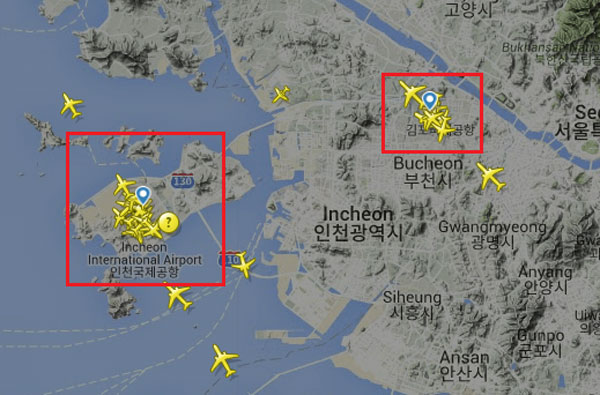
[Photo by NEWSIS] 1. When the 수능 approaches, bakeries and convenience stores across the country sell chocolate and 엿 (yeot, traditional candy) sets for test-takers. 3. Special "수능 mechanical pencils(Korean link)" are distributed to examinees, and some people collect them. Every year, people are eagerly waiting for news on which company produces the pencils for that specific 수능. 4. There are also many cases where police cars drive test takers who are running late for the exam. 5. During the listening portion of the 수능, airplanes wait to take off and land to prevent excess noise.
[Photo by Flightrader24]
SKY-high Aspirations How a Drama Depicts Real Life Struggles of Test-takers
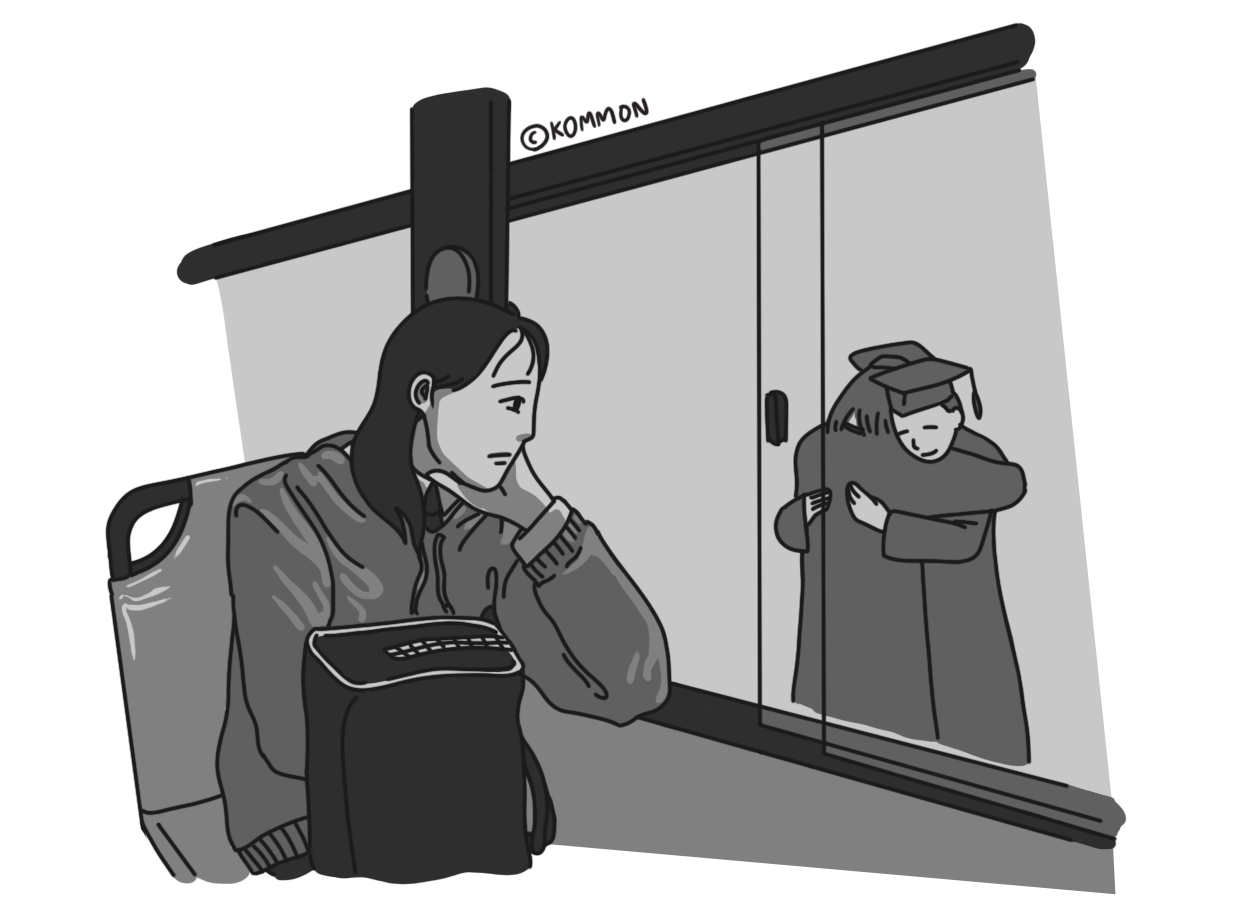
[Illustration by O.T.O] Have you ever heard of the drama <SKY Castle>? The drama depicts how obsessed Koreans are with the college admissions tests. "SKY" here refers to the top three universities in Korea (Seoul National University, Korea University, Yonsei University). This drama shows Korea's privileged class living in a luxurious house called "SKY Castle" that organizes their children's admission to college. The drama was very popular among Koreans for its realistic descriptions of Koreans' fixation on college admission. Scene #1
This is the "SKY Castle" residence of the drama’s characters. Students in this mansion are attending elite high schools. 👉"Gangnam School District 8" and "Daechi-dong" The "SKY Castle" reflects Korea's Gangnam School District 8, which is located in Seoul's Gangnam-gu and Seocho-gu areas. It contains elite high schools that produce many prestigious university attendees. Many Koreans long to live in Gangnam School District 8 to enable their children a better chance to enter elite universities, which makes the region's average housing price go sky-high. Daechi-dong, the core region of Gangnam School District 8 is famous for its night-illuminating hagwons. Daechi-dong's nightscape is always crowded with students studying late and their parents taking these students to and from their homes. Scene #2
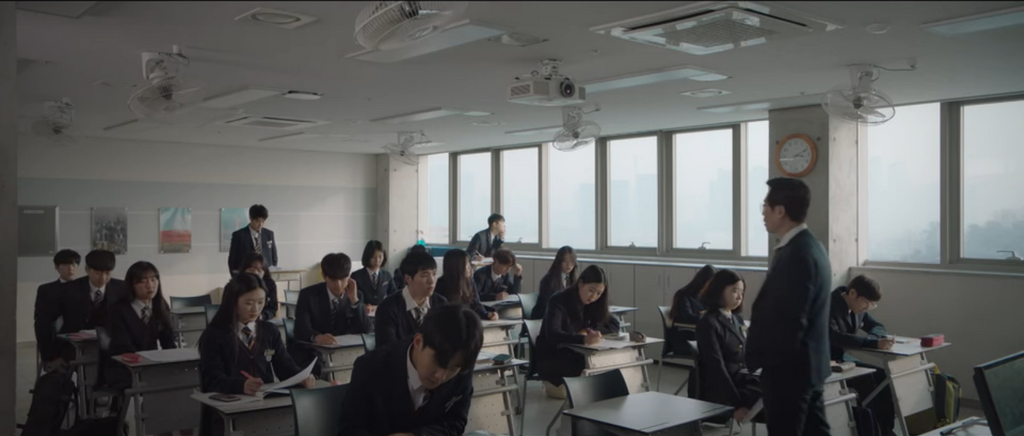
The teacher nags high school seniors: "You must go to the universities." 👉 7 out of 10 Korean high school students enter university Most Korean high school students aim for college admissions. The population with tertiary educations in the 25-34-year-old range in Korea is 69.8%, which is the highest rate among the OECD countries. Scene #3
<SKY Castle> depicts high school students' extracurricular activities which are aimed at meeting the qualification requirements of high-ranking universities. 👉 Qualification competition for college admissions The "General Evaluation of Student Record" is a typical type of rolling admissions. It evaluates extracurricular achievements. Therefore, high school students need to get more qualifications and achievements to enter better universities. However, as qualification competition gets heated, some have turned out to forge false accomplishments on their records. Recently, some hagwons(Korean link) were accused of vicariously writing book reports and essays for college applications. Scene #4
One of the families in <SKY Castle> met with a college entrance advisor. The adviser requested a high cost, but the family was willing to pay it if the advice could lead their children to elite schools' admission. 👉 Head toward private education Many Koreans consider it necessary to take some private education to enter high-class universities. They think public education is not enough to get the high scores required by elite universities. So Korean parents are willing to pay more education expenses, even if they cannot really afford it. According to 2019 statistics(Korean link), the total amount of money spent on private education expenses for elementary, middle, and high school students was ₩21 trillion. The number of students declined by 2.4% than last year but the private education expenses increased by 7.8%. Scene #5
The parents in the drama made their son solve a math problem. 👉 수능: an event for the whole family? It is quite normal in Korea that every family member supports high school senior family members who are studying for the exam. For example, parents of high school seniors use their spare time to drive their children to hagwons. They even hold off on raising the TV volume when their children are studying. The ritual ceremony of praying for a student's success in the entrance exam also prevails in Korea, such as praying 100 days before the 수능. Why Are So Many Koreans Obsessed with College Admission? Many people describe Korea as an "학벌 사회 (academic-centered society)". This means that Koreans' socio-economic status depends on their education level. Contempt for the low-educated is quite severe. That's why most of today's Korean high school students are studying practically nonstop to get a high level of education. 1. Historical background of Korea's academic-centered society Korea has a long history of being an academic-centered society wherein education is used as a means for a better social status. ✔ Goryeo dynasty: Korea's middle age dynasty, the Goryeo, adopted China's "과거제도", the National Civil Service Examinations. These allowed most people to be appointed to a public post if they passed the exam. In fact, there had been a lot of people who passed the exam even though they were not of high social class. ✔ Late modern times: While the 과거제도 was abolished in 1894, the belief in academic performance-fueled social mobility remained. During the Japanese colonial era, Japan had Korea adopt its National Civil Service Examinations, which similar to the 과거제도. This iteration of the National Civil Service Examination led to Korea's *공채 [Gong-chae] (open selection system) and the 수능. 🌸 Vocabulary (From our past issue: Click) * 공채 [Gong-chae] (공개경쟁채용, open competitive employment) A system that selects manpower by conducting a competition test for an unspecified number of people. It usually refers to a method that the government or companies employ on a large scale in the first and second half of the year. Unlike occasional recruitment, applicants are called in at once and selected through several procedures. Since Samsung first selected college graduates in 1957, major Korean companies have hired new employees in this way. Even though Samsung now holds large-scale applicant assessments, employees are still hired through the same process: documents → job aptitude test called "GSAT" → interview → final pass. Many students put a lot of effort into the Samsung GSAT test. However, since skepticism about this system has been emerging lately, the number of companies that switch to occasional hirings, such as LG, is increasing. ✔ After the Korean War, the university became a means of success. At the time, Korea was in a situation where most citizens were desperately poor. So the appeal of fairness in college admissions was appealing to many people. Many poor students entered elite universities and became quite successful. ✔ Introduction of national exam: Before 1980, each university screened applicants based on their own exam. Therefore, it was hard to rank each university using a universal metric. But the Korean government abolished individual university exams after 1980. All Korean universities started to screen their applicants based on national exam scores. This led to the intense university ranking system and academic elitism that exists today. 2. Differential in socio-economic status based on academic background ✔ High school graduates vs. University graduates In Korea, the differential between those who have received tertiary education and those who have not is greater than in many other societies. The wage gap(Korean link) between college graduates and high school graduates in Korea amounts to 160% (142% in Canada and 117% in New Zealand).
✔ Prestigious universities vs. Other universities 👉 Easier to get a job Generally speaking, it is much easier for people to get a job if they have graduated from a prestigious college. The government has been taken actions to address this form of discrimination with a policy known as "blind recruitment" in public institutions and enterprises. In "blind recruitment", applicants cannot write which college they graduated from. However, some private companies still prefer to hire students from prestigious universities.
In one notable example, Hana Bank manipulated(Korean link) the result of the job interview to hire students from elite colleges. 👉 Becoming "elite" It is much easier for Koreans to move up in society if they graduate from prestigious universities. 37% of the National Assembly members from the 21st general election (the latest election in 2020 April) graduated from SKY schools. 50~70% of high-ranking officials of the Moon administration and the judiciary were also SKY graduates. 💬 6 out of 10 prosecutors appointed during last 10 years were from SKY. (Link) 💬 37% of the National Assembly members graduated from SKY. (Link) 👉 Social Stigma Students from non-privileged colleges are not just discriminated against in the job market, but also are stigmatized in society, as well. The term "지잡대" shows this clearly: "지잡대", an abbreviation of "지방 잡 대학", means "insignificant college in a rural area", is often used. Some make fun(Korean link) of students from those colleges and believe "they deserve to be treated in such a way." Fierce Competition Has Not Been Easy for Many Korean Students Mental illness For Korean high school students, the college entrance exam creates much more stress compared to other tests. As many Korean students start studying for the 수능 at 12 years of age, students often think that the 수능 score is all that matters in their life. A large number of students attempt suicide because of the pressure and stress of the 수능. According to a survey(Korean link), 75% of Korean adolescents claimed they were suffering from academic stress. As of 2017, 404 high school students committed suicide due to academic stress. Suicide ranks as the top cause of death among Korean adolescents. No room to think about their career There is a phenomenon called "대2병"(Korean link), which means students in their second year of college begin to be concerned about their career prospects. Students do not have enough opportunity to explore what they want to do during the high school period and just study blindly. This leads to a lot of anxiety and self-doubt among many college students. No retirement plan As mentioned above, the amount of money spent on private education is enormous. A child costs at least ₩90 million to ₩300 million before graduating college. Under these circumstances, parents invest most of their assets in their children's education expenses and therefore fail to prepare for their retirement. This, in turn, leads them to focus and count even more on their children's academic success. Is the 수능 Really a Level Playing Field? Compared to 수시, where grades and extracurricular activities also matter, 정시, which is based on only a good score on the 수능, is considered to be fair, as everyone takes the same test and can be evaluated under the same criteria. If you study hard, you will get a good score, so there is no problem, people argue.
This might be true to some extent, but some claim that the 수능 is also not fair. In order to get a good score on the 수능, you need support from your parents: hagwon classes, tutoring. This is much easier when you live in one of Seoul's richest areas, such as the Gangnam School District 8 and Daechi-dong. One out of four students(Korean link) who entered Seoul National University during 2016~2018 was from the Seoul Gangnam area, where rich kids live and go to hagwons together. Furthermore, it requires a lot of money to retake the 수능. "재수" means taking the 수능 again, and there are many 재수 hagwons where students enroll to retake the 수능 and get a better score. Students need to pay at least 1 million won per month to get accepted and even more if they live in the school dormitory. However, students and parents still rely on this kind of hagwons, since their success rate at sending students to SKY universities is very high.
Today's Vocabulary "SKY" Meaning: An acronym for Seoul National University (S), Korea University (K), and Yonsei University (Y). These three are considered the most prestigious universities in Korea. Usage: "너가 가장 가고싶은 대학이 어디야?" "나는 SKY를 목표로 공부하고 있어." "What universities would you most want to attend?" "I want to attend a SKY school." "N수생 [N-su-saeng]" Meaning: This term combines "N (Number)" and "test taker," meaning "someone who took the same test N times". N-takers have experience-based know-how. N-takers does not only refer to the 수능 but also to various other national examinations, such as the civil service exam. Usage: "N수생들 때문에 수능 등급컷이 자꾸 올라가." "이러다 나도 올해 대학 다 떨어지고 재수생 되겠네. 흑." "Because of the N-takers, the 수능 average grade keeps going up." "At this rate, I'm going to fail all the 수능 and I'll have to retake it next year" Wanna know more? Drama <학교 2013> (KBS, 2013) This is a drama that realistically depicts the real lives of Korean high school students who are tired of entrance exams and teachers. Don't you want to see an epic production with a touching ending, skewering the problems of current education? Get in here! 👉 왓챠 Documentary on 수능 (Asian Boss, 2019)
Let's call it a day! We changed our layout a bit; we provided vocabulary and content recommendation this week. How was it? KOMMON TEAM 수수🌾 Sans🌻 바코🌊 오티오😈 쟈🍉 군밤🌰 기린🌴 쏘😺 기니👑 프레드
|