#Culture #KoreanAge #AgeHierarchyInKorea #존댓말반말 For dark mode users,
Hello, reader, this week we are covering: Index Trending News "How Old Are You, Again?" Zoom In The Origins of the Korean Age Hierarchy Today's Vocabulary Minjeung-geomsa (민증검사) This Week's Recommendations Drama My Lovely Sam Soon (내 이름은 김삼순) Don't forget to leave your feedback below!
"How Old Are You, Again?"
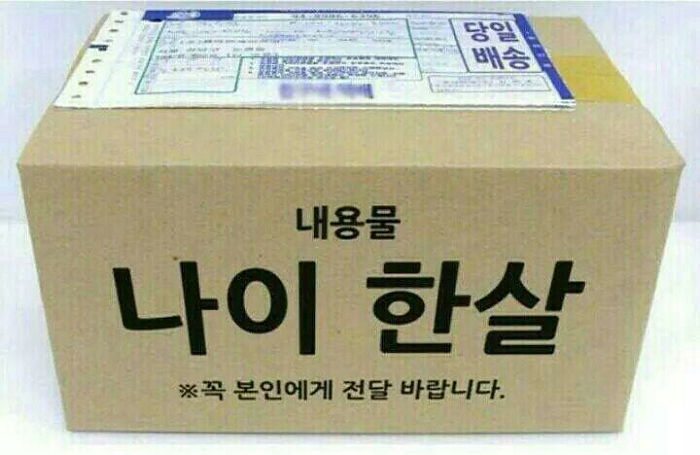
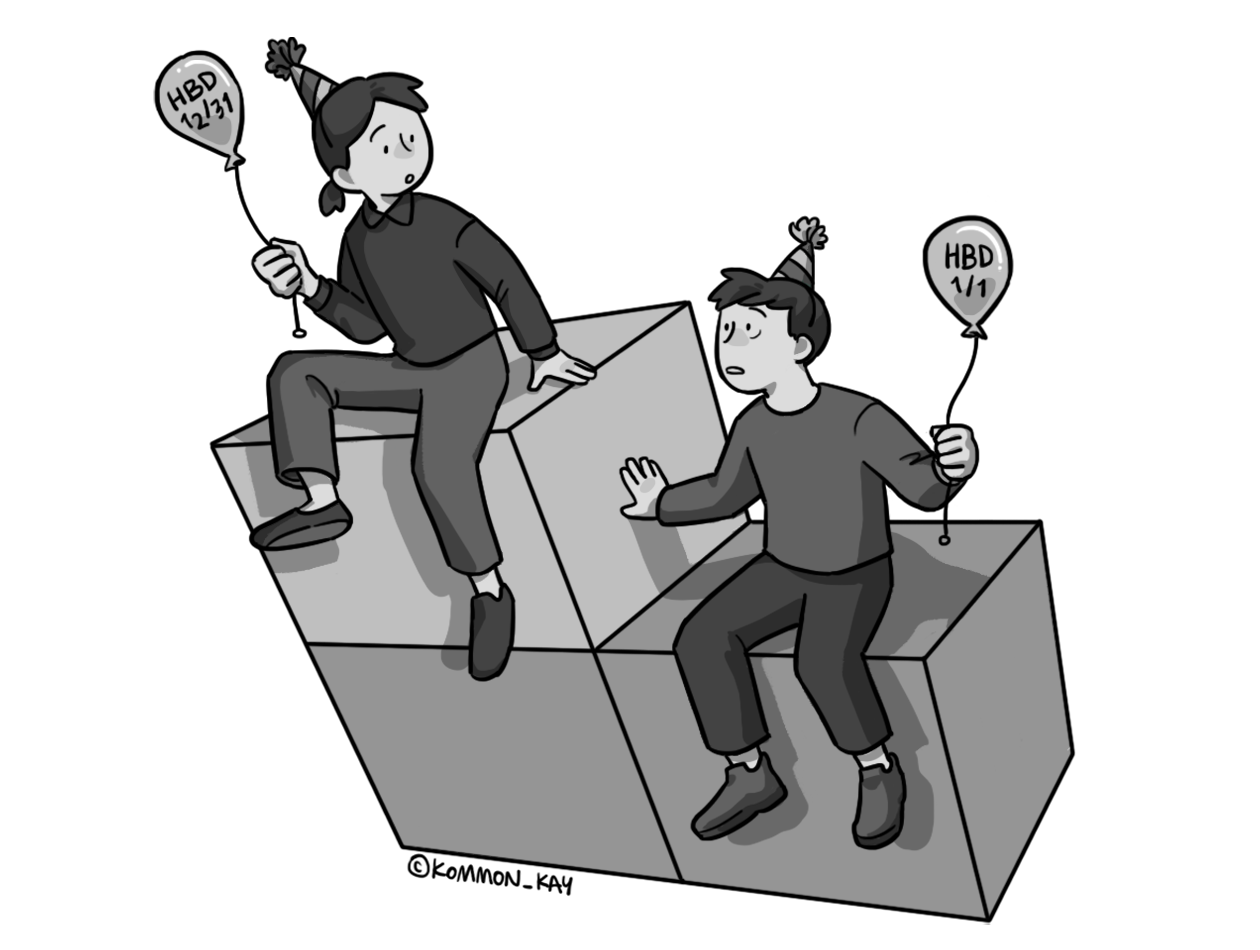
content: "AGE" *please deliver the parcel directly to the recipient* The clock strikes twelve and 2021 officially begins. Alyssa receives a text message from her Korean friend. It reads: "I don't wanna get a year older 🤢." Alyssa is dumbfounded. Is her friend's birthday on January 1st? Alyssa quickly learns that Koreans count age differently: people don't become a year older on their birthday; they do on January 1st. According to the Korean age system, Alyssa, born in December 1994, has just turned 28. In her home country, she is still 26. Perplexed, Alyssia thinks about the significance of age in Korea. She remembers that "how old are you?" is one of the first questions people ask. In Korea, people decide between using honorifics or a casual way of speaking depending on the age of the person they are talking to. Alyssa does not want to make mistakes when she talks in Korean. She wants to learn more about the Korean age system, and how she should behave around people who are not the same age as her. How to Count Your Age the Korean Way According to the Korean age system, called the "Counting Age System" (Saeneunnai, 세는 나이), newborns are one year old at birth. Moreover, everyone gets one year older on New Year's Day. Interestingly, if a person is born on New Year's Eve, they can turn into a two-year-old within 24 hours after birth according to the Korean age system. For example, let's say that a baby boy is born on December 31st, 2020. He is one year old at that point. Soon, the clock hits twelve and the year 2021 begins. He is then suddenly two years old, even though he hasn't even been alive for a full 24 hours yet. In other words, the Korean age system does not consider the month or the day of your birth. What it does take into account is your birth year. Those who are born in the same year all become a year older on New Year's Day. It doesn't matter if one person was born on January 1st while another was born on December 31st. They all become one year older -- together. There is another age system that is widely used in Korea as well, called Mannai (만 나이). This way of counting is commonly used for legal or official purposes. The Mannai counts people's age based on their birthday, as many other countries outside of Korea do. Let's talk about that baby boy born on December 31st, 2020 again. When the year 2021 begins, the boy suddenly becomes a two-year-old in Korean age. However, his Mannai will still be zero. Age Hierarchy in Korea Korean age, determined by one's birth year, can define how people interact with others in society. People born in the same year are on the same hierarchical level and can become chingu (친구), which means friends. They can talk in a casual way to each other in Korean and use friendlier second-person pronouns, such as neo (너). When you meet a Korean for the first time, he or she might ask what nyeonsaeng (년생) you are. This is to determine your hierarchical level according to your birth year. Nyeonsaeng, which means "birth year" in Chinese characters, is a suffix put at the end of one's birth year. When you use the suffix nyeonsaeng, you mention only the last two digits of the birth year. Rest assured, it is not that difficult to understand this with some examples. Alyssa from the story at the top of this letter was born in 1994. She is therefore on the hierarchical level of the birth year 1994 and can tell others that she is gu-sa-nyeonsaeng (94 nyeonsaeng). A person who is born in 2001 is gong-il-nyeonsaeng (01 nyeonsaeng) and a person born in 2010 is il-gong-nyeonsaeng (10 nyeonsaeng). The levels of age hierarchy also define how one should behave towards others. Even a year difference in birth year can be considered huge in Korea. For example, a person born in December 2001 is on a higher hierarchical level than a person born in January 2002. A gong-il-nyeonsaeng (01 nyeonsaeng) is considered a senior to a gong-ee-nyeonsaeng (02 nyeonsaeng). Their birthdays may be different by just a few days, but that's the custom. This is why many Koreans ask others for their nyeonsaeng, quite up-front and directly, the first time they meet. Koreans ask such questions in all types of social groups and at all kinds of gatherings: university orientations, work meetings, and even friendly hangouts. Different Age, Different Use of Language Korean has two different levels of politeness: jondaemal (존댓말, honorific) and banmal (반말, casual). When to use what depends on one's age and social status. A person who is on a lower hierarchical age level is expected to use jondaemal when addressing his seniors to show respect. People also talk in jondaemal to their parents and seniors at universities or workplaces. It is also considered polite to use jondaemal to a stranger or a person that you meet for the first time. Banmal, on the other hand, is a casual way of speaking and commonly used between close friends and people on the same level of age hierarchy. Inappropriate use of banmal can lead to conflicts. In June 2020, a man in his 50s hit (Korean link) a convenience store clerk with a liquor bottle. His motive, you ask? The man felt offended by the clerk talking in banmal. Jondaemal and banmal also allow for some tweaks. Jondaemal can be used sarcastically to suggest that someone is acting superior. Mixing the use of jondaemal and banmal in a sentence can also create double meanings. For instance, 오늘 걔 왜 일 안나왔대? Why isn't he here at work today? 아이고 걔 또 편찮으시댄다. Oh, Mr. is not well. Subverting Age Hierarchy Not everyone is happy with the strict age hierarchy in Korean culture. In fact, younger generations tend to be against this hierarchy, a cultural norm that indicates less respect towards those who are younger. Some companies, such as Kakao Corp. and Naver, decided to mask their employees' ages in the office to create a more equal and fairer work culture.
The Origins of the Korean Age Hierarchy
[Illustration by 케이] Where does the age hierarchy in Korea come from? There must be a variety of contributing factors, but many suggest it stems from the gisuje-munhwa (기수제문화) and jondaemal. Legacy of Confucianism? Contrary to popular belief, Korea's age hierarchy cannot be attributed to Confucianism. In the Joseon dynasty, when the country was dictated by Confucian values, people were still able to befriend those a few years older than them. For example, Oh-sung and Han-eum, fictional characters from famous folktales of the Joseon dynasty, were described as close friends even though there was a five-year age gap between them. Then what's up with Korea's age hierarchy? The Gisujemunhwa Under Japanese colonial rule, the gisuje-munhwa was introduced to Korea. The gisuje-munhwa refers to a culture where individuals who enter an organization earlier are considered and treated like seniors, which used to be the case in the Japanese military and the college class system. This culture has been deeply ingrained in Korea since then. Koreans started to think that older people who entered the military or a university earlier automatically have a higher social status than those who entered later. The Japanese gisuje-munwha later became part of Korean culture. It transformed into a culture where those who enter a company, school, or any other institution earlier are given privileges based on seniority. Later entrants, or juniors, are supposed to act submissive and show respect to their seniors, while seniors are expected to look after their juniors. As Korean society became more modernized over time, fewer and fewer institutions adopted the gisuje-munwha. It is, however, not entirely gone. There are many organizations, including the military, that still follow the gisuje-munwha hierarchy system. Jondaemal and Korean Age System Korea's age system originates from China. In fact, many other East Asian countries that once were under China's influence also adopted the Chinese age system. During "modernization" efforts, these countries ultimately adopted the age system that Western powers have been using. Until the 1960s, it was not as widespread for Koreans to use jondaemal to their seniors all the time. This changed in 1968, when the government made all people register as residents. Before the resident registration system, people's real ages did not necessarily match with their ages on official documents, because some people registered their birth late. Now that everyone's age was registered properly, Koreans became certain of the age of others, which made the age hierarchy more prevalent. One of the reasons that Korea has yet to adopt the international age system is because its use of jondaemal is so closely linked to age. Juniors are supposed to use honorifics when they talk to seniors, whereas seniors are not required to use honorifics when they talk to juniors. If Korea were to adopt the international age system, some people worry this could potentially create confusion because people would not be so sure anymore whom to address in banmal and whom in jeondaemal. According to a 2016 survey (Korean link), roughly 50% of Korea's population supports adopting the international age system. There have been several attempts, such as revision bills (Korean link), to adopt the international age system but all have failed so far.
Today's Vocabulary Minjeung-geomsa (민증 검사) Minjeung (민증), short for jumin-deunglogjeung (주민등록증), is a national identification card issued to Korean citizens. It contains a person's age, photo, and other personal information. Minjeung-geomsa refers to "national ID checks". Convenience stores, restaurants, and many other businesses check people's national IDs to identify minors. People under 19 are not allowed to buy cigarettes or alcohol in Korea. Businesses that sell illegal substances to minors are also fined. In Korean age, people are allowed to buy cigarettes and alcohol when they turn 20. Most Koreans enter university when they turn 20, and therefore often celebrate their start of college life by drinking. As we discussed above, however, this age cutoff is not as precise as the internal age registered on one's ID, which can lead to some confusion. Usage: A: 너는 왜 빠지는거야? 같이 놀러 가자! B: 미안 나 빠른 년생이라서… 거기 술집 민증검사 한대. A: Why aren't you not joining us? You should totally come down! B: Sorry, I can't, I entered school early*. That bar checks ID. * Note: In Korea, people who are born in the first two months of the year used to be allowed to enter school a year earlier than others. For example, a person born in January 1996 could enter the school in the same year as people born in 1995. However, the government repealed this custom in 2008 to prevent confusion at schools. This Week's Recommendations Drama My Lovely Sam Soon (내 이름은 김삼순) (MBC, 2006) 👉Watcha This is a drama series based on the love life of Kim Sam-soon. Kim is a 30-year-old unmarried woman. The show depicts the pressure she faces to tie the knot with someone and the numerous blind dates she has to go on. Her love story with Hyun Jin-heon was especially popular among the female audience. The plot is full of clichés but you will definitely fall in love with Kim once you start watching. The show was aired 10 years ago, but it's still worth watching today!
tell us what we should cover next :) KOMMON TEAM 수수🌾 Sans🌻 바코🌊 오티오😈 쟈🍉 기린🌴 쏘🐥 기니👑 프레드🍰 부엉🦉 타코🌮 Sunny🌞 호야🐻 가가🍒 케이☕
|