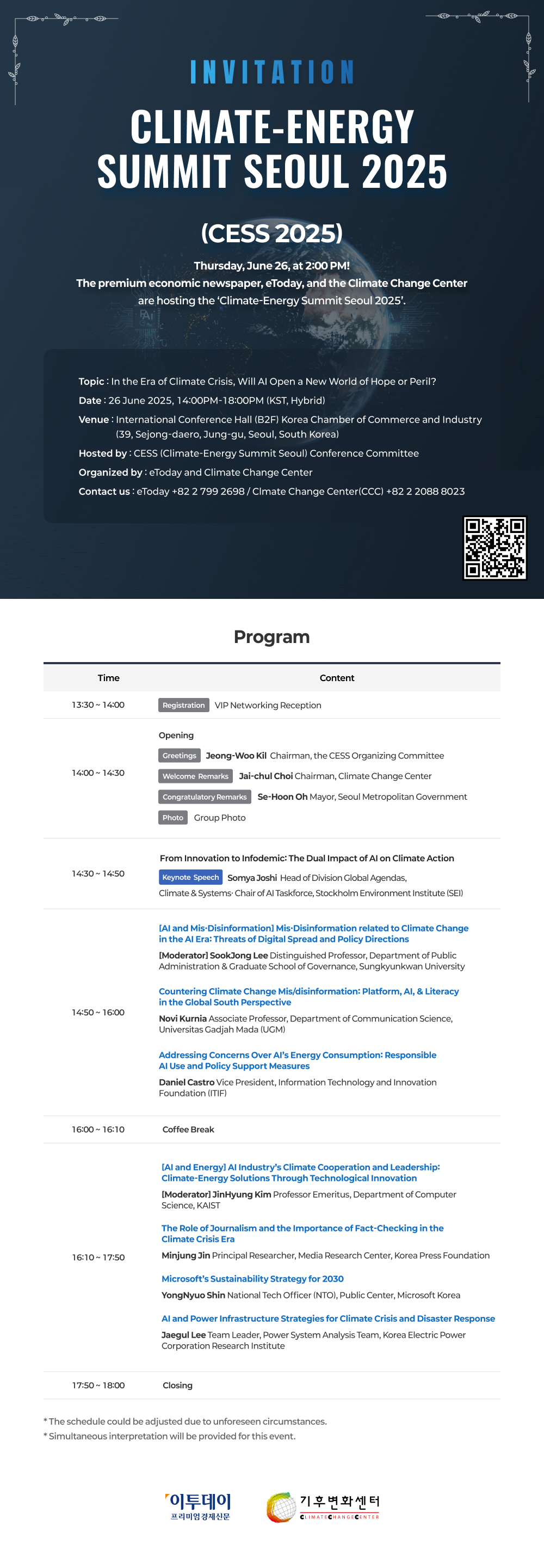
On June 26, the Climate-Energy Summit Seoul (CESS 2025) will bring together global experts in climate and technology. Jointly hosted by the Climate Change Center and EToday, this year’s conference will explore the theme : 🤖“ In the Era of Climate Crisis, Will AI Open a New World of Hope or Peril? "
💡As the world enters a decisive phase in implementing the Paris Agreement and formulating 2035 Nationally Determined Contributions (NDCs), the rapid expansion of Artificial Intelligence (AI) is reshaping the climate and energy policy landscape—introducing both new opportunities and complex challenges.
🌟AI is already contributing meaningfully to areas such as climate disaster forecasting, energy optimization, and carbon footprint analysis. Microsoft’s Planetary Computer and Google DeepMind’s data center cooling system exemplify AI’s potential to support climate solutions.
💥However, AI is also an energy-intensive technology. Training and operating large-scale models require thousands of GPUs running non-stop, consuming massive amounts of electricity. For example, training GPT-3 alone consumed about 1,300 MWh, equivalent to the electricity a household might use over several decades.
⚡This level of energy use is not just a corporate issue—it presents a structural burden on national power systems. According to a recent report by Korea Electric Power Corporation (KEPCO), the rapid growth of the AI sector could exacerbate imbalances in energy supply and pose serious threats to grid resilience, especially in the face of climate-related disasters.
💻There’s also the matter of AI-driven misinformation. A 2023 report found that approximately 40% of climate misinformation online originated from AI-generated content. Misleading narratives—like “glacier loss is just part of the natural cycle”—can spread rapidly through algorithms, distorting public understanding and undermining climate policy. AI holds enormous promise, but it must be grounded in sustainable energy systems, transparent algorithms, and accountable governance frameworks to be a true force for good.
At CESS 2025, we will examine both the potential and the perils of emerging technologies and explore what principles and values should guide the intersection of AI and climate response. 👉 You can register in advance via the link below. We look forward to your participation in this vital dialogue for a sustainable future.