📬 Deep Dive Korea Vol. 12 : E-commerce Strategies to Minimize Risk
South Korea is one of the most dynamic and active e-commerce markets in the world. For any brand planning to enter this territory, an e-commerce strategy is naturally the first item on the agenda.
However, when we meet with global partners on the ground, the questions we hear are almost the same: "Can we simply translate our existing global webstore?" or "Can we reach Korean customers through Amazon?"
Unfortunately, the answer to both is "No." Even Amazon, the world's leading platform, has a minimal presence in Korea. Furthermore, global standard websites often fail to meet the unique expectations and user experience (UX) standards of Korean customers.
So, how should a global brand navigate the Korean e-commerce ecosystem? In today's newsletter, we provide a concise guide to practical platform strategies to ensure your brand stays on the right track when entering Korea.
|
|
|
E-commerce Strategies to Minimize Risk in the Korean Market
|
|
|
1. Why Platforms Outshine D2C for Your Initial Entry
When global brands enter Korea, their first instinct is often to launch a Direct-to-Consumer (D2C) webstore. It seems like the simplest path—just translate the existing global site. However, starting with a D2C site in Korea is both risky and inefficient.
The primary reason is that a standalone webstore often fails to meet the high service standards of Korean consumers. In this market, convenience and trust are paramount. Korean shoppers have little patience for complex checkouts or slow deliveries; if the experience feels even slightly cumbersome, they will abandon the site before even considering a purchase. Furthermore, they rely heavily on detailed user reviews and ratings—social proof that a new D2C site struggles to accumulate quickly.
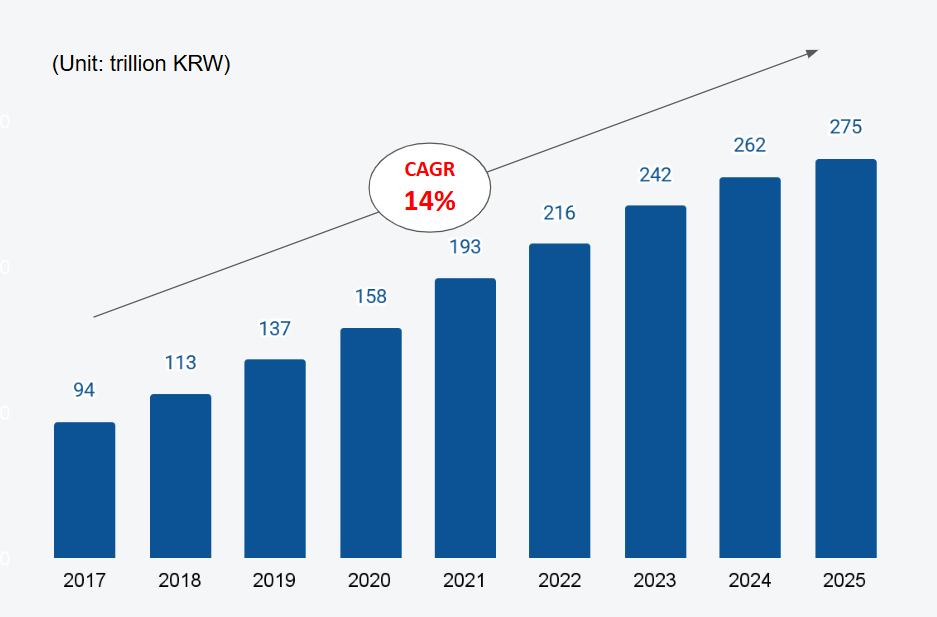
South Korea’s e-commerce market is the fourth largest in the world, valued at approximately KRW 275 trillion (USD 186 billion) annually. Two local giants, Coupang and Naver, control 45% of the total market. These platforms have already perfected the high-speed delivery and seamless payment systems that Korean customers demand. This is precisely why even a global powerhouse like Amazon has failed to gain a foothold here.
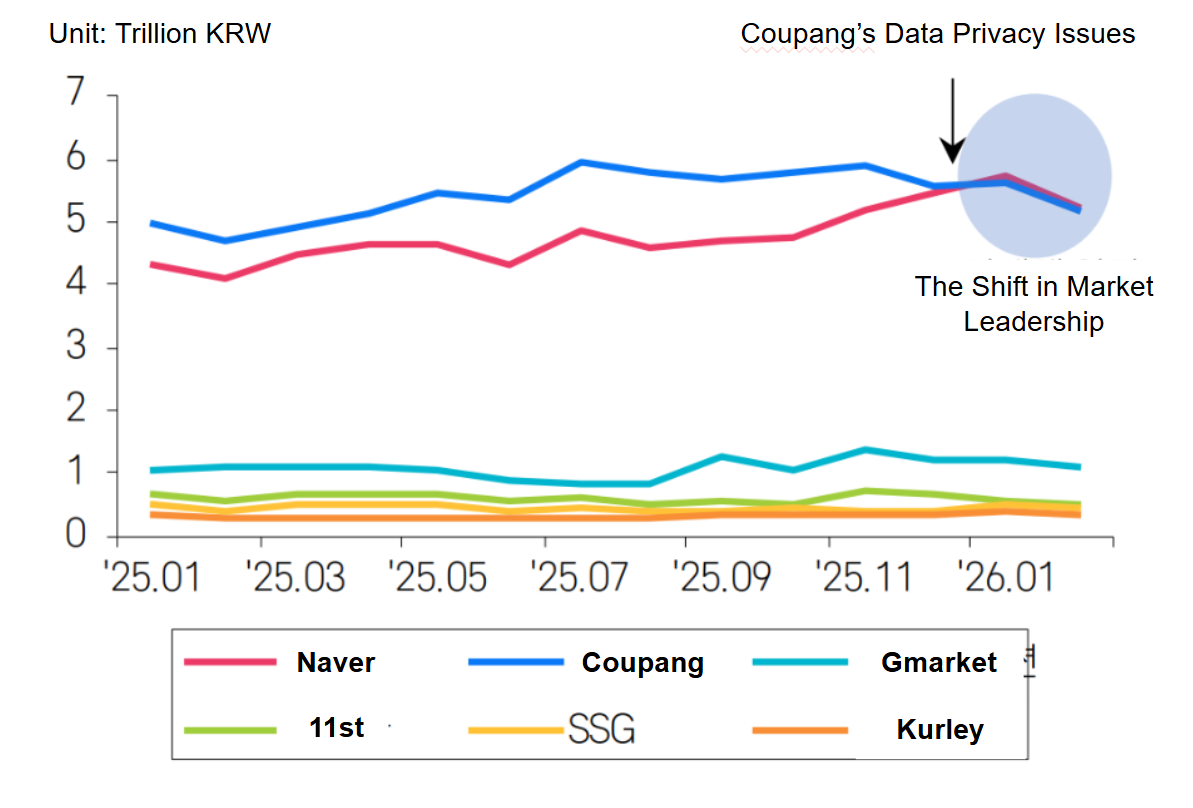
The Korean market has moved beyond mere expansion and entered an era of "qualitative growth." With delivery speeds and search technologies now having matured, platforms are evolving to focus on providing unique customer experiences. Furthermore, the competitive landscape continues to shift; as of February 2026, Naver reclaimed the top spot in market share, overtaking Coupang and signaling a new phase of intense rivalry."
Ultimately, your success in the initial entry phase depends on your platform strategy. To maximize resource efficiency and ensure a rapid launch, you must understand the distinct characteristics of platforms like Coupang and Naver and expand your presence organically, aligned with your brand's growth stage. |
|
|
⬇️ South Korea's E-commerce Market Growth (2017-2025)
Source: Statistics Korea (KOSTAT), Online Shopping Trends Survey |
|
|
⬇️ Monthly GMV Trends of Major E-commerce Platforms (Source: Wise Retail)
|
|
|
2. The Big Three: Understanding Korea's E-commerce Landscape
To help brand managers navigate the market, we have categorized the three main pillars of Korean e-commerce: Coupang, Naver Smart Store, and D2C (Direct-to-Consumer) Webstores.
2.1. Coupang: The "Plug-and-Play" Powerhouse for Immediate Sales
|
|
|
The greatest advantage of Coupang is its ability to generate immediate sales with minimal upfront investment in time or infrastructure. Leveraging its massive logistics network, Coupang offers "Rocket Delivery" and "Rocket Growth." Once you ship your products to their fulfillment centers, Coupang handles the rest: delivery, returns, and customer service (CS).
Coupang customers tend to prioritize sales volume, price, and delivery speed over a brand's long-term heritage, allowing emerging brands to achieve explosive short-term growth based solely on product competitiveness.
However, the downside is that brand control is significantly limited within this ecosystem. Due to the "Item Winner" system—which grants top exposure to the seller with the lowest price—maintaining a consistent price point is notoriously difficult. Furthermore, high commission rates and advertising costs that can reach 20–30% often become a heavy burden.
Most importantly, since the platform monopolizes customer data, direct CRM or retargeting is impossible, creating a structure where sales performance remains highly dependent on continuous discounts and aggressive ad spend. |
|
|
2.2. Naver Smart Store: A "Relationship Hub" for Organic Traffic and Customer Retention
|
|
|
The primary strength of Naver Smart Store lies in its ability to drive organic traffic through portal searches and build a loyal customer base. As South Korea’s dominant search engine, accounting for 65% of domestic search volume, Naver allows brands to funnel search traffic directly to their channels without heavy ad spend—provided the content is compelling.
Naver also provides granular customer data, including inflow paths, keywords, and purchasing patterns by age, which is ideal for executing sophisticated, personalized marketing strategies. Additionally, the low transaction fees (around 5–6%) are a significant advantage for maintaining profitability.
However, this platform requires a continuous investment in internal operations and content creation. Since Naver Smart Store functions more as a "shop-in-shop" concept, the seller must take full responsibility for order management, inventory, shipping, and customer service (CS). Establishing the necessary manpower and systems is essential.
Furthermore, brands must consistently invest energy into content marketing (SEO) through blogs, cafes, and influencers. If content quality falls short, the brand risks being sidelined by search algorithms, and any lapses in customer communication will be directly reflected in public ratings and reviews. |
|
|
2.3. D2C Webstore: An "Online Flagship Store" That Embodies the Brand’s Soul
|
|
|
A D2C webstore is the ultimate space for brand storytelling. Free from the rigid templates of third-party platforms, every element—from fonts and colors to layout—can be tailored to reflect the brand's core philosophy. This immersive environment allows customers to engage with the brand's universe rather than being distracted by mere price comparisons.
Additionally, transaction fees are minimal (approx. 2–3%), and since the brand retains 100% ownership of customer data, it enables highly effective CRM and personalized marketing strategies.
However, the most significant drawback is the high Customer Acquisition Cost (CAC). Because a D2C site lacks the massive native traffic of a major platform, brands must invest heavily in advertising to attract visitors during the initial stages.
Technical implementation is another critical hurdle. Korean consumers have an exceptionally low tolerance for friction during identity verification and payment. Therefore, it is vital to build an optimized infrastructure that eliminates these barriers and to continuously refine the user journey. To win over Korean shoppers, a D2C site must not only look beautiful but also function as seamlessly as the major local platforms. |
|
|
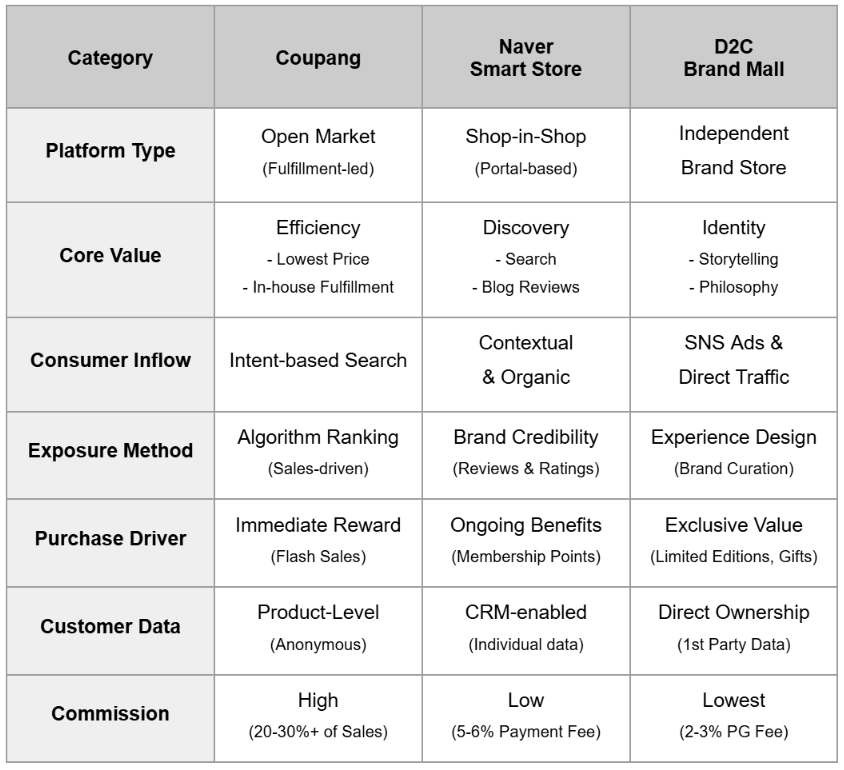
2.4. Comparison of Major E-commerce Channels
The table below summarizes the key characteristics of each platform to help you determine the best fit for your brand's current stage. |
|
|
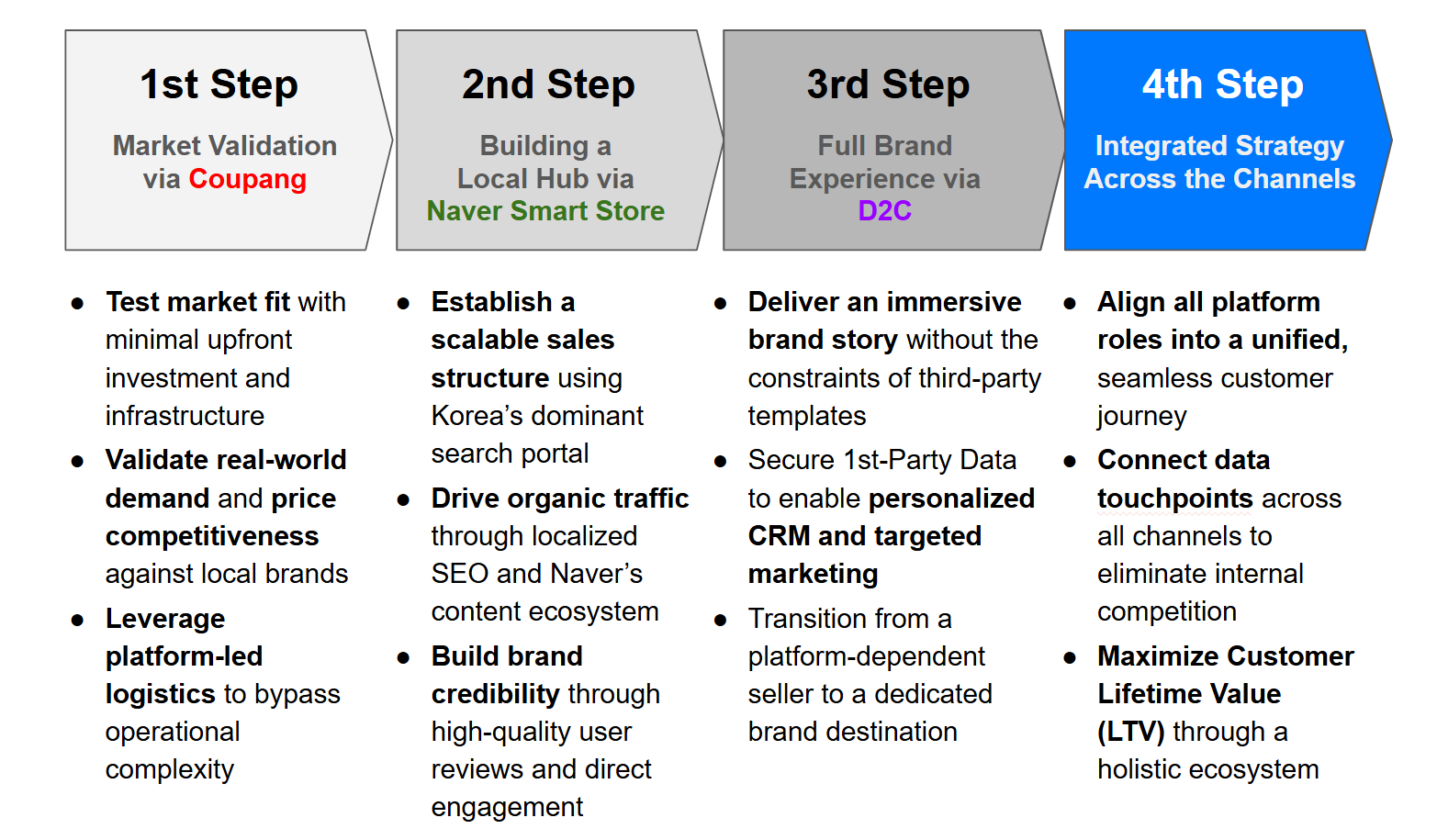
3. E-commerce Roadmap for Entering the Korean Market
To minimize risk and ensure sustainable growth, we recommend a phased approach that defines a clear role for each channel as your brand matures in the Korean market. |
|
|
⬇️ E-commerce Roadmap for global brands |
|
|
[Phase 1] Market Validation via Coupang
Coupang is the fastest and most efficient gateway for international brands entering the Korean market. By leveraging "Rocket Growth" (Fulfillment by Coupang), brands can delegate all logistics and customer service (CS) to the platform. This allows you to immediately test your product’s potential without the need to establish a local legal entity or commit to massive upfront investments. Most importantly, it provides a direct opportunity to gauge your competitive edge—in terms of product quality and pricing—against local brands before scaling up your commitment.
However, remaining in this phase for too long carries the risk of becoming a mere supplier, heavily dependent on the platform's ecosystem. To successfully progress to the next stage, brands should use this period to gather critical data on market trends, customer behavior, and the competitive landscape. The ultimate goal of this phase is to complete a comprehensive review to determine if the Korean market is worth investing in.
|
|
|
[Phase 2] Building an "Online Subsidiary" via Naver Smart Store
Once market fit is validated through Coupang, the focus shifts to establishing a structured presence in Korea. Opening a Naver Smart Store goes beyond simply launching an online shop; it signifies building a localized operational system and opening a real-time communication channel with Korean consumers. From this stage, brands can directly analyze traffic data and begin building a framework to accumulate customers as brand assets. In essence, this is the starting point where simple sales transition into strategic Customer Relationship Management (CRM).
However, due to the nature of search-based platforms, neglecting SEO and content management can limit traffic and lead to growth stagnation. This phase is about evolving into a mainstream brand by accumulating content assets and securing consumer trust, which requires a long-term investment perspective. Once you have cultivated a sufficient "fandom" or loyal following, you can then consider expanding to the next level.
|
|
|
[Phase 3] Delivering a Comprehensive Brand Experience via D2C
As the number of customers who have experienced your products grows, so does the audience seeking a deeper understanding of your brand. At this stage, a D2C (Direct-to-Consumer) webstore should not be viewed merely as another sales channel, but as a space to complete the brand’s philosophy and experience. To achieve this, the site must showcase a rich "Brand Universe"—ranging from the brand’s origin story, the problems it aims to solve, and the founder's vision, to curated lifestyle content, digital magazines, and campaign narratives.
However, without a distinct and compelling content strategy, a D2C site risks falling into "cannibalization," simply competing for the same customers as your existing third-party platforms. Furthermore, attempting to force traffic to a D2C site before establishing a solid fandom can lead to excessive marketing expenditures (CAC). Instead of forcefully diverting customers from existing platforms, the focus should be on building a high-integrity brand universe that naturally draws customers in through curiosity and resonance.
|
|
|
[Phase 4] Integrating Platforms Across the Customer Journey
Once all platforms are established, the focus must shift to designing a seamless organic connection between them based on the customer’s purchase journey. The key is not to maximize the performance of a single channel, but to ensure each platform operates complementarily to create a unified flow.
In the Korean e-commerce ecosystem, the customer journey typically follows the sequence of "Discovery → Trust → Loyalty." You can assign specific roles to the three platforms to match these stages:
-
Discovery: Use Coupang to drive new customer inflow through its massive, high-intent traffic.
-
Trust: Use Naver Smart Store to build credibility through diverse content and direct customer engagement.
-
Loyalty: Use your D2C Brand Mall to foster long-term relationships and brand advocacy.
To make this structure effective, you must design a strategy that minimizes friction between platforms. For example, a customer who first experiences your product on Coupang should be guided to search for your brand on Naver, eventually leading them to your D2C mall through organic content and targeted search strategies. Furthermore, data collected from each channel should be analyzed holistically to understand customer behavior, creating a "virtuous cycle" where insights are funneled back into your marketing strategy.
Ultimately, the core objective is to move beyond managing platforms as isolated sales channels and instead build an "Integrated Commerce Structure" that aligns with the evolution of customer perception and relationship building. This approach provides a foundation for sustainable growth by maximizing Customer Lifetime Value (LTV) alongside short-term sales.
|
|
|
Enjoyed this newsletter?
📬 Subscribe now!
We're be back on May 13, 2026,
with even more insightful stories and exciting updates!
We’d love your feedback!
|
|
|
Want to Share This Newsletter?
Just copy and paste the URL below
|
|
|
EDWORK
hello@edwork.jp | 4F, Tower B, 50, Jong-ro 1-gil, Jongno-gu, Seoul, 03142
|
|
|
|
|