#Cyworld #GenZ #Nostalgia #Korean_Social_Media For dark mode users,
Hello, reader! Today, we are covering: Headlines: A nuclear power plant in North Korea, transgender rights in the military, and more Cultural Insight: “Are you on Cyworld? Let’s be an Ilchon!” Slang: How close are you to your relatives? The “chon” system +) Do you want to support KOMMON?
A letter from the editor-in-chief This Friday is Seollal (설날, New Year's day in lunar calendar), one of the biggest holidays in Korea! KOMMON team is also taking a break for a week, which will take place from February 12th (this Friday) to 17th. And from the week after next, we will be meeting you once a week (Friday). We've published a newsletter twice a week since last October. Although it has been a great joy for us to plow through the schedule, we realized that, against our best wishes, maintaining quality and frequency at the same time is not an easy task. I firmly believe that the newsletter should bring happiness to both its writers and its readers. Rather than making the project a burden to our team members, I have decided that it is time to slow down, find a way for the newsletter to continue. Please understand that I have made this decision to make the newsletter sustainable, to give you quality content as long as we can. Thank you for your understanding and for reading the newsletter every week. You are the reason we are doing this! See you next Friday! :) Best, SUSU, editor in chief.
North Korea Building a nuclear power plant in North Korea? During the 2018 inter-Korean summit, President Moon Jae-in handed North Korean leader Kim Jong-un a USB drive with various ideas for inter-Korean cooperation–including the plans to construct a coal or hydroelectric power plant. After the summit had concluded, the South Korean Ministry of Trade, Industry, and Energy (MOTIE) reviewed a plan to build a nuclear power plant in North Korea. Controversy erupted after an internal document from MOTIE was leaked to the press. Conservatives see building a nuclear power plant for North Korea, which is technically still at war with South Korea, as inherently problematic. These critics have suspected that it was not just MOTIE discussing the possibility, but the Blue House as well. Others have noted that while MOTIE internally has discussed the possibility of a nuclear power plant in North Korea, the Moon administration has been decommissioning nuclear power plants in the South. However, representatives from MOTIE say that the idea was just one concept floated in an internal meeting. The document even states “this document is not an official statement but to examine ideas.” There is no evidence that the Blue House had influence over this conversation. The conservative People Power Party (PPP) has urged a special prosecutor to investigate the case. This is not the first time discussions of building a nuclear power plant in North Korea have arisen; the 1994 Agreed Framework between North Korea and the United States used the construction of a nuclear power plant as a reward for North Korea ending their nuclear weapons program. However, some also argue that a lot has changed between South Korea, United States, and North Korea relations in the subsequent 27 years. Link Human Rights Can’t transgender become a soldier? Byun Hee-soo, an army staff sergeant, was forcefully discharged from Korean Army after undergoing gender confirmation surgery. She has filed a lawsuit to contest the army's decision. Korean Army argued that losing one’s testicle should be considered a “physical disorder” and therefore should no longer be able to serve as a soldier. The National Human Rights Council in Korea (NHRCK), which advises different organizations and individuals in terms of protecting human rights, advised that Byun's was unjust, stating that the result of surgery that allows someone to have a body they feel most comfortable with cannot be considered a disorder. However, the decision made by NHRCK cannot revoke the army's decision. Byun has to wait for the result of litigation. For more than 6 months, the Korean Army has refused to hear her case. Link Pets join the line for COVID-19 testing Pets are no longer considered free from COVID-19. This week, the government announced that pets that show symptoms of COVID-19 will also be tested for the virus. The decision came after one cat in the southern city of Jinju tested positive. It was the first confirmed case involving an animal in Korea. Only dogs and cats are subjected to testing. If they test positive, they will be quarantined or be put into government facilities. Link Culture Spotify launches in South Korea - but without major k-pop players The long-awaited launch of Swedish streaming service Spotify seems to have let down many Korean users, at least at the moment. Spotify, which boasts a significant catalog of records produced outside Korea, does not provide many of the most popular Korean songs and albums. Kakao M, which runs the biggest streaming service in Korea, Melon, monopolizes the streaming rights of music produced by artists such as IU, ZICO, and Lim Yeong-woong. Without Kakao M’s cooperation, Spotify users are unable to listen to songs of major Korean artists. This happened during the launch of Apple Music, as well. When it launched in Korea, Apple failed to make a deal with Kakao M and thus was unable to secure streaming rights to most big Korean artists. Apple Music now controls only 1% of the music streaming market share in Korea. Link Environment The government tries to tackle down air pollution with two new measures
1) Using more hydrogen energy The government is going to build more hydrogen charging stations for cars. You’ll see them in various areas including industrial complex, logistics complex, rest stops on highways, and more. The government is also planning to fund businesses related to hydrogen energy. Link 1 (Korean) 2) Helping people scrap emission-creating cars Many cars emitting a lot of emissions are unable to attach particulate filters due to technical reasons. The government provides ₩3,000,000 worth of funds to retrofit cars with these filters and will double the fund to ₩6,000,000 starting 5th this month. They will also provide additional funds for purchasing low emission cars and electric cars.
These measures are expected to reduce the fine dust in Korea. Link 2 (Korean)
“Are you on Cyworld? Let’s be an ilchon!”
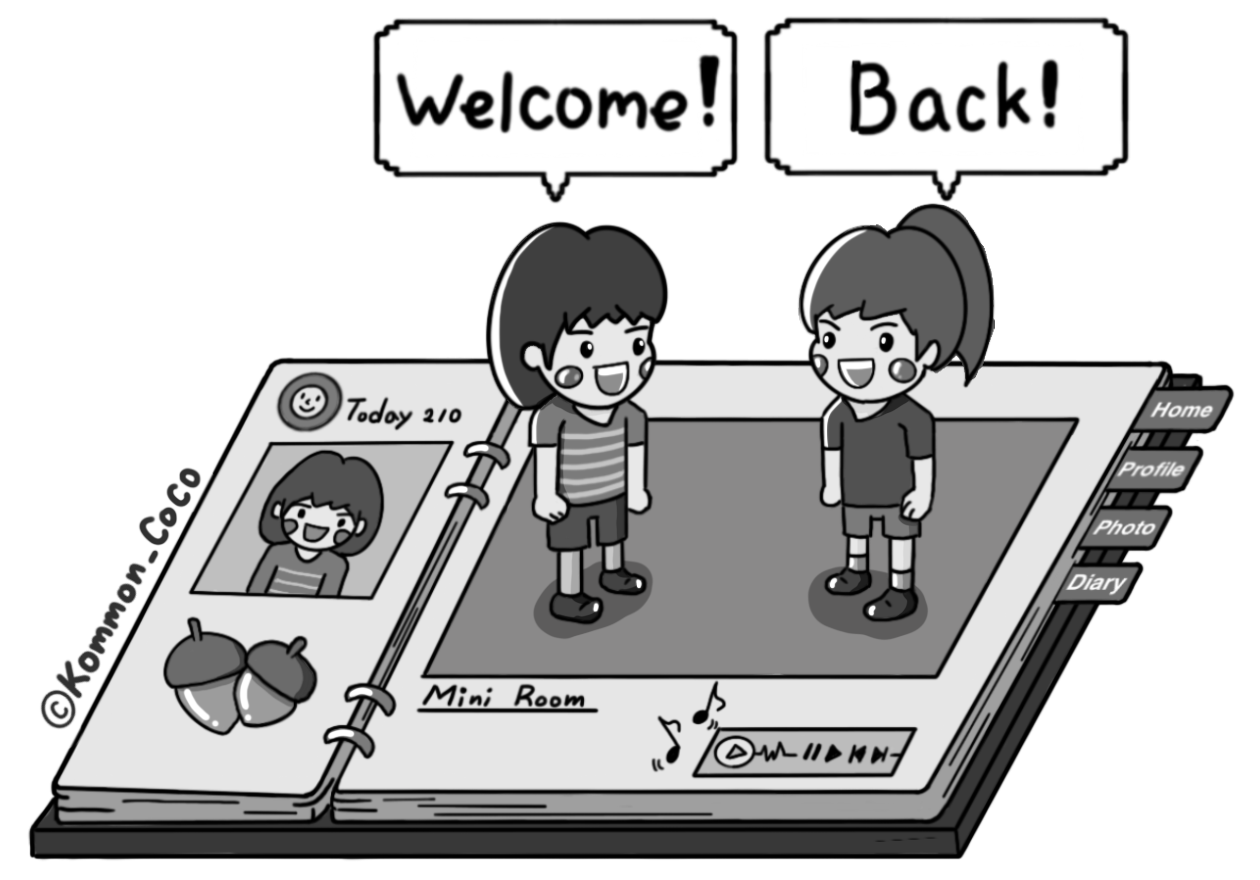
[Illustration by COCO] Revival of Cyworld Last week, Cyworld, one of the first Korea’s social networking services that gained mass popularity in the early 2000s, released its plan to relaunch its service in March after years of absence. It was once the most popular social media in Korea but has been halted due to ₩1 billion worth of overdue payments. Lots of people instantly hailed the news. Some even said that they’re going to leave Facebook and Instagram for Cyworld.
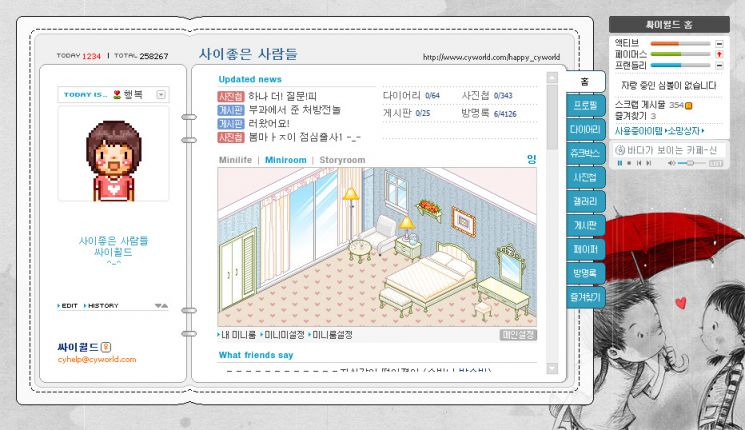
A screenshot of Minihompy. An avatar called Mini-me is on the upper left and a mini-room is in the middle. What is Cyworld? Cyworld, first launched in 1999, obtained its user base in the early 2000s by establishing its service based on Minihompy (미니홈피). Minihompy is short for “mini-homepage.” Every user of Cyworld had their own homepage with a mini-room and an avatar called Mini-me (미니미) in it. People could write diaries and upload images in their minihompy. Users could also personalize their minihompy with purchased page backgrounds, virtual decorations for mini-rooms and background music. The virtual currency used for this was called Dotori (도토리), meaning acorn in Korean. One dotori was worth ₩100. Usually, with 5-6 dotoris, one could purchase a background music for the minihompy. The cost of Minihompy page backgrounds varied from 10 to 30 dotoris, and they would last for various time spans from one week to one year. “Cyworld” is a compound of “cyber” and “world” but also a Korean word sai (사이), which means relationship, and “world”. In short, Cyworld means “relationship world”. As the name indicates, Cyworld’s main function was to transfer offline relationships online. Instead of “friending” someone, like on Facebook or “following” someone on Instagram, regular online interactions began when users became Ilchon (일촌) with one another. Ilchon originally indicates the relationship between a parent and a child. Cyworld allegedly adopted the concept of ilchon in its service to express those online relationships in Cyworld are as close as such. To be an ilchon in Cyworld, knowing the person’s actual name or Cy-address was a must.
Rarely did people meet a completely new person on Cyworld, but one could make new friends by engaging in Ilchon padotagi (일촌 파도타기); “Padotagi” means to surf. With links on ilchon’s minihompy, it was possible to explore others’ minihompies and leave messages on their bulletin boards, even for those who are not ilchon. Yet, explorations were limited for non-ilchons since many users uploaded postings with ilchon-only privacy settings. Rise and Fall of Cyworld The Cyworld boom was certainly enormous in Korea. 32 million people, roughly 60% of the Korean population, were members and the number of ilchon connections was over a billion as of 2009. The popularity even gave birth to a new term, Cyholic (싸이홀릭), which described heavy users of Cyworld. Cyworld was an entirely PC-based service and failed to adapt to the increasingly mobile-riendly world. Unfortunately for Cyworld, more and more people with smartphones wanted to use social media on their mobiles rather than computers. Facebook slowly overtook its glory around 2010. Plus, people were able to write on well-organized blogs of other websites, such as Naver and Daum by then. Blogs were easy to create, widely accessible via search engines and allowed posting high-resolution photos. Instant mobile messengers, such as Kakaotalk, also emerged, enabling prompt communications. It was unnecessary to upload a post on Cyworld or visit someone’s minihompy to say hello. Can’t Let You Go, Cyworld Still, lots of people couldn’t entirely let go of Cyworld. Many users intermittently logged in to the website even after they stopped actively using Cyworld. User complaints flooded Cyworld whenever people were unable to access minihompies. Many simply wished for Cyworld to be there like a permanent safe where unforgettable memories are locked. Cyworld brings back nostalgic feelings to a lot of Koreans since it carries nostalgia from the 2000s. Similar to the emo subculture that was once big in the U.S., an emphasis on emotional expressions were in fashion in the 2000s of Korea. A majority of photos, videos, and background music in Cyworld followed that trend. Confessional, sensitive, and sometimes gloomy stories were often considered worth posting. Have a little peek at Cyworld and the early 2000s in Korea with this playlist: Link Since Cyworld was so popular, it possesses 17 billion photos, 150 million videos and 530 million mp3 files that users have uploaded. Many consider these vast amounts of photos and postings on Cyworld to be cringy and even embarrassing memories but also cherishable at the same time. Millennials are the ones who were largely committed to Cyworld when they were teens. Now in their 20s and 30s, they naturally feel nostalgia for Cyworld and welcome the once-popular-social media coming back on track. Can Cyworld Reclaim its Fame? This time, Cyworld seems to be preparing for a proper return. Its new owner, a consortium of five domestic firms named Cyworld Z, acquired Cyworld and paid off most of the unpaid wages for previous employees. It’s getting ready to launch a mobile service, Cyworld 3.0, in the first half of 2021. However, the road to a glamorous return is rather bumpy. ₩20 billion needs to be repaid to creditors and it is uncertain how many loyal users the platform will be able to secure. According to a survey (Korean link) done by Opensurvey in October 2019, 67.5% of people predicted a negative outlook for Cyworld’s revival despite some service upgrades to be made. With or without negative predictions, only 13.4% responded that they will use Cyworld if it’s back with advanced design and user convenience. Judging from these, most people could use it once or twice out of curiosity, but maybe not repeatedly. Cyworld may not naively count on people’s welcoming words. Currently, Instagram, Facebook, and Naver Band are three dominant social media channels in Korea. In order to be competitive against them, it seems that Cyworld will need to be equipped with something more than nostalgia.
Slang
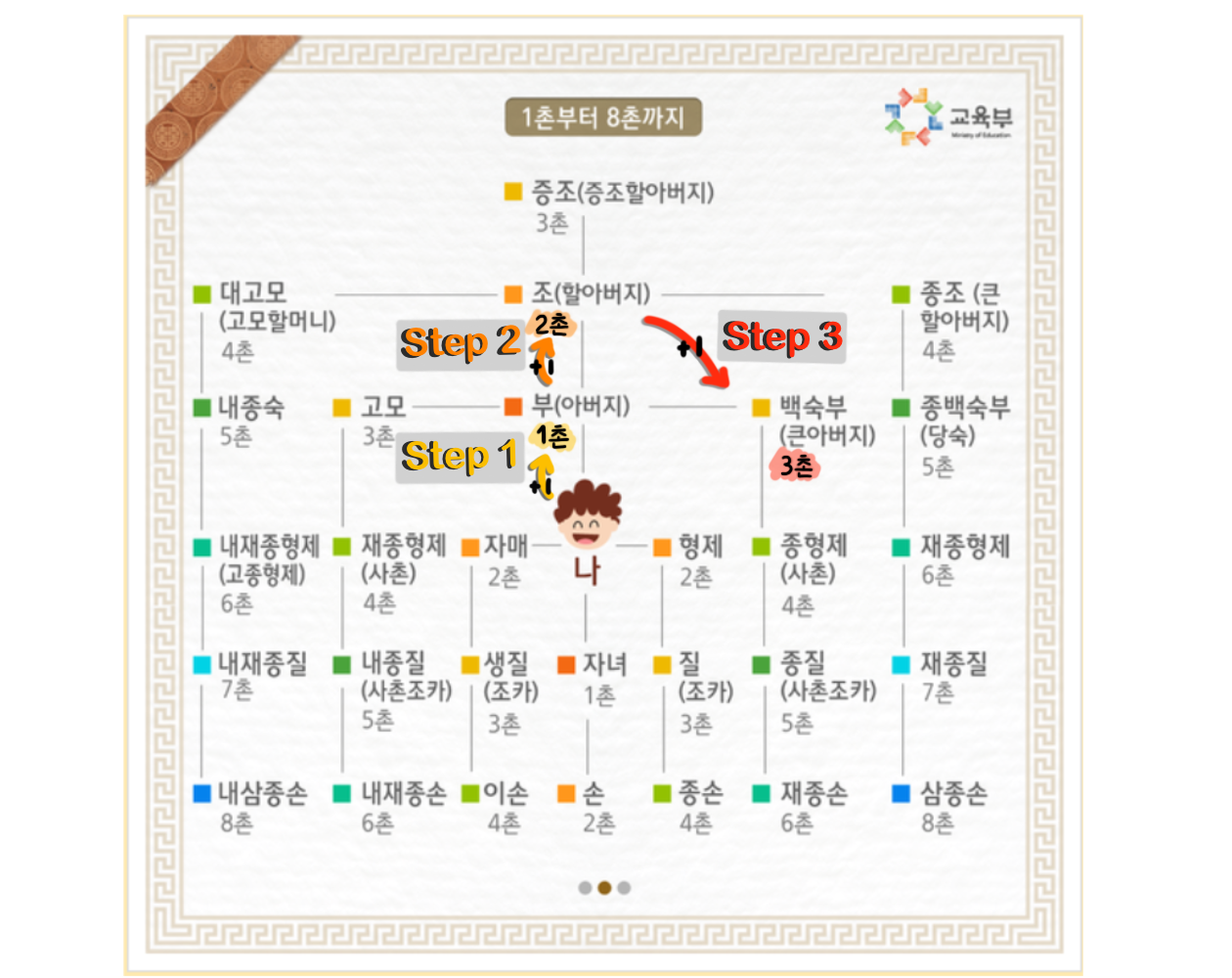
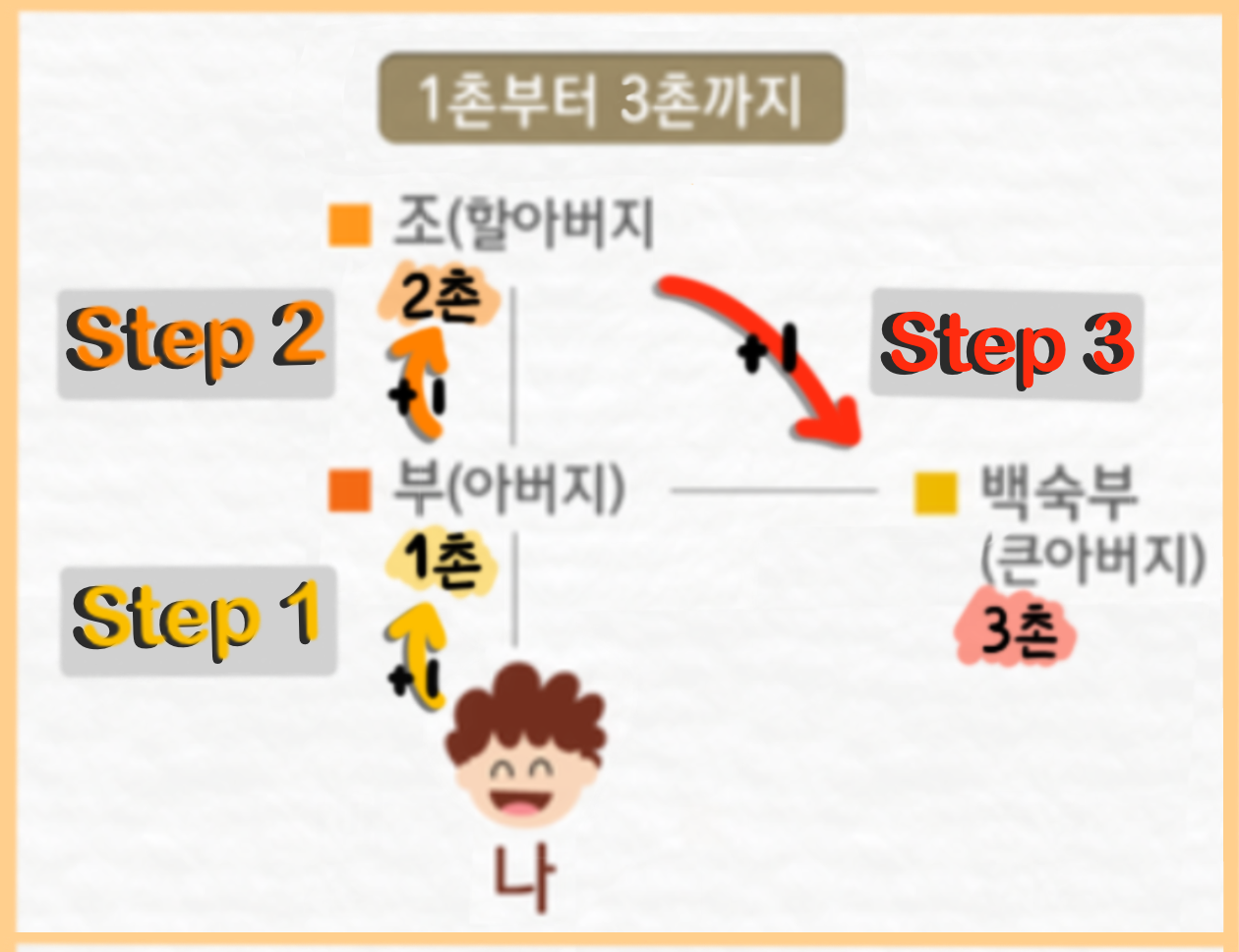
Source: Ministry of Education How close are you to your relatives? The “chon” system Have you heard of samchon (삼촌), meaning uncle, or sachon (사촌), meaning cousin? These words are combinations of Korean pronunciation of the numbers three and four and the word chon (촌); Sam (삼) means three and Sa (사) means four in Korean. What is chon? Chon is a unit of measurement used to count the distance between you and your relative in the family tree. Simply put, you are “counting all the lines between you and your relatives.” (Link). This system is called chonsu (촌수) system, which is the combination of the words “chon” and “su,” which means “number”. The most basic unit of chonsu, which is 1 chon, is that with your parents. So how far are you from your grandparents in the family tree? You add the distance between you and your parents with the distance between your parents and their parents, which will each be one. Hence, you and your grandparents are 2 chon, two degrees apart. Long story short, just add +1 every time you move vertically from you to reach them in a family tree. You can only count the chon up-and-down. For example, you measure up to your uncle by adding the degree between you and your parent, and then adding another degree between your parent and their parent, and then downward, measuring the distance between your grandparents and your uncle. This movement will be up, up, and down, resulting in a three-degree distance.
Similarly, sachon (cousin) is 4 chon since they are children of 3 chon. You have to add one more to reach them in a family tree from you. Ilchon in Cyworld was coined from this chonsu system. [Example] A: 저 사람 너네 삼촌 아니야? B: 아니야. 저 사람은 내 할아버지 형의 자식이라 나랑 5촌 사이야. A: Isn’t he your uncle? B: No, he’s not. He is a child of my grandfather’s brother, thus he is my “5 chon”.
KOMMON TEAM 수수🌾 Sans🌻 바코🌊 오티오😈 쟈🍉 기린🌴 쏘🐥 기니👑 프레드🍰 부엉🦉 타코🌮 Sunny🌞 케이☕ 코코🐦 Gumball🍬 🌸Help us continue our work!🌸
|