For dark mode users,
Hello, readers! Today, we are covering: Index Zoom In Presidential Candidate: Lee Jae-myung, Democratic Party of Korea This Week's Recommendations King Maker (킹메이커, 2022) Don't forget to leave your feedback below!
Presidential Candidate: Lee Jae-myung, Democratic Party of Korea Writer: Yeon Woo Lee, Solwon Pyeon Editor: Aleya Sharif Senior Editor: Regine Armann Editor-in-Chief: Fred McNulty Researcher: Yul Jun
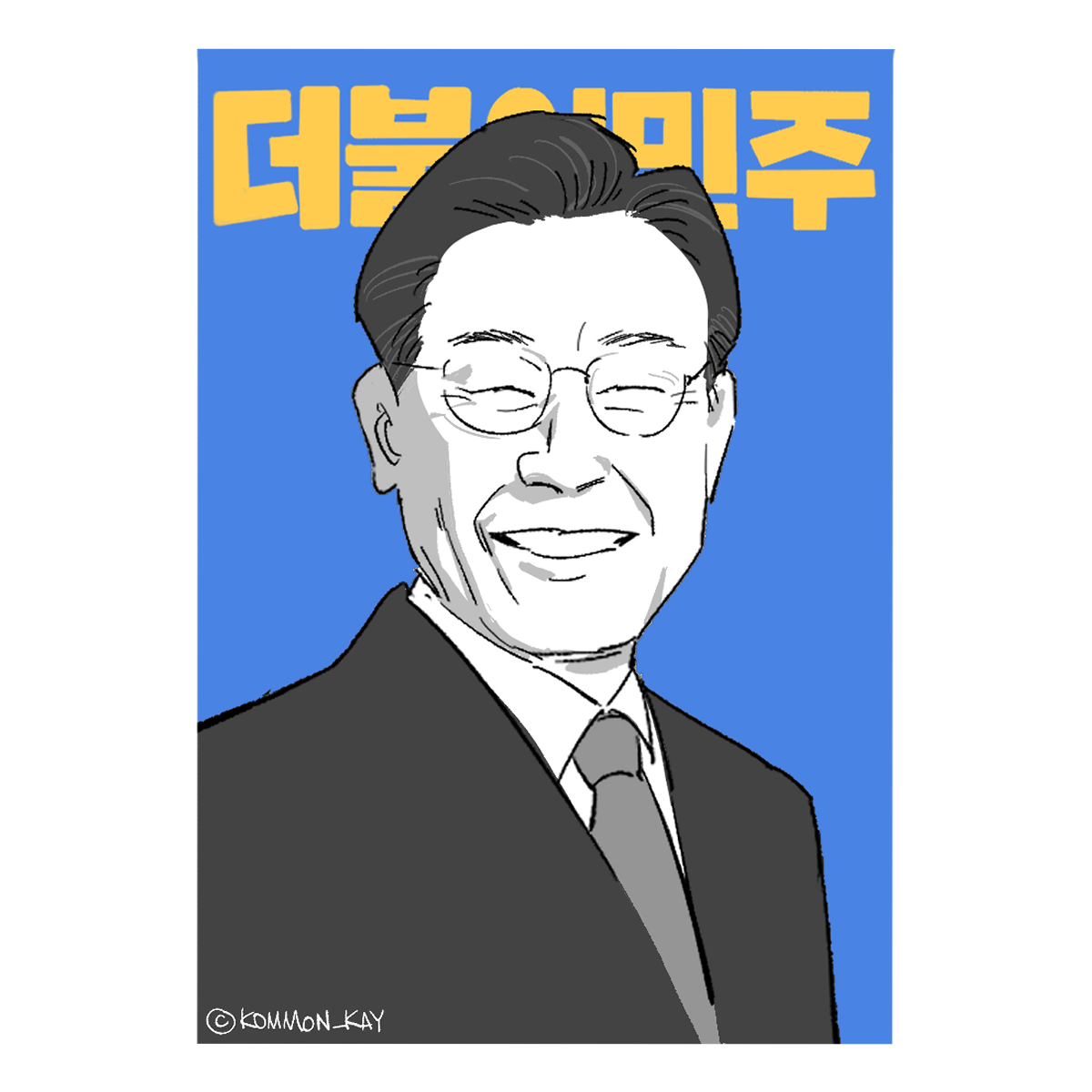
[Illustration by Ah-young Kim] Intro South Korea is currently in the midst of a presidential election. The KOMMON team has prepared a special two-part feature to introduce the two most popular candidates to our readers. Our last issue covered Yoon Seok-yeol (윤석열), the candidate of the conservative People’s Power Party (국민의힘) In this issue, we are covering Lee Jae-myung (이재명), candidate for the center-left Democratic Party of Korea (더불어민주당). We are taking a closer look at their lives before becoming presidential candidates, their backgrounds, as well as their initiatives for their potential presidential terms. South Korean voters living abroad were able to vote from February 23 through 28, and voters in South Korea will cast their ballots on March 9. There is also a brief early voting window on March 4 and 5. Biography/Background
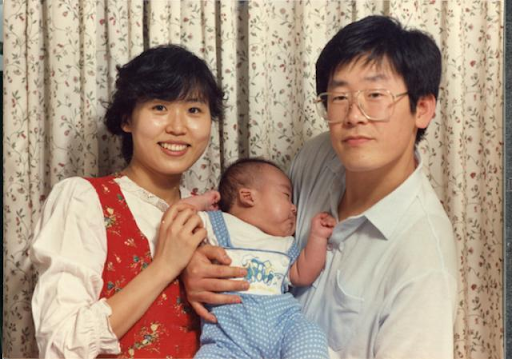
Young Lee Jae-myung holding his child Source: Presidential camp of Lee Jae-myung Lee Jae-myung is a liberal politician who has become famous by actively pushing welfare policies and whose down-to-earth speeches and behavior have gained him popularity with the Korean public. Lee is the presidential candidate of the incumbent Democratic Party, and he is currently in a neck-and-neck competition with Yoon Seok-yeol from the opposition People’s Power Party. Lee was born in 1964, in the rural regions of Andong, North Gyeongsang Province (경상북도 안동), as the fifth of seven children. His family was poor and Lee had no choice but to work from the age of 16. While working, he developed disabilities as the result of an accident where his arm was stuck and twisted in the factory’s press machine. While he did not complete his middle and high school studies, he passed the geomjeonggosi (검정고시), a qualification exam equivalent to the middle and high school diploma. He then entered the School of Law at Chung-ang University (중앙대학교) on a scholarship. In 1986, he passed the bar exam and started his career as an attorney specializing in human rights. His political career began as he participated in a movement for the establishment of the Seongnam Citizens Medical Center (성남시의료원), which is the first public hospital established in response to residents’ petition. Lee was elected as Mayor of Seongnam City (성남시) in 2010 and pushed for then popular policies such as universal free postnatal care centers, a basic income for youths, free school uniforms, and local business vouchers. Later in 2018, he was elected as Governor of Gyeonggi Province (경기도), the first time after 20 years of the conservative party holding that office that a liberal politician was elected. His initiatives/proposals 1. Post Covid-19 Plans Lee promised the government’s active engagement in fully overcoming the COVID-19 pandemic. He intends on investing in the development of domestic vaccines and medicines. For small business owners, Lee has promised financial compensation, in addition to helping to increase sales on a national level by issuing local business vouchers and coupons. 2. Economy Booster Plans Lee’s top three goals for the economy are reaching $1 trillion on exports, $50 thousand on national income, and 5000 on the stock price index. To achieve that, he has promised to expand support for new technologies and industries such as blockchain, quantum information technology, and 6G. 3. Basic Economic Rights and Opportunities for Youths The most controversial but popular policy proposed by Lee is a universal basic income. His proposal includes the condition that he will gain the public's opinions before adopting a new policy. However, his plan is to annually pay ₩1 million to all youths aged between 19 and 29 years during his term in office as a UBI-type pilot program. 4. Real Estate and Development Lee has promised to offer 3.11 million homes nationwide in order to stabilize the real estate market. He said he will effectively distribute resources to seek equal developments nationally. Lee plans, for example, to improve educational, medical, and cultural infrastructures in regions other than Seoul. He also promised to move several government institutions located in Seoul to Sejong City (세종특별자치시). 5. Public Welfare Lee has promised to take on more responsibilities for the elders, patients, the disabled, children, and infants. His goal is to relieve each families’ burden by building a solid welfare system. 6. Guarantee workers’ rights Lee has promised to create a society in which no worker faces any discrimination. The “Basic Law on the Guarantee of the Rights of Workers” (working title, no details are known at this point) will be enacted to build a safety net for workers. He is also aiming to adopt the 4.5-day work week. 7. Transforming Education Lee has proposed an “education transformation”. He proposes that he will strengthen digital education all the way from elementary school to universities. Moreover, Lee promised to extend support to youths engaging in scientific research. 8. Building a Culture Powerhouse In order to make Korea a culture powerhouse, Lee has promised to invest more in the media industries. He proposes to pay ₩1 million annually to artists as part of a universal basic income-type plan. Moreover, he will support local media and media creators. 9. Political and Judicial Reform Lee’s goal is to enforce the public’s basic rights with political and judicial reforms. He will push for changing the current 5-year presidential term into two 4-year terms with the possibility of re-election. He will also support the public by offering legal assistance services that help citizens understand legal procedures, actions, and recourses. 10. Foreign Affairs and National Security Lee’s ultimate plan is to actualize the denuclearization of the Korean Peninsula. He proposes to build a “smart” army by utilizing new technologies. When it comes to foreign strategies, Lee suggests a practical approach to conflicts between the US and China. He proposes to expand Korea’s diplomatic boundaries to various other nations. Controversies The phone call A recorded phone call (Korean link) of Lee and his brother in the past was revealed during the presidential campaign. During the phone call, Lee was aggressively arguing and swearing in an enraged tone. Lee explained that there has been a serious family issue since his brother also became involved in politics. In addition, he claims that those phone calls happened because his sister-in-law talked ill about his mother (Korean link) and he could not stand it as a son. Furthermore, Lee also alleged that the phone call was manipulated to make him look bad. Daejang-dong issue (대장동) During his time as Governor of Gyeonggi province, Lee’s Daejang-dong (대장동) development project was a public project run by the provincial government, but in the end, the profit was unequally distributed to a private corporation in spite of its small contribution. The main beneficiary, Hwacheon Daewoo (화천대유), invested ₩50 million and earnt approximately 1,153 times their investment in profits from this land development project. Lee was accused of favoritism towards the private corporation. So far, this is the biggest hindrance to Lee’s approval ratings. According to a survey (Korean link) from JTBC, about 59.6% of voters responded that it affected their decision-making process regarding the presidential election, while 38.2% said it did not. However, during his official press interview, Lee insisted that his actions were all legal and that his intention was an impartial distribution of income and a benefit for the province. He further claimed the People’s Power Party is framing him for bribery, while they are instead the ones who feed on unearned income from private corporations. Troubles within 1. Kim Hye-gyung (김혜경)’s controversies Kim is the wife of candidate Lee, and she has been involved in numerous scandals during his campaign. People suspected Kim of having a private Twitter account named “Hyegyeonggung Ms. Kim” (혜경궁김씨) which she used to criticize administrations and disparage previous presidents and comment on serious national issues such as the Sewol ferry (세월호) disaster. Although most of the evidence was pointing at her, she denied owning the account, and she pleaded innocent (Korean link) due to lack of evidence. In addition, Kim abused her status and her husband’s power and gave personal commands to one of his fellow officials. However, it is illegal to use one’s authority in this way and put a public official to work on personal matters. She is also accused of misusing a corporate card for her grocery shopping. Kim made several public appearances and apologized (Korean link) for all her misbehaviors, saying she “should have drawn a distinct line between public and private matters,” and promised to take full responsibility, comply with the investigation, and face further consequences. 2. Lee’s cousin’s murder case attorney In 2006, Lee’s cousin murdered his ex-girlfriend and her mother. The cousin was found guilty and was sentenced to life imprisonment. This probably would not have been a problem for Lee if he had stayed out of it; but unfortunately, he didn’t. Lee, who is an accredited lawyer, claimed his cousin could not afford a lawyer for his case and he therefore had to defend him. Later, in November 2021, Lee mentioned (Korean link) him being the attorney in this case on his Facebook page, but referred to it as a case of “serious dating violence”, instead of calling it a “murder case”. This infuriated the victim’s family, who accused him of not properly weighing the seriousness of his cousin’s crime and downplaying what he did. During an interview with the newspaper Munhwa Ilbo (문화 일보), the father of the victim said the rest of the family are still living in trauma and Lee must be shameless to bring this up in public again without ever having issued any genuine apology. Lee immediately apologized for his inconsiderate choice of words and denied attempting to downplay the case. “Are you done?” Lee also had moments where his attitude toward social issues seemed somewhat indifferent. In one case, when Lee visited Seoul National University (서울대학교) early last December, he encountered protestors going on a strike for the implementation of anti-discrimination law. A few protestors demanded that Lee apologizes to all the minorities he had offended by saying there must be “social consent (Korean link)” before such a law can be enacted—which is what Lee had said when he met with The United Christian Churches of Korea (한국교회총연합회) a month before. Lee listened to the protestors’ speech, then asked “Are you done? (Korean link)” and left the site without even waiting for an answer. This gave other parties one more opportunity to criticize him for his ignorance and his lack of interest in minorities. Conclusion President Moon Jae-in (문재인 대통령) is set to leave office as the most popular Korean president in history. This means that fellow Democratic Party member Lee Jae-myung has to walk a difficult tight-rope: court devoted Moon supporters while being able to navigate his own path. Lee’s opponent Yoon Seok-yeol, who is a Moon administration appointee-turned-enemy, has tried his best to paint a potential Lee administration as nothing more than a continuation of a Moon presidency—a concept that is anathema to conservative voters. Although this election cycle has been filled with scandals, mud-slinging, and neck-and-neck polls, it has also captured many Koreans’ attention with significant overseas voter registration numbers and record TV debate viewerships. When the last ballots are submitted on the evening of March 9, the next five years of executive leadership will be a reflection of the current state of South Korean politics.
This Week's Recommendations
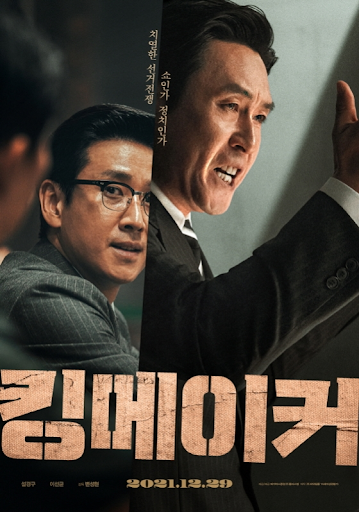
King Maker (킹메이커, 2022) Available on Youtube (123 minutes) King Maker is about Kim Un-beom (김운범), a politician who fails four elections before he meets an unknown campaign strategist, Seo Chang-dae (서창대), who helps him embark on a fierce election campaign during the 1960s–70s. The story is fictional, but its motifs are based on the lives of former president Kim Dae-jung (김대중) and his campaign strategist Uhm Chang-rok (엄창록). The movie depicts Korea's election process back in the 1960s-70s, with the help of cinematic imagination.
💚 Support us! 💚
|