DALL·E 3 / GPT - 4V(ision) / Gobi / Gemini 2023 Oct Week 2 Datumo Newsletter |
|
|
📰New AI Devices and the Future of Chatbots |
|
|
Sam Altman, participating in an event held in Korea in June.
Source: SoftBank Ventures YouTube.
Hello!
Among the many news emerged in the AI industry, the one of 'OpenAI stepping into new AI hardware development' caught my eye the most.
Summarizing the reports in the last week of September, OpenAI CEO Sam Altman discussed a billion-dollar project to invent the 'AI era iPhone' along with former Apple chief design officer 'Jony Ive' and SoftBank CEO 'masayoshi son'.
Have you heard of the term 'CPND'?
CPND stands for an industrial ecosystem connecting Contents-Platform-Network-Device. With various services, contents, and active cloud infrastructure in the AI market, it seems that device development has now begun.
It is expected that various visions pursued by current tech companies will be concentrated in AI dedicated devices to be introduced in the near future.
In this letter, we will briefly discuss 'on-device AI' and 'interface' related to AI devices😃
|
|
|
Apple, Samsung, and Meta are pointing towards 'On-device AI' |
|
|
At the 'Samsung Developer Conference 2023' held in San Francisco.
Source: Samsung Electronics Newsroom.
On-device AI, as the name suggests, is AI implemented within the device without going through cloud servers. Fast operation is possible in low-latency environments because information is processed within the terminal device, and most security issues can be resolved as it does not go through a central server. It is expected that new AI devices will also support on-device services.
The key element in implementing on-device AI is the proprietary AI chip. Many tech companies are now developing their own AI chips for △fast hardware for real-time AI services △securing stable GPU supply for mass production △optimizing device design. In the past month, major companies have emphasized their own designed chips along with on-device AI.
Firstly, Apple unveiled iOS 17 in September, introducing on-device AI features (auto-correction & dictation) based on their own 'Apple Silicon' chip. Similarly, Google's recently released smartphone Pixel 8 features a custom silicon chip 'Tensor G3', and Samsung Electronics also highlighted 'on-device AI' as their AI strategic keyword at the annual Developer Conference (SDC) on 5th.
Meta plans to offer 'Lama2' as on-device AI with Qualcomm, targeting application in 2024. They plan to support Lama2 on the Qualcomm Snapdragon platform to provide AI-based services without internet connectivity on smartphones, PCs, tablets, cars, etc.
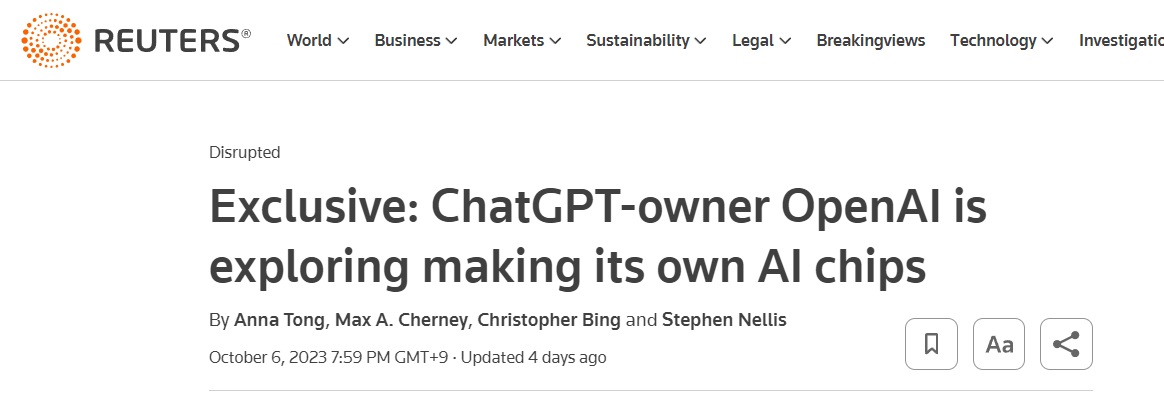
Therefore, recent speculative articles suggesting 'OpenAI is exploring making its own artificial intelligence chips and has gone as far as evaluating a potential acquisition target' are gaining traction. Reuters reported this on 5th, with multiple insiders stating, “since at least last year it discussed various options to solve the shortage of expensive AI chips”
|
|
|
'OpenAI is planning to manufacture its own AI chips,' according to a Reuters report. |
|
|
*Reasons Why Tech Companies Are Developing Their Own AI Chips
The reason GPUs began to be utilized in the AI field is because they can divide the matrix operations of artificial neural networks (neural networks) into multiple simple multiplications.
NVIDIA pioneered the general AI accelerator market through the CUDA platform, which supports parallel computing and programming. Due to the varying bottleneck factors depending on the AI algorithm, developing dedicated chips for specific purposes can yield higher performance. (e.g., Google TPU, Tesla D1, etc.)
|
|
|
Beyond Chat Interfaces, Towards AI Devices |
|
|
Apple Vision Pro. Source: Apple Newsroom.
There is also interest in the new interfaces that new AI devices will have. Sam Altman said, "We have embarked on device development for a more natural and intuitive user experience," which is interpreted to mean that the current chat interface is not the optimal interface for utilizing artificial intelligence.
The drawbacks of the chat interface include △it's difficult to make full use of artificial intelligence if the user does not express questions clearly △multimodal inputs utilizing visual and auditory information △single turn dialogue (we send several sentences at once during a conversation). To improve these, chatbot services are continuously being updated.
Recent chatbots like ChatGPT are creating appropriate follow-up questions in advance for user convenience, allowing users to choose one of several answers, and supporting multimodal functions with input/output for attached documents and voice-images.
With such accumulated improvements, if AI services solely for individuals are provided in an on-device environment, it is expected that technically, a higher level of personalization, long-term memory, and real-time feedback functions will be supported.
Apple has implemented Augmented Reality (AR) devices through eye tracking, hand tracking, and 'pinching.' AI devices to be released someday are also expected to have innovative interfaces for interacting with the real world.
|
|
|
The Data for Smarter AI
Datumo is an all-in-one data platform for your smarter AI.
|
|
|
Datumo Inc.
📋 contact@datumo.com
|
|
|
|
|