For dark mode users,
Hello, readers! Today, we are covering: Index Zoom In Wildfire: a result of the climate crisis? Today's Vocabulary 힘내세요 (Himnaeseyo) This Week's Recommendations The Tower (타워, 2012) Don't forget to leave your feedback below!
Wildfire: a result of the climate crisis? Writer: Yeon Woo Lee Editor: Aleya Sharif Senior Editor: Regine Armann Editor-in-Chief: Fred McNulty Researcher: Yul Jun Illustrator: Ah-young Kim
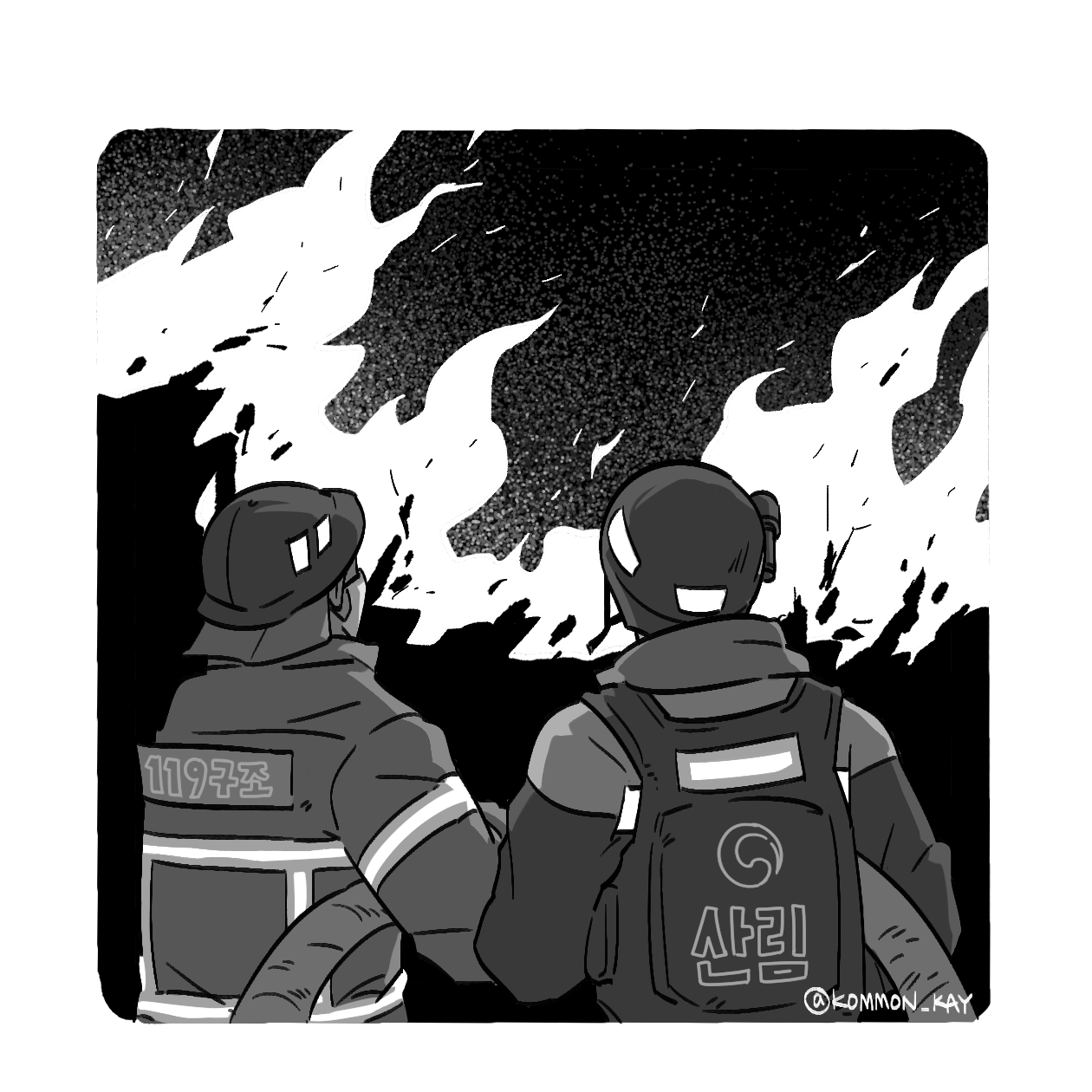
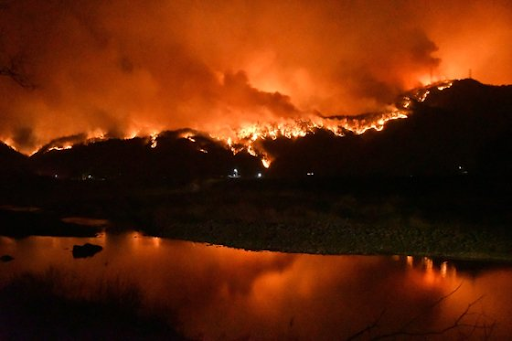
[Illustration by Ah-young Kim] Residents on the eastern coast of Korea are suffering from forest fires. The affected area ranges from Uljin in Gyeongsangbuk-do (경상북도 울진군) to Gangneung in Gangwon-do (강원도 강릉시).
Source: Samcheok City
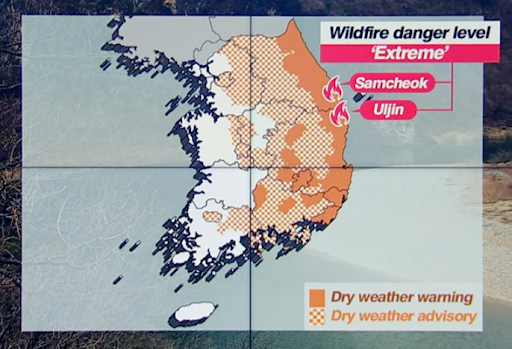
Source: Arirang TV An area of 24,940 hectares (Korean link) on the eastern coast is considered damaged. That is almost 41.2% the size of Seoul. It is the most extensive damage from fires (Korean link) in Korea, ever since the Korea Forest Service (산림청) started collecting statistics in 1986. According to a press release by the Ministry of Interior and Safety (행정안전부), 17,940 firefighters, 86 helicopters, and 650 fire trucks are being employed to extinguish the fires. As of March 7, 504 households have moved to temporary housing facilities and relatives' houses to escape the fires. Gangneung-Donghae (동해) wildfire Nearly ninety hours after the outbreak, the main fire source was extinguished on March 8th. A 60-year-old man, who held a grudge against his neighbors, had set fire to his house where he lived with his mother. The police arrived at the scene after a resident reported that a man was setting a fire with a torch. The suspect was arrested on-site, but the fire had already spread from his house to the mountains. According to an interview by the Chosun Il-bo (조선일보) with police personnel, the man committed the crime to get back at his neighbors who according to him have ignored him for years. He admitted his guilt.
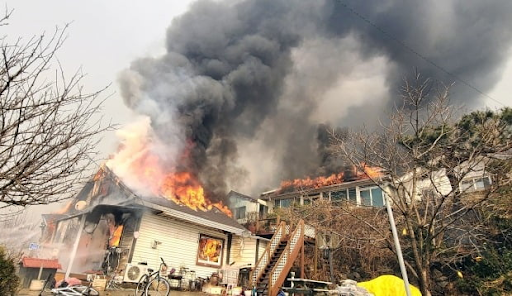
The burning house that was the source of the wildfire Source: Yonhap News Uljin-Samcheok (울진-삼척) wildfire The main source was extinguished on March 13th, 213 hours and 43 minutes after the fire outbreak. Forest authorities are trying to catch all remaining fires. Based on the private CCTV installed in the nearby mountain area, it seems the main cause of the fire may have been a cigarette thrown away (Korean link) while still burning by a driver in a nearby mountain. At 11:17 am on March 4th, 10 minutes before the fire was reported, a total of three cars had passed by the road nearby. Forest authorities have therefore announced plans to track those cars and investigate the circumstances that led to the fire.
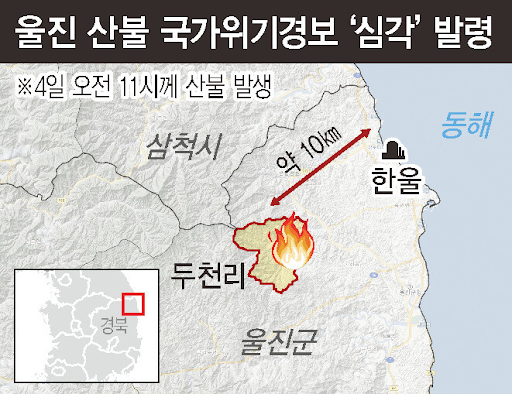
Distance between the fire and the Hanwool nuclear plant The fire could have led to a disaster, since the Hanwool nuclear power plant (한울원전), the second biggest nuclear plant in Korea and the third biggest nuclear plant in the world, is located at a 10km distance from the outbreak. This plant provides 5% of Korea’s domestic electricity. If the fire had made its way into the plant, it could have resulted in an explosion. The National Fire Agency (소방청) dispatched 24 fire trucks and 26 fire-extinguishing machines to prevent the fire from entering the plant.
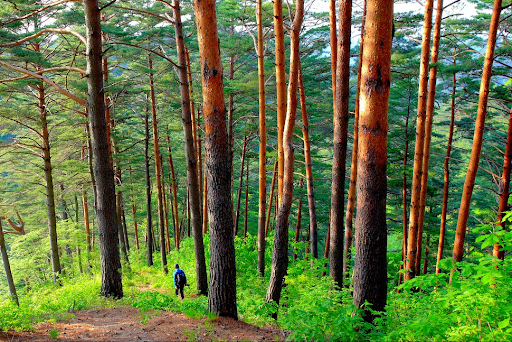
The Geumgang Pine Habitat of Uljin Source: Uljin Apart from the risk of a nuclear disaster, this fire also posed a potential threat to the Geumgang Pine Habitat of Uljin. Geumgang Pine trees (금강송) are high-grade pine trees that were used in the past to build the royal palace and large temples. The Korean Forest Service (산림청) protects this Habitat area as a natural reserve. There are around 80,000 old pines with more than 200 years of history. Relationship with climate change According to the Korean Forest Service, the number of wildfire cases from January to March in 2022 was 228, with 608.5 hectares of land charred. The average number of wildfire cases in the same time of the year for the last 10 years was 92, with about 135.64 hectares of land charred. The average number of cases registered during the first 2 months of 2022 is thus already 2.5 times higher (Korean link) than the average of the last 10 years, and considering more cases until the end of the year, this number may increase further. The Korea Forest Service believes that the dry weather and low precipitation resulted in the fires. Experts say that climate change has led to an increase in dryness and therefore encouraged natural fires. National Institute of Forest and Science (국립산림과학원)-related personnel reported that this year was the driest year in Korea since 1973. Green Korea United (녹색연합), a prominent environmental group, also supported the idea that this wildfire was a natural disaster due to climate change and reported that the observed increase in dryness during winter and spring will result in even more fires over time. According to the Kyunghyang Shinmun (경향신문), they stated that “the consequences of climate change are difficult to prevent, even with high-level practical systems and advanced technology,” and that “we need to improve the overall response implementation of climate change crisis measures”. The government’s support plans Central government President Moon declared the damaged regions as special disaster zones (Korean link). This allows the provision of national financial support for damage restoration, up to 70% for private facilities and 50% for public facilities. Moreover, the government will provide subsidies for living costs and allow a grace period for taxes. Maintenance fees including electricity and water are also cut down for residents in the affected area. The Ministry of Public Administration and Security (행정안전부) is opening a Central Disaster and Safety Countermeasures Headquarters (중앙재난안전본부) soon to discuss and implement further measures. Provincial government Gangwon-do has decided to provide temporary shelter for the victims. According to the JoongAng Il-bo (중앙일보), about 60 victims of the wildfire in Gangwon-do have moved to their relatives’ or friends’ houses and hotels for a temporary stay. Gangwon-do decided to build prefabricated homes for those who are in need and is currently investigating the demand. Although the fires have mostly ceased now, these outbreaks gave an immense opportunity to Korea to acknowledge the seriousness and danger of such natural disasters. Although the causes of individual fires may vary, we can now expect the government and the Korean population to be more aware and hopefully better prepared for future disasters.
Today's Vocabulary 힘내세요 (Himnaeseyo) 힘내세요 (Himnaeseyo) is used to cheer someone up in a difficult situation. There is no natural translation of this expression into English, but literally, “힘 (Him)” means “strength” and “내세요 (Naeseyo)” means “have”. Example: A: 오늘 힘든 하루였어요. B: 힘내세요. A: Today was a rough day. B: Have strength. This Week's Recommendations
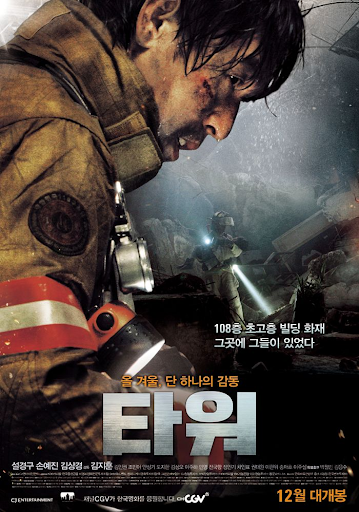
The Tower (타워, 2012) Available on Netflix (121 minutes) The movie takes place in a luxury high-rise building in Seoul on Christmas Eve. Two helicopters collide into the building, and an amazing holiday with family and lovers turns into a terrible disaster. The crash causes a big fire in the building, and a group of people, including firefighter Young-gi (영기) and others who were eating at the same restaurant, struggle to survive the collapse of the building. The movie has elements that are somewhat related to the topic of this week’s newsletter. It displays people’s struggle to survive an abrupt danger, and how the struggle turns into hope.
💚 Support us! 💚
|