‘Cash Cow’ CJ Olive Young Generates About 1Trillion Won KOSPI ▼4,108.62 │ KOSDAQ ▼915.20│ KRW/USD▼1,461.91 |
|
|
As of 3:30 p.m. on the previous trading day |
|
|
There are so many stories that have built up over the year, right?
I hope the end of the year can be a time to pause for a moment and catch your breath.
At least on Christmas, may it be a day where warmth comes before numbers
And I hope you have a calm and comfortable year-end! |
|
|
✴ Bluepoint Partners╎After six years, it moved to raise new capital by bringing in Jet Venture Capital and InBody as strategic investors. While the company valuation was not raised significantly, the deal is seen as a signal of a strategic shift, as it secured global deep-tech partnerships leveraging Japanese and U.S. networks.
✴ Carlyle╎Following the acquisition of Twosome Place, which has drawn attention over the packaging band controversy, Carlyle continued its bolt-on strategy by acquiring a 100% stake in KFC Korea. The move is seen as an effort to expand its portfolio in the domestic F&B and quick-service restaurant market and enhance business synergies.
✴ Yellow Umbrella Mutual Aid╎In its final PEF commitment program of the year, it selected six GPs, including Stonebridge Capital, Eum Private Equity, and Genesis Private Equity. By committing a total of $214 million and shortening the fund formation deadline to nine months, execution speed and operational capability have become more critical for the selected houses.
✴ WelltoSee Investment╎Under a manufacturing-focused strategy for 2025, it significantly accelerated large-deal execution by acquiring S.I. Flex and Encos in succession. At the same time, it is reviewing the sale of MNC Solution, pursuing investments and exits in parallel, and is seen as having clearly demonstrated its execution capability and identity as a mid-sized PEF.
✴ Bowon Chemical╎It passed the preliminary review for a KOSDAQ listing through a SPAC merger and has entered the formal listing process for next year. Based on the merger valuation, early financial investors are expected to achieve more than a twofold return, bringing VC exits into clearer view.
✴ Orchestra Private Equity╎By selling KFC Korea to The Carlyle Group, it achieved a return of more than twice its invested capital in just two years. The large exit is seen as securing sufficient capacity to pursue both value-up initiatives for Banolim Pizza and the resumption of new investments.
✴ TS Investment╎Despite having ample cash reserves, it raised $3.2 million through a third-party allotment capital increase, sparking debate over its intent. While the move may strengthen support from major shareholders alongside treasury share purchases of KX Innovation and OdiTec, concerns are growing over dilution for minority shareholders and potential overhang risk.
✴ Eum Private Equity╎By forming a $357 million blind fund with a commitment from Yellow Umbrella Mutual Aid, it reached a turning point in moving from a small-to-mid-sized PE firm to a mid-sized one. The selection by a conservative institutional LP validated its management capabilities, and the fund size jump is positioning it as a house focused on mid-sized deals.
|
|
|
Shinhung, a succession puzzle behind a 70-year “distribution giant” |
|
|
⭑ Business structure and position in Korea’s dental distribution market
Shinhung is a Korean dental distribution company founded in 1955. It was listed on the Korea Exchange in 1991, and its core business is the distribution of dental materials and equipment. The company operates a structure that combines in-house manufacturing capabilities, logistics infrastructure, and an online platform. Through its online mall, DV Mall, product purchases are linked with participation in academic events. Based on its DV Hub logistics center, Shinhung has built a nationwide supply network for dental clinics and hospitals, and it has continued a model that combines distribution, education, and services by regularly hosting academic conferences and conventions. However, most of its revenue still comes from the domestic market, and its high dependence on domestic demand remains unchanged.
⭑ China approval of “Everthis” and global expansion status
Shinhung has set a mid- to long-term goal of becoming a global top player by 2030. In this context, Everthis, an implant brand developed in cooperation with Yuhan Corp., received final approval from China’s National Medical Products Administration (NMPA) in November 2025. As this approval is a mandatory step for selling implants in China, it represents the company’s first institutional gateway for overseas expansion.
However, in numerical terms, there is still a long way to go. As of the third quarter of 2025, more than 90 percent of Shinhung’s revenue was generated in Korea, and overseas sales remain limited. Compared with major competitors whose overseas revenue accounts for more than 70 percent, Shinhung’s global business appears to be at a very early stage in terms of its revenue structure.
⭑ Changes in ownership structure and debt guarantee status
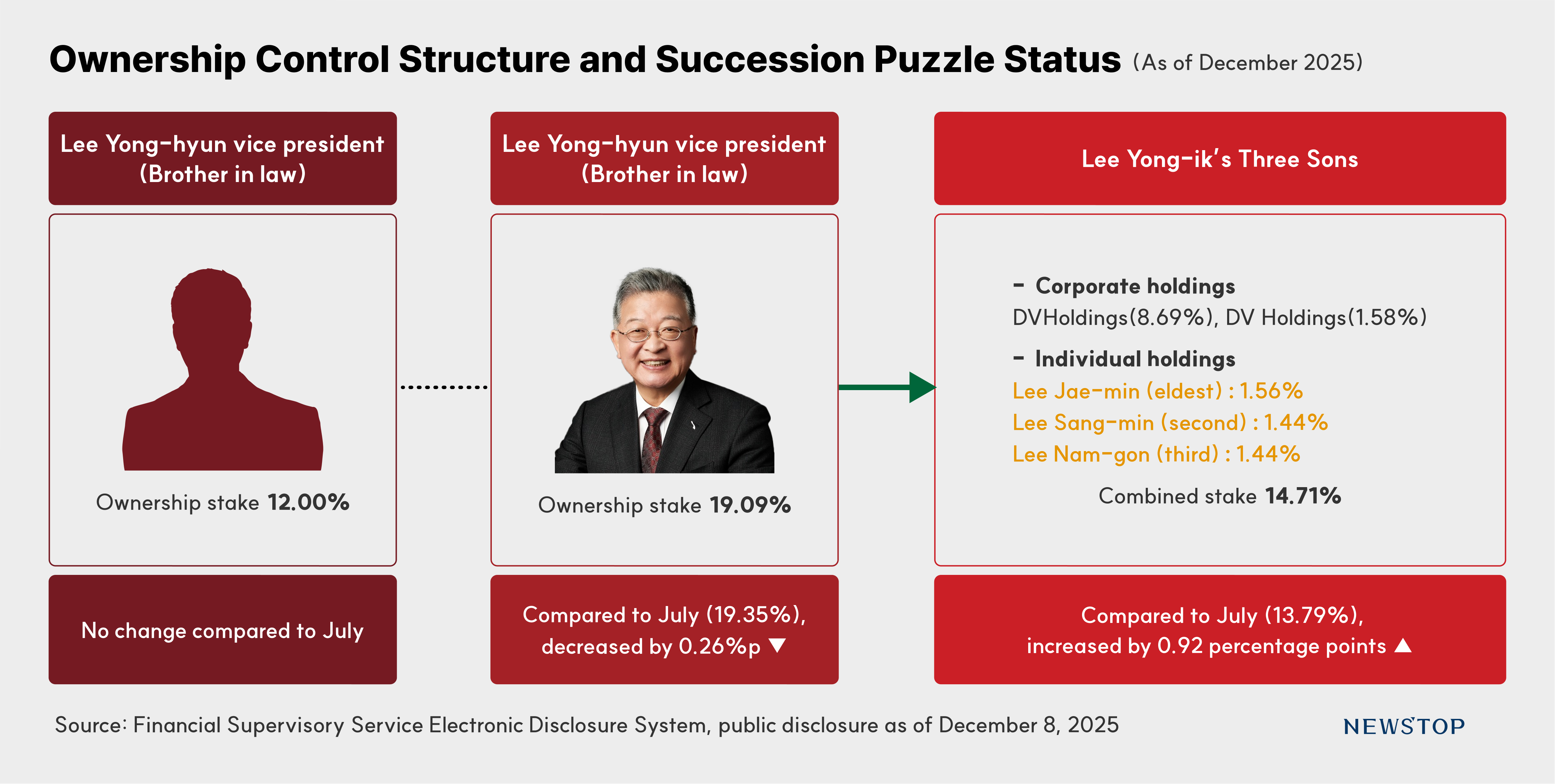
DV Holdings, an unlisted company owned by the third-generation owner family, is a family entity wholly owned by the three sons of Chairman Lee Yong-ik. After July 2025, Chairman Lee’s personal stake declined slightly from 19.35 percent to 19.09 percent, while the combined stake of the three brothers increased from 13.79 percent to 14.71 percent over the same period. Disclosures show that this increase resulted from on-market purchases of Shinhung shares through DV Holdings and its subsidiaries.
Meanwhile, Shinhung is providing a debt guarantee for a bank loan of about $1.2 million (₩1.8 billion) borrowed by DV Holdings. The company explains that DV Holdings is a related party but not a consolidated subsidiary. Chairman Lee’s older brother, Vice Chairman Lee Yong-hyun, currently holds about a 12 percent stake in the company.
|
|
|
Attention is focusing more on the transparency of the succession process than on Shinhung’s stated global vision. In the market, there is commentary that the structure itself, in which the credit of a listed company is intertwined with a phase of strengthening control by the owner family, can raise doubts. Combined with a conservative communication approach, some assessments say there is a noticeable temperature gap with the recently emphasized trend toward shareholder friendliness and value enhancement. Ultimately, before moving into global expansion, how Shinhung addresses governance risks could act as a key variable affecting its credibility and future valuation.
Compared with the positive image built through its dividend policy and social contribution activities, the lack of explanation during the succession phase may instead be perceived as a risk. If the company aspires to be a global player, there is an underlying view throughout the piece that it needs persuasive alignment with global standards not only in business performance but also in governance and communication practices. |
|
|
‘Cash Cow’ CJ Olive Young Generates About One Trillion Won in Cash Annually |
|
|
⭑ EBITDA Near One Trillion Won, Stronger Cash Position
CJ Olive Young recorded EBITDA of $5.51 billion (₩803.6 billion) in the first to third quarters of 2025. Investment banks expect full-year EBITDA to exceed $6.86 billion (₩1 trillion). EBITDA indicates how much cash a company generates from operations, excluding accounting factors such as depreciation. Korea Ratings estimates that CJ Olive Young will have around $6.17 billion (₩900 billion) in cash liquidity directly available over the next year, meaning substantial cash remains even after operating and non-operating expenditures. This confirms its position as a clear cash cow within the group.
⭑ Offline, Online, and Indie Brands Growing Together
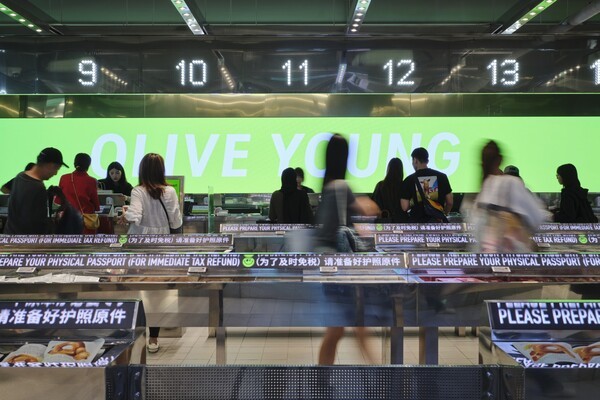
CJ Olive Young operates about 1,400 offline stores in Korea. By combining these with urban micro-fulfillment centers, it has built a structure that quickly processes online orders while covering both online and offline channels. As a result, consolidated revenue for the first to third quarters reached $29.24 billion (₩4.2619 trillion), with annual revenue expected to reach the mid-$34.29 billion range (₩5 trillion range). Revenue was $12.61 billion (₩1.8379 trillion) in 2020 and $19.09 billion (₩2.7809 trillion) in 2022, meaning it has nearly tripled over five years and almost doubled over three years. This growth is based on a long-term strategy of discovering indie brands since the 2000s, with about 2,400 small and mid-sized brands currently carried by CJ Olive Young.
⭑ Improving Profitability and Rising Group Status
As market share has increased, stronger bargaining power has lowered the cost ratio. CJ Olive Young’s cost ratio declined from 54.0% in 2020 to 51.7% in the first to third quarters of this year. Expansion of private brand products has also supported profitability. Based on this cash generation, CJ received dividends of $319 million (₩46.5 billion) from CJ Olive Young in the first to third quarters, exceeding dividends from CJ CheilJedang. CJ also collected $132 million (₩19.2 billion) in brand royalties during the same period. Given the growth pace, some forecasts suggest CJ Olive Young could surpass CJ Logistics in EBITDA next year. However, as competition in cosmetics distribution intensifies, the stability of the current profit structure will need continued monitoring.
|
|
|
🤬Insurer fighting consumers?╎Rising burden from the highest number of lawsuits
Have you ever had to fight with your insurance company? If you are a customer of Samsung Fire & Marine Insurance, you may have felt this firsthand. As of the third quarter this year, the insurer was involved in 4,976 lawsuits, the highest number among major non-life insurance companies. Lawsuits over insurance payouts have accumulated as cases drag on through second and third trials, intensifying legal friction with customers. In cases such as boiler piping accidents, the insurer has been criticized for rigid claims procedures after continuing litigation even after losing in the first trial, only to later drop the case. While the company argues that the high number of disputes reflects the sheer size of its policy base, critics say its approach to dispute management itself is weighing on customer trust. |
|
|
🎅Santa’s Gift Is AI╎Painting My Stocks Green
Year-end markets are usually generous, but will that hold this time? The S&P 500 has posted double-digit gains since the start of the year, yet expectations for a traditional Santa rally have noticeably faded. Much of this year’s upside is seen as having already priced in an AI-driven tech rally. Market participants say uncertainty over the timing of rate cuts by the Federal Reserve, along with slowing corporate earnings growth, is capping year-end optimism. Among Wall Street traders, there is a growing view that capital flows and economic data after January matter more than the final few trading days of the year. |
|
|
🧑💼The Chairman’s Inspection Log╎Checking Samsung’s Semiconductor R&D
Lee Jae-yong, chairman of Samsung Electronics, visited the next-generation semiconductor R&D complex NRD-K at the Giheung campus and urged employees in the DS division to restore technological competitiveness. The visit underscored the importance of fundamental semiconductor capabilities as core infrastructure in the AI era. NRD-K is an advanced R&D hub covering memory, system semiconductors, and foundry operations, with Samsung planning to invest about $14.3 billion (₩20 trillion) by 2030. Lee later met executives at the Hwaseong campus to discuss future strategy, reiterating that regaining semiconductor leadership is impossible without bold investment and innovation. |
|
|
📚Glass Substrates╎Samsung Electro-Mechanics Enters Full-Scale Testing with AWS
Samsung Electro-Mechanics is supplying prototype glass-core semiconductor substrates to Amazon Web Services for testing. The move is seen as securing another global big-tech customer following entry into the supply chains of Google and Broadcom. Samsung Electro-Mechanics is operating a pilot line with mass production targeted for 2027 and has formed a joint venture with Sumitomo Chemical to secure key glass-core materials. However, analysts note that commercialization success will depend on progress in collaboration with materials and equipment suppliers, given the near-monopoly held by Ajinomoto in buildup processes and insulating films. |
|
|
🏃🏼Mass User Exodus╎Coupang Sees Sharp Drop After Data Breach
If you have ever used Coupang, learning that your personal data may have been exposed likely came as a shock. Following a large-scale data breach, the company’s daily active users fell by about 9%, with user attrition becoming evident despite the peak year-end shopping season. DAU has dropped from around 16.2 million to 14.8 million users. On social media and online communities, calls for so-called “de-Coupang” movements are spreading, alongside posts encouraging participation in class-action lawsuits. On the ground, logistics centers have even implemented voluntary unpaid leave, signaling a noticeably subdued internal atmosphere.
|
|
|
💸Scraping together every resource╎Doosan secures a semiconductor cash cow
Doosan Group secured about $1.37 billion (₩2 trillion) in liquidity to acquire SK Siltron by issuing PRS backed by its stake in Doosan Robotics and taking share-backed loans from affiliates. SK Siltron operates in the same industry as Doosan’s Electronics BG division and Doosan Tesna, but offers limited direct vertical integration due to structural differences. Given SK Siltron’s stable, loss-free performance, the move is seen less as a semiconductor expansion and more as a strategy to secure a group-wide cash-generating asset. |
|
|
Kakao: A Structure Users Cannot Leave |
|
|
National Messenger: A Structure Users Cannot Leave
Kakao has once again been put to a test of trust after a series of personal data issues. With a revised terms of service, past data breaches, and controversy over overseas data transfers emerging at the same time, criticism is growing that its management of personal information is lax compared with its status as the “national messenger.”
Revised Terms, Controversy Over the Loss of Choice
Kakao announced that under revised integrated service terms, starting February 2026 it will use user activity patterns for AI training. The scope includes usage records across services such as KakaoTalk profiles, open chats, short-form content, and Kakao Map. Kakao says this is a preparatory step to advance its AI services, and that separate consent will be obtained where personal information is required.
However, controversy grew after it became known that users would be deemed to have consented if they do not explicitly opt out by a certain date, and that refusing consent could restrict service use. Critics say the problem is not data usage itself, but a structure that offers no option to keep using the service after refusing.
Distrust Left by Past Data Breaches
This debate is more sensitive because of Kakao’s past record. The company was fined 15.1 billion won last year over a personal data leak caused by security vulnerabilities in its open chat service. An unencrypted temporary ID structure was cited as the cause, and the penalty, the largest of its kind, raised broader questions about responsibility for overall security management. Against this backdrop, expanding the scope of usage data collection has intensified user anxiety.
The issue is compounded by a separate Kakao Pay case. Kakao Pay was fined after it was found to have transferred personal credit information overseas without user consent, and the possibility of additional regulatory action by financial authorities has been raised. Given the service’s position as a widely used payment platform, analysts say the issue is difficult to dismiss as a simple mistake.
Ultimately, the controversy reflects a direct clash between expanding data use to strengthen AI competitiveness and users’ perceived rights to choice and trust. In short, Kakao appears to have entered a phase where restoring trust is more urgent than accelerating technological development.
|
|
|
Meaning of Top-down in management? |
|
|
✴ Overhang
Overhang refers to a large volume of shares that has not yet been sold but could enter the market at any time. The key issue is not whether the shares are actually sold, but the uncertainty over when they might be released, which continues to pressure the stock price. For this reason, overhang functions as both a supply-demand issue and a psychological discount factor.
Situations where overhang commonly occurs
Lock-up expirationWhen lock-up periods for major shareholders or institutional investors expire after an IPO, the shares become immediately tradable. In cases where the stock price has risen significantly since listing, expectations of profit-taking can weigh on the price in advance, even if no actual selling takes place.
Convertible bonds (CBs) and bonds with warrants (BWs)
CBs and BWs can be converted into shares in the future, implying potential dilution through an increase in share count. Even before conversion occurs, the announcement of issuance alone often leads the market to price in concerns about future supply.
After block deals
When institutional investors or controlling shareholders acquire a large stake through a block deal, the perception that these shares may eventually be sold acts as an overhang. While off-market transactions can reduce immediate market impact, uncertainty over future selling pressure remains in the medium to long term.
Rights offerings
Large-scale rights offerings dilute existing shareholders and raise concerns about an increase in future sellable shares. In particular, when a company with ample cash proceeds with a capital increase, it is often interpreted as unnecessary share issuance, amplifying overhang concerns.
Why it matters
The biggest issue with overhang is its psychological impact rather than actual selling. Uncertainty weakens investor sentiment, puts downward pressure on the stock price, and discourages new investor inflows. As a result, the stock may trade at a discount regardless of the company’s intrinsic value.
That said, the presence of an overhang does not necessarily mean a long-term negative outcome. While volatility and downside pressure may increase in the short term, if a company’s fundamentals and growth drivers remain intact, it can present a buying opportunity for long-term investors. What matters most are the size of the overhang, its timing, and how the company responds.
Implications of the TS Investment case
TS Investment’s decision to raise $3.1 million (₩4.5 billion) through a third-party allotment despite having sufficient cash can be seen as a case that triggers overhang concerns, as the issuance dilutes minority shareholders and the newly issued shares may enter the market in the future.
In other words, it is less a financial issue than a matter of supply-demand dynamics and market trust. |
|
|
Send us any suggestions you’d like to share while reading Bitter’s newsletter! |
|
|
Advertising, inquiries : viter@thevistapartners.com / Published by Newstop. Unsubscribe |
|
|
|
|