Heated debate on secondary relief funds.
1. Will I get the money? 2. One labor union became legal. What's this all about? KOMM'ON here. Capture the favorite part of this week's newsletter, and share it with your friends! Tag us on Instagram or Facebook, then we'll visit your post😸 Controversy Over Relief Funds 🍀5 Minute Read
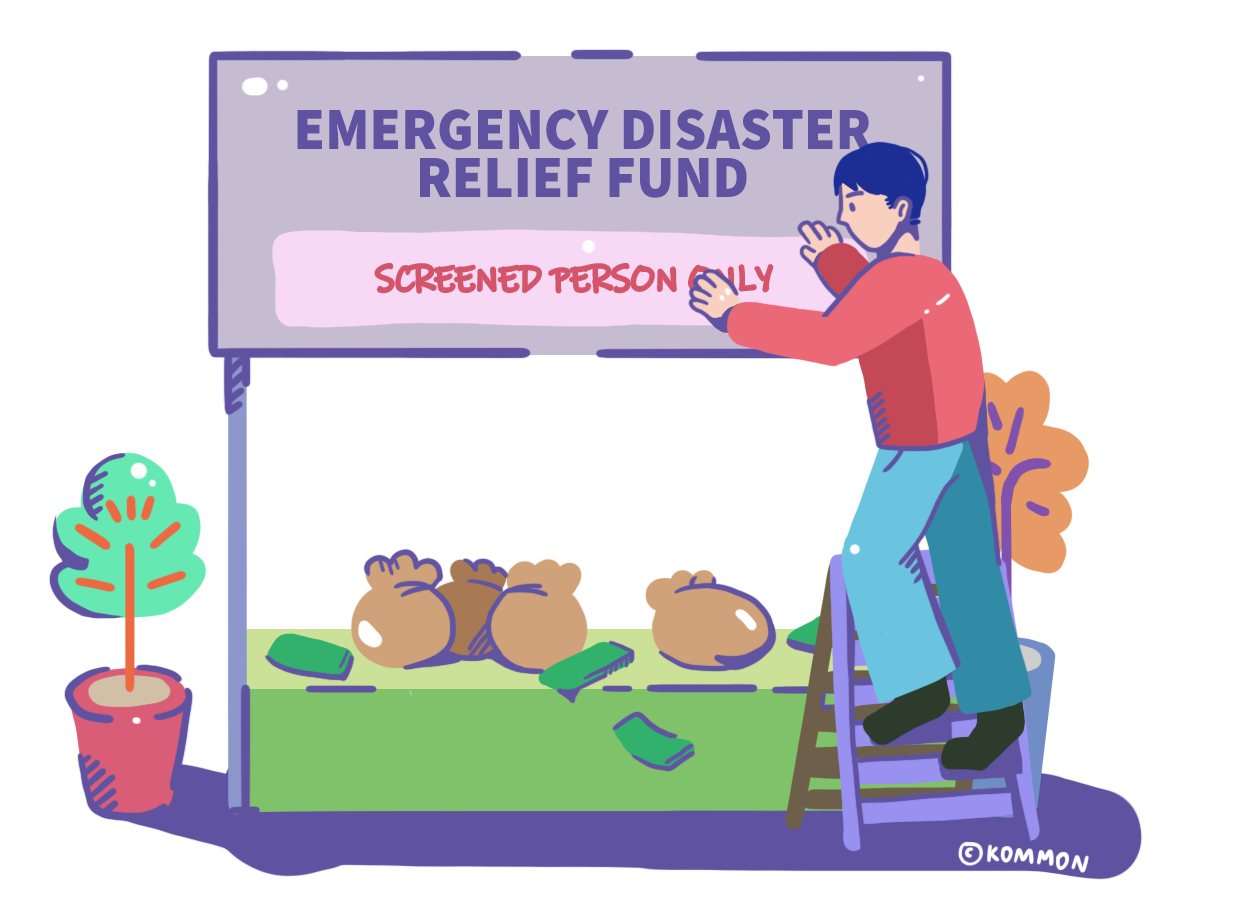
[Illustrated by O.T.O] Recently, the government decided to release the second round of emergency disaster relief funds. The government stated that it will provide secondary relief funds to the self-employed and small business owners who are suffering because of the COVID-19 pandemic. Moreover, the government is planning to give out funds for living and communication expenses to freelancers and low-income families. However, there have been disputes over whom to give to and on what basis. 💥Dispute #1. Funds for foreign residents VS Just for Koreans When central and local governments in Korea were providing COVID-19 relief funds, foreign residents were mostly excluded from the support schemes. However, the National Human Rights Commission of Korea (NHRCK) later stated the exclusion of foreign residents from the funds is a violation of equal rights and urged to include them. The NHRCK provided the following reasons for their decision: 1) Disaster comes to all. Foreign residents are also the ones suffering from disaster and nationality cannot be the reason for the exclusion. 2) Excluding foreign residents will inhibit the recovery of the local economy. If Korea does not provide appropriate support to foreign residents who are very likely to have suffered from the disaster, the local economy will become more vulnerable, and in the end the recovery from pandemic will be more difficult for all. Seoul government has accepted this advice and decided to include foreign residents in the relief funds scheme. From August 31st to September 25th, those who live in Seoul can apply for it. What about other regions? However, other local governments and the central government are not considering foreign residents as beneficiaries, and most provide relief funds for married immigrants or permanent residents only. 🌲 The Gyeonggi-do provincial government: “We don’t have enough money to support foreign residents” 👤 Rep.Kim Byeong Gi from the Democratic Party (DP): “We should take care of ‘our’ people first” 🌿 Justice Party, meanwhile, criticized Gyeonggi-do for its indifferent attitude toward foreign residents. 💥Dispute #2. Screened provision VS Universal provision Controversy has arisen over “how” to provide relief funds to recipients. Last May, the government provided funds to every Korean citizen (universal provision); now, however, they decided to hand funds out selectively (screened provision). Screened provision and universal provision each have their own advantages. 1) Screened provision 🍀 Appropriate for providing intensive aid for those in desperate need of help. The amount has increased compared to the first fund scheme, which provided only half of the current amount(up to 2,000,000 won). 🍀 Screened provision puts a lesser burden on the country, considering the government’s soaring debt due to additional budgets and subsidies for COVID-19 (FYI: the debt amounts to 847 million won after the outbreak). 2) Universal provision 🍀 Suited to help those who need support but do not meet specific standards. Universal provision benefits vulnerable groups that screened provision does not cover. 🍀 Effective in urgent situations. Universal provision does not require a selection process, which saves the government time and money. 💥Dispute #3. Income VS "sales" The third dispute revolves around the criteria used in providing the fund. This is an important issue because some people who need support may be excluded depending on the criteria. In April, the government announced that it would screen the recipients based on the amount paid for health insurance premiums. Now the government plans to set “last month’s sales” of self-employed and small business owners, not health insurance premiums or income, as the selection criteria for the secondary relief funds. It is expected to provide more timely support than health insurance premiums. How are other countries doing?😮 In other countries, instead of nationality, income, tax payment, and residence were the criteria for inclusion into relief fund schemes. 🍃 US: regardless of nationality, the government has so far paid $1,200 (1.4 million won) to every person who has a social security number and earns less than $75,000 per year. 🌸 Japan: The government has paid 100,000 yen (1.1 million won) to every person who is registered as a resident (the same amount for foreign residents and Japanese nationals). 🍁 Canada: $2,000 (about 1.8 million won) were paid out over a period of 4 weeks to those who stopped working due to COVID-19 regardless of the recipient’s nationality.
- 🌷 Germany: Up to 15,000 euros (21 million won) were provided to self-employed residents, regardless of their nationality. 🌼 UK: Provided support for 28 weeks at a rate of £95.85 per week (150,000 won) to those unable to work due to COVID-19, also regardless of their nationality. KTU Regains Legal Status 🍀3 Minute Read
[Illustrated by O.T.O] Recently, the 'Korean Teachers and Educational Workers Union(KTU)'(전교조) was recognized by the Supreme Court as a legal union after 7 years of controversy. Shall we find out what the KTU is and why there was such a huge debate on the legality or illegality of the union? 💁What is the KTU? KTU is the largest teacher labor union in Korea. It consists of about 60,000 teachers in public and private kindergartens and in elementary, middle, and high schools. The KTU was founded on May 28, 1989, under the aim of realization of 'True Education'(참교육). It started with 'the National Teachers Council for the Promotion of Democratic Education'(민주교육추진전국교사협의회), which was created after the Democratic Uprising in June 1987 and pushed the struggle for school democratization. This seemed necessary because the 1980s were a time when the Republic of Korea was under a dictatorship. Wanna know more about the democratic process of Korea? Youtube Video "The Dynamic Development of Korean Democracy" Illegal at first At the time, the group was oppressed by the government, as it was illegal for teachers to form a union. When the KTU was officially established, 1527 teachers were fired. The dismissed teachers were reinstated in 1994 under the Kim Young Sam government's conditional reinstatement policy. In 1999, as the “Teachers' Union Act” (교원노조법) passed the National Assembly, the KTU was finally recognized as a legitimate organization, 10 years after its inception. However, since 2013, it has lost its legal status again. Why is the union controversial?😮 The KTU is a progressive organization, evidenced by the fact that it preceded the struggle for the democratization of Korean society and for the democratization of education (it has a somewhat opposite character to the other large teacher union, the “Korean Federation of Teachers' Associations (K.F.T.A)” (교총)). Moreover, the KTU has now the right to negotiate, so it can engage in collective negotiations with the government. This is especially controversial as group actions can be taken to improve the education system and the working conditions of teachers. This is why some people look negatively at the collective actions of teachers who are supposed to maintain political neutrality due to the nature of their job. Its political orientation is also controversial 💬Recently, former KTU officials were sentenced to probation on charges of violating the National Security Law, for example, for possessing books or videos that praise North Korea, spread anti-American propaganda, and call for the withdrawal of US troops. 💬In 2010, 134 teachers of KTU were also charged with joining and sponsoring the Democratic Labor Party(민주노동당) in spite of having to be politically neutral as teachers. The Supreme Court pleaded the charges and convicted them. In addition to this, the perception of the KTU as “left-wing” was strengthened as people with an affinity to the National Liberation Party (민족해방파) that insisted on cooperating with North Korea to work towards reunification caused problems within the union. ✋However, the KTU has also achieved meaningful results in relation to the treatment of teachers and the educational environment. In particular, it pushed for the introduction of a “health leave” for female teachers and education to prevent sexual harassment and sexual violence. Other achievements have been free meals and a campaign to root out bribery. But, previous controversies were not the reason for the illegality😕 Since the KTU is an organization with a very clear political position, it has been involved in a variety of debates every time the government changes. For example, former President Park and President Moon had a confrontation over their stance on the KTU in 2012. In 2013, the Park government insisted that “the KTU cannot be recognized as a legal union”, because the KTU's acceptance of dismissed teachers as union members violated the “Enforcement Decree of the Teachers' Union Act”, which stipulates that only incumbent teachers can be union members. On the other hand, the Moon government pledged to put an end to the illegal status of the labor union during the presidential election. After that, a long process followed and the KTU’s request was accepted on September 3 this year. This means that it is impossible to restrict labor rights, which constitute important basic rights, by an enforcement decree, not a law. 👭Vocab for Daily Use  Korean slang, 사이다[Cider]😝 Original Meaning: Lemon-lime soda such as Sprites or Seven-up (in Korea, it does not mean a drink made from apples) As a slang: When someone says something is ‘사이다’, that means it is gratifying and delightful, just like when you are drinking soda. When can I use it? When a stuffy situation is resolved. For example, when someone deals a blow to the bad guys and justice is served. Ex) “드디어 걔가 망했구나! 사이다다!"
“Finally he got what he deserves! How gratifying!" +Antonym)
고구마[Go-gu-ma], sweet potato: When something is frustrating and stuffy to watch, just like when you eat sweet potato without something to drink. What made me smile this week😊-from SUSU🌾 Hello, dear readers! This is SUSU🌾. It's my first time to say Hi. Thank you for reading this every week. Making a newsletter and talking to you has been the joy of my quarantine life. Other than the newsletter, there have been a few more things that made me smile😄 this week. And now I’m sharing them with you. I hope these would make you smile, too! 💏 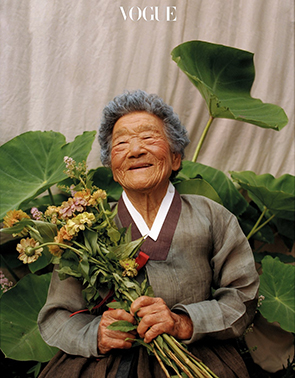 Vogue Korea's September Issue Vogue Korea September issue covered 'Halmonis'(할머니, "grandmothers") aged around 100, living in the Jeolla Province. Under the theme “Hope”, Vogue Korea chose the faces of these Halmonis as the faces of hope. The photoshoot took place in the house of each Halmoni. They were all wearing hanbok, holding flowers, and smiling. The article is in Korean, but the pictures are enough to put a smile in your heart. 👉 Link  The New National Celebration Day A clear blue sky always makes us smile. The Ministry of Environment has now declared every September 7th as “International Day of Clean Air for Blue Skies”. The day was proposed by the Korean government in the UN General Assembly last year and designated by the UN. Our mission for that day: Stop air pollution and make the sky crystal clear again! Those who want to see a clear blue sky, find out more here: Also, You Might Not Wanna Miss These...😉 Expats👪 News 1. Gyeonggi Province decided to introduce a permit system for land deals by foreigners and corporate bodies to prevent speculation. 👉 Link 2. South Korea and Singapore agreed on September 2nd to introduce a "fast-track" entry program, starting this week, for essential trips by businesspeople and others in exception to the current coronavirus entry restrictions. 👉 Link 3. The foreigner-only casino at the Paradise City gaming resort, near Incheon International Airport, is to stay closed “indefinitely”, because two staff members have been confirmed as being infected with COVID-19. 👉 Link Hmm... Worth Knowing😏 1. A man who went around spitting in young women's faces while riding a bicycle in the Jungnang-gu area got caught. He said it was ”just for fun”.👉 Link 2. High school education will be free for all students in South Korea starting next year, with expanded budget support. This will make education free for all primary, middle, and high school students. 👉 Link 3. An advertisement accusing Son Jung Woo who ran a child porn website and was sentenced to only 18 months has been displayed on the New York Times Square billboards. A group of women called “Kedo Out” put up the advertisement to denounce South Korea’s negligence towards online child sexual exploitation. 👉 Link (twitter) Meeting you every week makes us happy. We want to make sure you feel the same😁 KOMMON TEAM 수수🌾 Sans 🌻 바코🌊 오티오😈 쟈🍉 군밤🌰 기린🌴 쏘😺 기니👑
|