For dark mode users,
Hello, reader! Today, we are covering: Index Zoom In The anti-discrimination bill is back on the table, will it pass this time? Today's Vocabulary 이반 (I-ban) This Week's Recommendations “We pave the way anywhere” Don't forget to leave your feedback below!
The anti-discrimination bill is back on the table, will it pass this time? Writer: Yeon Woo Lee, Solwon Pyeon Senior Editor: Regine Armann Editor-in-Chief: Fred McNulty Researcher: Yul Jun, Daeho Park Illustrator: Ah-young Kim
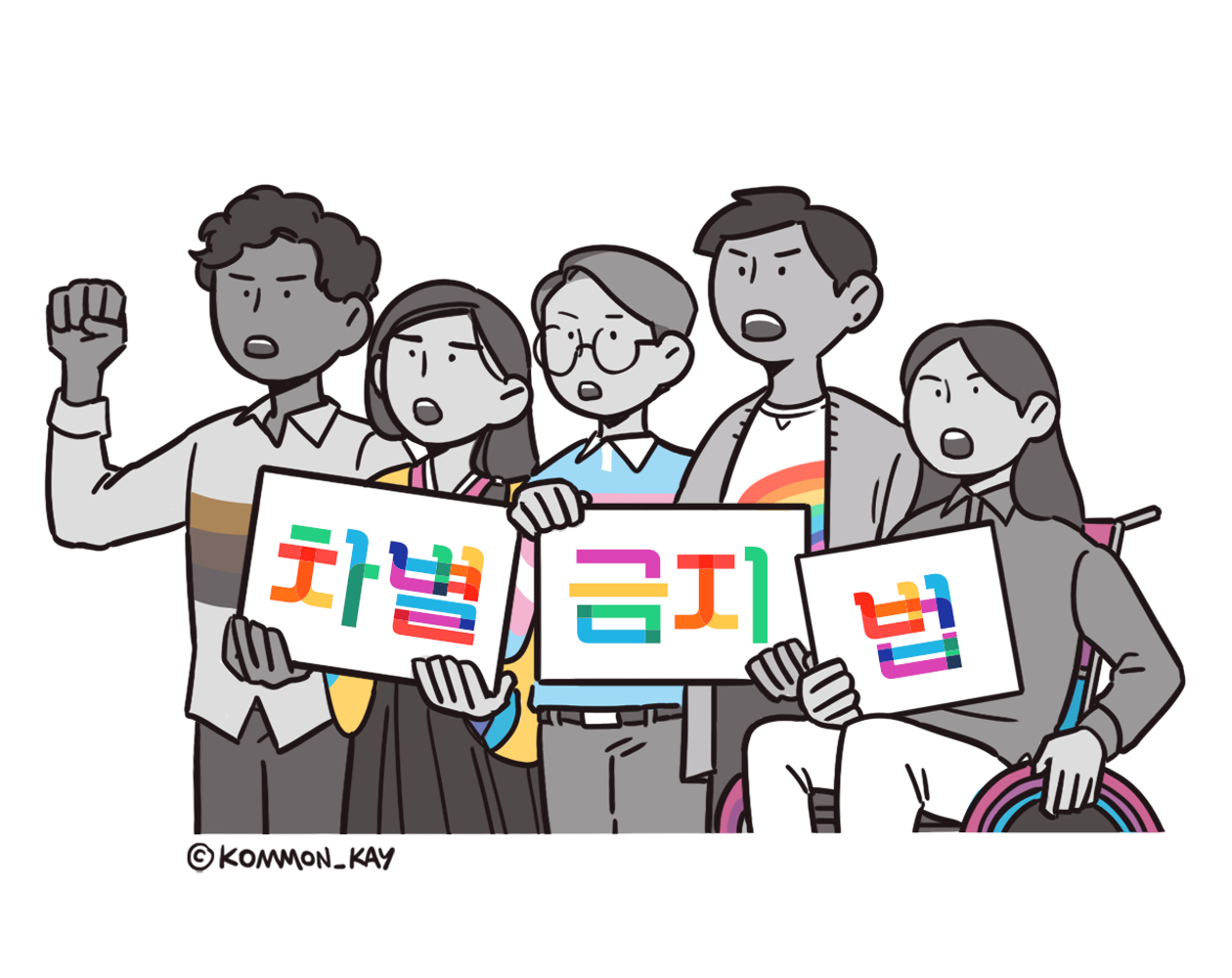
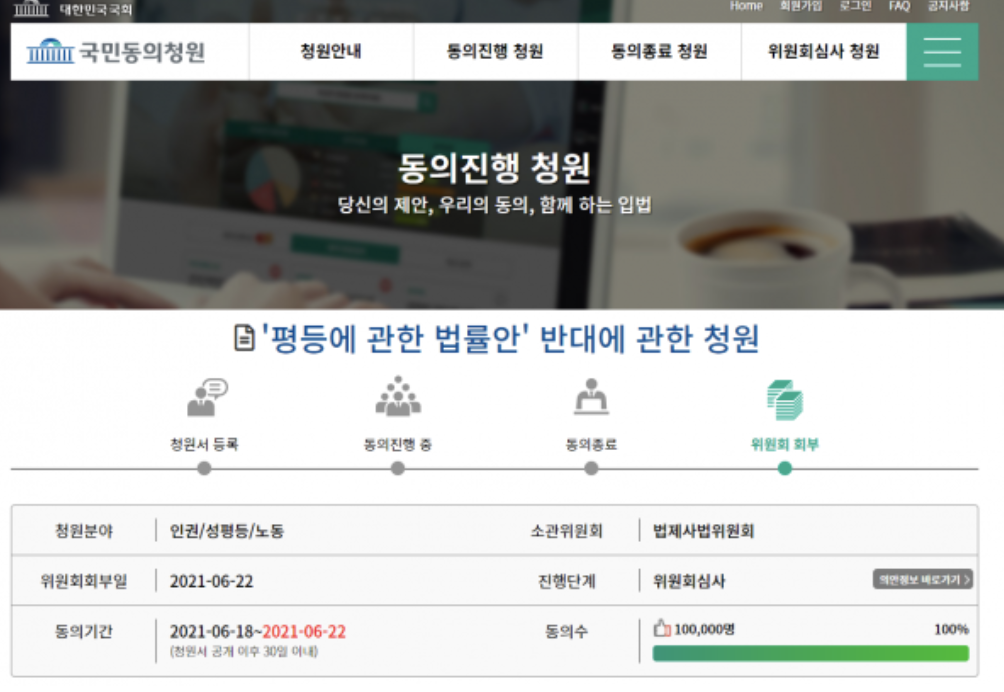
[Illustration by Ah-young Kim] Jang Hye-young, a member of the Justice Party, presented an anti-discimination law initiative on June 29, 2020 to journalists at a press conference. She criticized how the government has been indifferent toward the treatment of marginalized people and highlighted that it is time for a change. (Korean link) Lee Sang-min, a member of the Democratic Party, also proposed an initiative to introduce an anti-discrimination law on June 16, 2020. He further added that the law will “become an opportunity to embody practical equality”. (Korean link) Throughout the term of the 21st national assembly, the anti-discrimination bill was proposed four times by Jang Hye-young and Lee Sang-min as well as by Park Jumin and Kwon Insook, both members of the Democratic Party. (Korean link) The problem is that the legislative process has not led to the adoption of the law. Calls for anti-discrimination laws grow, but so do opposing voices. There is a flood of online petitions for and against such a law. The online petition shown below was posted to oppose such regulations and successfully gathered 100,000 signatures. When a petition gathers 100,000 signatures from the public, the jurisdiction committee reviews the relevant legislation. (Korean link)
An online petition opposing the anti-discrimination law Source: https://petitions.assembly.go.kr/referred/pending/C45FE62650EA257AE054A0369F40E84E What would an anti-discrimination law do? The anti-discrimination proposal prohibits discrimination on 23 factors such as sexual orientation, employment type, gender, nationality, education, medical disorders, and many more aspects. Types of discrimination range from direct and indirect discrimination to physical and sexual harassment. The purpose of this law, according to Jang, is to prevent minorities from being discriminated against for being who they are. Nevertheless, no criminal punishment (Korean link) will be given to people who commit discrimination but only recommendations of mediation or rectification. A brief history of Korea’s anti-discrimination law The anti-discrimination proposal has been knocking on the door of Korea's National Assembly from 2007 to 2020. (English link) It has had no success so far. However, some hold the view that now the moment has finally come to pass the anti-discrimination law in parliament. Public calls for the law have escalated since a 25-year-woman, Kim, revealed how sexist Dong-A Pharmaceutical’s job interviews are last March. (English link) According to Kim, who was the only female candidate for the posted position, one of the male interviewers asked if she agrees that women should receive a lower salary than men because they do not serve in the military and whether she is willing to serve in the military later. Her experience inflamed public anger since Dong-A Pharmaceutical is a company that mainly sells menstrual products. Kim put forward an online petition (Korean link) in May urging the adoption of the anti-discrimination law, and accumulated 100,000 signatures within four days. Why has parliament procrastinated on the law? 1) Opposition from conservative Christian groups According to the Ministry of Culture, Sports and Tourism’s “Religion Status of Korea 2018” (Korean link), Protestants hold by far the largest share of religious affiliations in the country, taking up 19.73% of the population. Buddhism follows with 15.53%. Protestants have traditionally exerted tremendous power in Korean politics. Opponents insist that anti-discrimination laws can restrict freedom. One pastor expressed his worries recently in an article in the Kookmin Ilbo (Korean link), stressing that asking employees at Christian organizations to be Christian can fall under the restrictions proposed by the currently discussed anti-discrimination law. Further, Christian organizations banning so-called “heretics” such as Shincheonji members from entering or asking them to leave their religious sites can also be considered religious discrimination, the pastor insists. Members of the Shincheonji church believe that Jesus selected their founder Lee Man-hee as “the promised pastor” (English link) to disseminate the ultimate truth. Nevertheless, there are divisions (Korean link) over the anti-discrimination act even inside the churches. The United Christian Churches of Korea (UCCK), a major conservative Protestant group that openly opposes anti-discrimination laws, formed a committee to stop the anti-discrimination law. The UCCK is considered the largest coalition of Protestant churches (English link), which consists of 30 denominations and includes 56,000 individual churches. On the other side, the National Council of Churches in Korea, a liberal group of churches, is supporting the law and launched an organization called “Christians for a World Without Discrimination and Hatred”. (English link) 2) Worries about the anti-discrimination factors specified in the bill Some have raised issues regarding the 23 manifestations of discrimination that the anti-discrimination law is supposed to restrict. For instance, the Ministry of Education has voiced its opinion that a person’s academic background can be counted as a reasonable discriminatory factor and should therefore be excluded from the factors listed in the bill. The Ministry said that academic backgrounds can differ in a large part according to levels of achievement that result from individual choices and efforts. However, as people criticized that the Ministry’s argument is in direct opposition to the government’s efforts to abolish elitism, the ministry withdrew its opinion within a month. (Korean link) On the other hand, whether it is okay to disregard individual efforts has become another controversy that erupted over the proposed law. 3) Existence of individual anti-discrimination laws Korea has already adopted a few anti-discrimination laws, such as the Disability Discrimination Act, the Equal Employment Act, and the Age Discrimination Act. For this reason, the new law’s opponents insist that an anti-discrimination law that includes every potential discriminatory factor is not necessary and somehow redundant. However, individual laws that protect individuals from all 23 types of discrimination do not exist at the moment. 4) Suppression of freedom of expression Under the anti-discrimination law, it is hard to distinguish between discrimination and personal preference that one is free to express and pursue. Freedom of expression is a fundamental human right. However, opponents argue that if the anti-discrimination law gets adopted, it might become a tool for the government to control public expression. They are afraid that they might have a scarlet letter for speaking what they want. Some insist even discriminative speech toward certain groups should be respected since it’s still their “opinion”. How have countries that have adopted anti-discrimination laws been affected? Among the 34 member states of the OECD, all countries except Korea and Japan have laws that are similar to the anti-discrimination bill now proposed in Korea. The Equality Act of the UK, the Discrimination Laws of Australia and Canada, and the Civil Rights Act of the USA are representative examples. (Korean link) Embassy Counselor Patrick Haber from Canada highlighted the positive effects that Canada’s Discrimination Law has had on Canadian society. He said that embracing variety is the key to making a strong country. By abolishing discrimination in the employment environment for migrants, Canada’s population growth rate has increased and is now the highest among the G7 countries. Counselor Graham Nelson from the UK insisted that people in the UK feel safe and respected due to the Equality Act. According to him, the UK has become a positive, inclusive, and optimistic society while freedom of speech or marriage traditions is not compromised. (Korean link) Current status of the anti-discrimination law People’s attention toward discrimination has grown. According to the National Human Rights Commission of Korea’s 2020 public survey on discrimination (Korean link), 93.3% believe that discrimination is a social issue and that more efforts should be made to eliminate it. 88% agree with adopting the anti-discrimination law, compared to 72.4% in a similar survey that took place in 2019. However, the UCCK refuted the National Human Rights Commission of Korea’s survey and conducted their own survey instead. According to the UCCK survery (Korean link), 47.7% of respondents do not agree with adopting the anti-discrimination law and 59.9% do not know the contents of the law or only just heard the name. Since public opinion on adopting the anti-discrimination law is so deeply divided, the national assembly will probably postpone the discussion and make no public statements regarding the issue, which goes against the major role it plays in Korean politics and legislation. (Korean link) The anti-discrimination bill still did not pass the National Assembly’s plenary sessions, even though more than 100,000 people, the minimum number required for the jurisdiction committee to take action, have agreed online on the adoption of the bill. In response to the national assembly’s silence, supporters are taking action to pass the law. (Korean link) Nationwide NGOs such as the South Korean Coalition for Anti-Discrimination Legislation criticized the National Assembly’s negligence and planned an online sit-in to express their frustration. In addition to this planned protest, 156 teenagers and 33 youth organizations have issued public joint statements that the anti-discrimination law should be adopted immediately to ensure everyone’s equal rights and sent to the national assembly. Some teenagers even expressed how strongly they feel about this issue by revealing their real names and school affiliations. (Korean link) The law will definitely change society inside out. However, to make a society that is safe and respects everyone, maybe it's really time to get it done.
Today's Vocabulary 이반 (I-ban) (異般) I-ban is an old slang term meaning “homosexual”. It is similar to the term “queer” in English. As Korea was not open to homosexual communities in the 1990s, homosexuals barely used the terms gay and lesbian and instead created their own term. I-ban was frequently used during the late 1990s in online homosexual communities and spread to the offline world in the 2000s. However, it is rarely used nowadays. This Week's Recommendations Online queer parade of the Dotface, “We pave the way anywhere”
Official poster of Dotface’s online queer parade (Source: https://pride.dotface.kr/close) Dotface, an online media start-up, has organized an annual “online queer parade campaign” since 2020, as queer culture festivals in Korea were postponed due to COVID-19. After its campaign “We make a path that never existed (우리는 없던 길도 만들지)” in 2020 gained popularity, its 2021 campaign attracted 39,000 people who participated in the online parade.
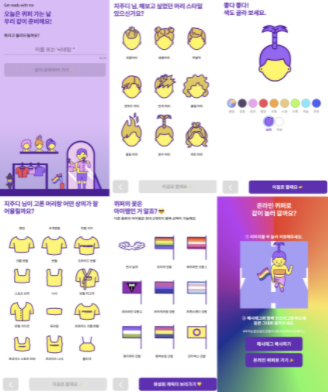
How to dress up the avatar (Source: https://www.gokams.or.kr:442/webzine/mobile/plan/view.asp?idx=2408&page=1&c_idx=48&searchString=&c_idx_2=) Participating in the parade is simple. People can dress up their avatars on the Dotface website, and share the images of their avatars on social media with hashtags such as “온라인 퀴퍼 (online queer parade)”. Dotface links the images of created avatars and runs a virtual parade that is similar to the offline one.
💚 Support us! 💚
|