For dark mode users,
Hello, readers! Today, we are covering: Cultural Insight: How Starbucks Took Over Korea Slang: Seu-se-gwon (스세권) This Week's Recommendations Gabi (가비, 2012) Don't forget to leave your feedback below!
How Starbucks Took Over Korea
Writer: Yeon Woo Lee, Solwon Pyeon Senior Editor: Regine Armann Editor-in-Chief: Fred McNulty Researcher: Yul Jun, Daeho Park Illustrator: Ah-young Kim
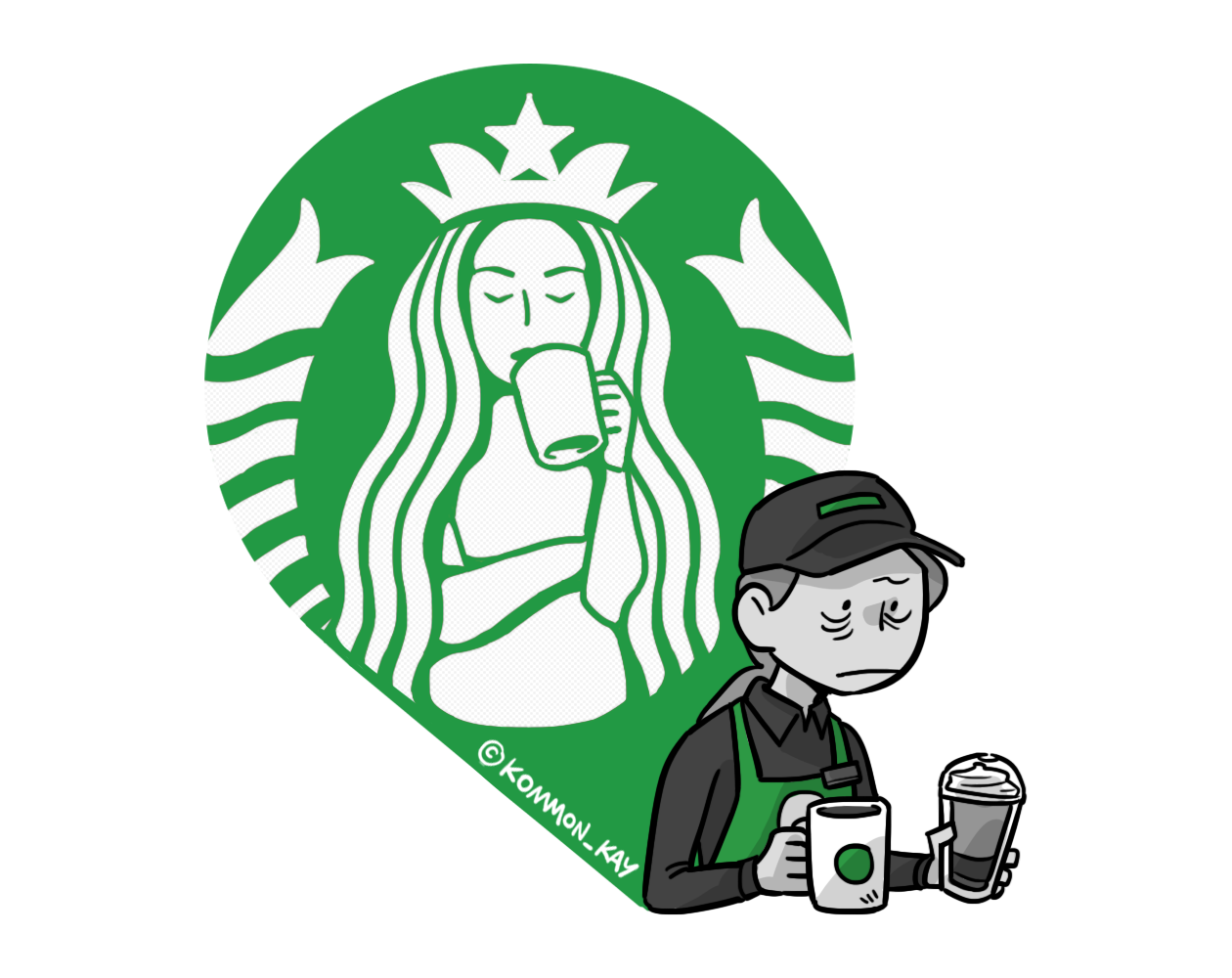
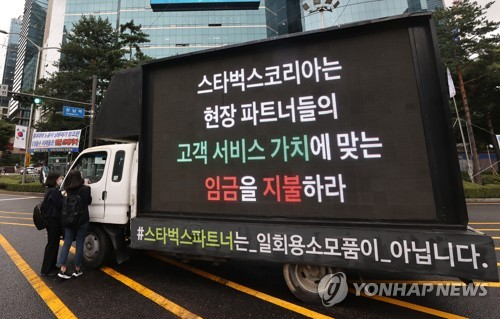
[Illustration by Ah-young Kim] From October 7 to 8, employees at Starbucks Korea held a “truck rally”. Two trucks drove around Seoul with a message that read: “Starbucks employees are not expendable. We want a working environment where we can focus on providing one cup of coffee to one customer”.
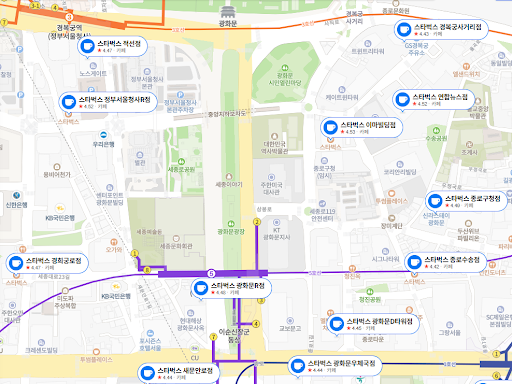
Source: Yonhap News With their first-ever demonstration, the employees of Starbucks Korea wanted to protest their heavy workload stemming from the company’s recent marketing events, where customers could receive limited-edition reusable cups to celebrate Starbucks’ 50th anniversary. Even though Starbucks limited the maximum order per person during these events to 20 cups, there were long lines in front of most local Starbucks stores, and the Starbucks app crashed when more than 7,000 users (Korean link) tried to simultaneously log in. However, this was not the first time that people went frantic over Starbucks Korea’s marketing events. Starbucks Korea’s regular e-frequency reward event, where customers can pick one item when they purchase a total of 17 drinks including seasonal beverages, always makes customers rush to the stores early in the morning before the items run out of stock. As a result, Starbucks Korea’s revenue surpassed ₩1 trillion and the company has opened 77 new local stores (Korean link) in 2021 alone, despite the COVID-19 pandemic. But why do Koreans love Starbucks so much? How Starbucks Entered the Korean Market Starbucks Korea has in fact caused a lot of controversy from the beginning. In 1999, when Starbucks was first introduced to Korea, Korea was a desert when it came to take-out coffee. The taste and prices of Starbucks coffee varieties were unfamiliar to Koreans who were used to sweet and cheap instant “coffee mix” (커피믹스). At that time, Starbucks coffee was a symbol of excessive consumption. However, over the course of several years, Starbucks successfully transformed itself into Korea’s major representative of coffee culture How Did Starbucks Korea Become So Successful in Korea? 1) Ubiquity There is a joke that Korea is not the Republic of Korea (대한민국) anymore, but is now the Republic of Starbucks (스타벅스 공화국). When you walk around the main streets of Seoul, you will come across a Starbucks store at almost every corner. For example, at Gwanghwamun Square in Seoul, there are around 12 Starbucks stores in the area between Gwanghwamun and Gwanghwamun Station alone. There are a total of 1,500 Starbucks stores (Korean link) in Korea, and Seoul is the city with the largest number of stores in the world.
Starbucks stores between Gwanghwamun and Gwanghwamun station According to Open Survey (오픈서베이), a mobile questionnaire service run by Edaily (이데일리), 38.9% (Korean link) out of 800 respondents from all over Korea favored Starbucks over other coffee chains in 2019. The main reason respondents provided for their selection was not the taste and quality of the coffee, but rather the Starbucks stores’ ubiquity. 2) Customer-oriented Service Starbucks Korea has adopted various technological tools early into their system and becomes the first coffee chain that offered up-to-date services to customers. Some services gained huge support from the Starbucks headquarters and now are also provided at Starbucks branches outside of Korea. For example, Starbucks Korea started its “siren order” system in 2014, which allows people to order directly from the app and walk into a store to pick up their purchased beverages. Nearly 5 million customers have already registered for the service and its accumulated number of purchases has surpassed 200 million (Korean link) in 2021. Starbucks Korea also introduced the Korean version of their “call my name” service in 2014, where staff doesn’t call out the customer’s real name, but the nickname they registered on the Starbucks app when their order is ready. In most cafes in Korea, customers receive an electric bell after placing their order and the bell will automatically ring when the order is ready. However, Starbucks’ “call my name service” (Korean link), has earned a positive response from customers who consider it “friendly communication” but also care about their privacy. Last but not least, Starbucks Korea implemented the “MY DT PASS” system in 2018, as a worldwide first. This system allows the automatic payment of coffee purchases by linking a customer’s car license number with their prepaid cards. As a result, customers can drive away with their coffee in drive-through stores (Korean link) without having to physically pay. The number of customers who registered for the “MY DT PASS” exceeded 1.5 million (Korean link) by December 2020. 3) Success of Its Merchandise Marketing Strategy Starbucks Korea holds seasonal events that offer limited-edition merchandise to people who fulfill the e-frequency requirements. Even though these events are only interesting for customers who are highly loyal to Starbucks, as they need to buy 17 beverages to participate, Starbucks Korea’s limited-edition merchandise has always been in high demand. However, Starbucks Korea has also encountered criticism for these reward events, because some fans hoard seasonal goods on the launch day by purchasing 17 beverages at once. Last year, one customer at Starbucks in Yeouido, Seoul, purchased 300 cups of coffee and left with a single cup of coffee and 17 “summer ready” bags, one of the items in the Starbucks Korea 2020 summer edition. The remaining cups of coffee were left in the store and about half of the cups were thrown away as nobody wanted them. What Is the Criticism Starbucks Faces? 1) Green Washing Starbucks has promoted itself as an eco-friendly corporation by offering discounts on drinks when consumers use their own bottles and replacing plastic straws with paper straws. However, Starbucks has recently been accused of “greenwashing”, which means that a company leads their consumers to believe it is environmentally friendly or sustainable, even though it is not. For example, on September 28, Starbucks Korea held a nationwide “Reusable Cup Day” event. To celebrate the 50th anniversary of Starbucks and International Coffee Day on October 1, Starbucks provided all drinks in a reusable cup to deliver an eco-friendly message and reduce the usage of disposable cups. However, the reusable cups were made of plastic and consumers questioned whether the event matched the initial plastic-free concept. Lee Eun-hee, a professor at the College of Consumer Science at Inha University, was cited in the Korea Financial Times (Korean link) as stating that this event was a representative case of a plan and the contents of an event not matching. She further stated that “Although the original purpose of the plan was very eco-friendly, providing plastic cups makes it hard to consider it [an eco-friendly event].” 2) Intense Working Hours and Low Salaries Despite Starbucks' reputation and popularity, employees do not seem to enjoy working there. An anonymous user who claimed to be a Starbucks store manager wrote a post on Blind (블라인드), an anonymous community app for employees, stating that the company did not plan the 50th anniversary event properly and only overloaded their employees (Korean link) with work. The user added employees go through mental and physical hardship because there are often not enough workers to cover the intense workload. In 2020, according to data by the National Health Insurance Corporation and the Korea Labor Welfare Corporation, over 613 people (Korean link) who worked at Starbucks underwent treatment for mental illness, which is about 5 to 6 times more than 5 years ago. And yet they tend to feel they are just expendable for the company. Moreover, the salary Starbucks pays is noticeably lower compared to the high intensity of the work. JobKorea (잡코리아), a recruitment website, reported that 81% of Starbucks employees on average receive a yearly salary of less than ₩30 million. Starbucks baristas were known to earn about ₩1.3 million per month (Korean link), working 5 hours each for 5 days. However, their income is not increased even when they have been working for long periods of time, and people on such wages experience financial hardships due to not earning enough money to cover their living costs.
Slang Seu-se-gwon (스세권) Seu-se-gwon means a residential area or zone with Starbucks located nearby -- “so close that you can go there in your slippers from home”. A: 이 집은 제가 살기에 너무 비싼 것 같아요. B: 그치만 스세권이잖아요! 스타벅스가 걸어서 1분 거리예요. A: I cannot afford this house. B: But it’s in Seu-se-gwon! You can walk to Starbucks within one minute. This Week's Recommendations Gabi (가비, 2012) Taking place during the Joseon Dynasty, the story follows the first introduction of coffee to Korea under the reign of King Gojong in the later part of the 19th century. While seeking refuge in the Russian consulate after his wife, Empress Myeongseong, was assassinated by the Japanese army, the King tries coffee for the first time and falls in love with it. Upon his return, he hires Tanya as his personal barista. Tanya, along with her lover Ilyich, a Russian sniper, then gets tangled up in an elaborate plan run by a Japanese officer named Sadako to assassinate the King. How will Tanya's role as the barista play out during this scheme? "There is a proverb saying that the words you say when drinking coffee are as light as dust" - Tanya, Gabi
|