For dark mode users,
Hello, readers! Today, we are covering: Index Zoom In Where’s the beef? Revisiting the 2008 anti-US beef protests Today's Vocabulary 바늘 도둑이 소 도둑 된다 (He that will steal a pin will steal an ox) This Week's Recommendations Old Partner (워낭 소리, 2008) Don't forget to leave your feedback below!
Where’s the beef? Revisiting the 2008 anti-US beef protests Writer: Fred McNulty, Sunny Um Editor: Aleya Sharif Senior Editor: Regine Armann Illustrator: Ah-young Kim
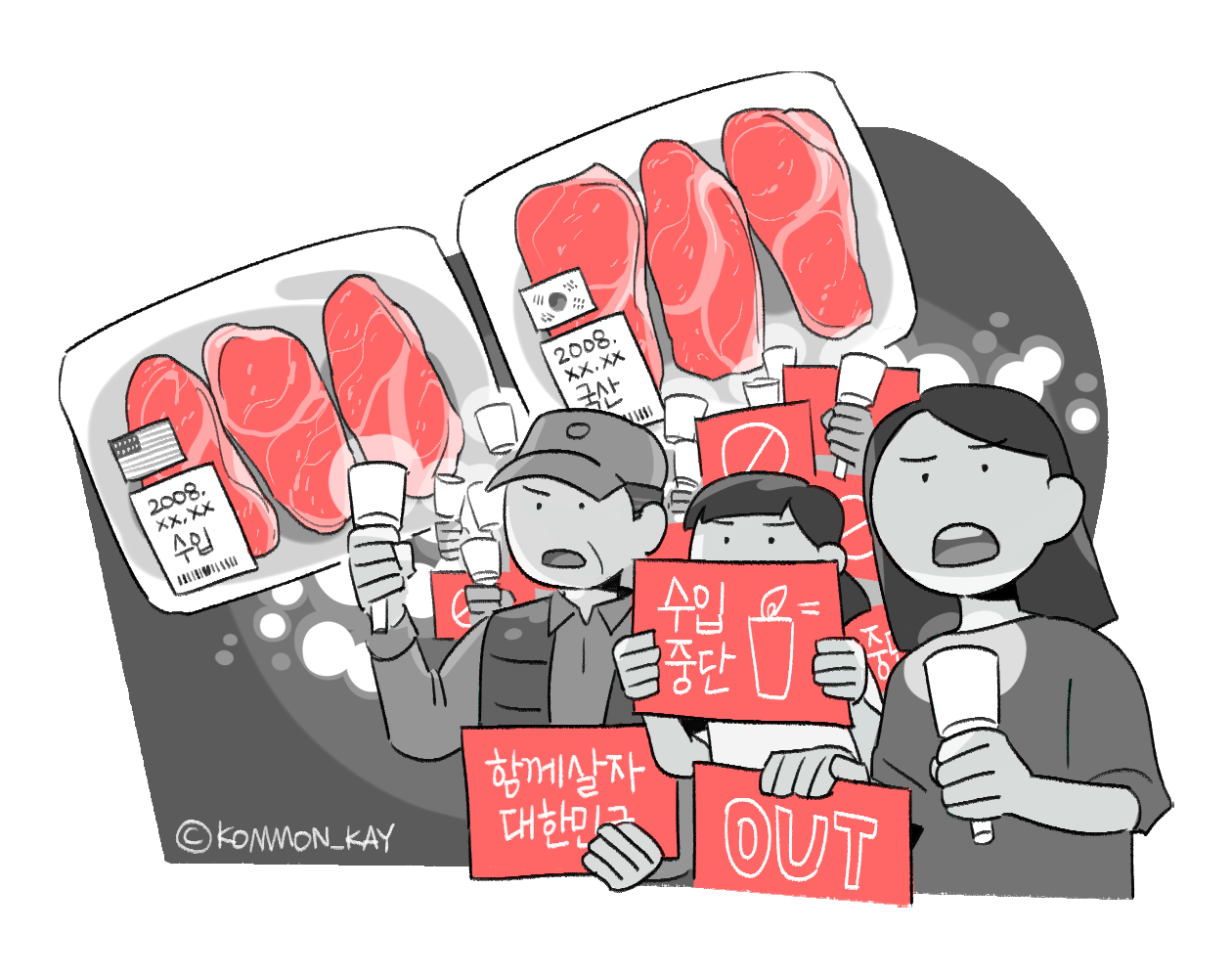
[Illustration by Ah-young Kim] Introduction March 15 marked one decade of the full implementation of the Korea-U.S. Free Trade Agreement (KORUS FTA). Negotiations over the agreement began in 2006, but took nearly 6 years to finalize due to considerable political upheaval. This ten year anniversary also comes as conservative President-Elect Yoon Suk-yeol (윤석열) seeks to expand free trade agreements abroad while pursuing a slew of controversial social policies on the domestic front. With Yoon’s transition from “President-Elect” to “President” approaching rapidly, we thought it was fitting to revisit the 2008 protests against the import of U.S. beef, which served as a proxy to critique free trade agreements. These protests were among the largest demonstrations in Korean history at the time, making international headlines in a manner that would foreshadow subsequent mass rallies. Why were beef imports so controversial? In the summer of 2008, mass protests in Korea made international headlines. At its peak, these demonstrations included more than 1 million demonstrators, all of whom were either members of more than 1,800 participating civil groups or individuals who had galvanized their support online. As with any sizable protest, there were people from all walks of life advocating a number of different causes, but these protests were jump-started by scares of mad cow disease entering Korea through the import of beef from the United States. While there had been several confirmed cases of the disease on U.S.-based farms, the accusations of the protesters were highly politicized, with many people using concerns of mad cow disease as evidence that the ensuing Korea-U.S. Free Trade Agreement did not protect the security and safety of Koreans. The Korean-United States beef trade has its roots in the 1990s, as Korea’s economic successes turned it into a prime target for major U.S. beef exporters. By 2003, 75 percent of all beef in Korea was imported from foreign sources, with U.S. beef making up half of that amount. At that time, Korea was the third largest export market for U.S. beef, accounting for one-fifth of the entire U.S. beef export industry. In that year alone, the United States shipped $815 million USD worth of beef to Korea—more than double the $390 million USD from the same trade in 2001. The Korean-U.S. beef trade was big business. However, on December 23, 2003, a case of bovine spongiform encephalopathy (BSE) or, more commonly, mad cow disease, was discovered in a cow in the northwestern state of Washington. The cow had been imported from Canada to the United States in 2001. What makes mad cow disease particularly hard to track is its long incubation cycle. According to the U.S. Food and Drug Administration, there is an average span of six years between the time a cow contracts the disease and the occurrence of symptoms. The cow then dies anytime between two weeks and six months later. Despite urban legends, humans cannot get the disease by drinking milk. Like in cows, symptoms of the disease can only be identified in humans when it is in its advanced states. The fallout from the December 2003 discovery was devastating: the Korean government banned beef imports from the United States. They were not alone, as some 65 other countries had placed restrictions on U.S.-bred beef by 2006. From 2004 through 2006, virtually no U.S. beef was exported to Korea. In its absence, beef exports from New Zealand and Australia stepped up to fill this void: in 2007, they made up 92 percent of Korea’s beef imports; that same number was 29 percent in 2003. The United States government was unhappy with this massive loss in trade, and sought to repair the damage that had been done. In January 2006, the United States and Korean governments coordinated an agreement to allow boneless beef only from cattle that were less than 30 months old. After implementation in late 2006, Korean regulators rejected U.S. imports after finding small fragments of bone in a few crates. In April 2007, the import of U.S. boneless beef continued in Korea throughout the year, despite Korean regulators’ finding more bone fragments in October 2007. In April 2008, before a meeting between then-U.S. President George W. Bush and then-Korean president Lee Myung-bak (이명박 대통령), negotiators in Korea came to a joint agreement on the import of U.S. beef. The deal allowed for all cuts of U.S. beef, regardless of bone content and regardless of the age of the cattle, given that specified risk materials known to transmit mad cow disease are removed. It also contained some other minor technical specifications. While some minor regulations remained in place, in effect, this was a lifting of the ban on the import of U.S.-bred beef. How did the protests begin? The reaction from critics in Korea was swift. Between May and August 2008, this decision mobilized hundreds of thousands of people to protest in Korea. While this was without a doubt the catalyst for the protests, it was by no means the only issue that was being raised by the protesters. These demonstrations became known in Korea as the “2008 candlelight protests (2008년 촛불 시위)”. At night, participants would hold candles to show their solidarity with the cause. On June 10, the demonstrations amassed the largest number of protesters of the entire campaign, with one million people coming out. The first wave of protests started on May 2 and lasted through May 28. These focused on candlelight demonstrations, where masses of people would protest holding candles as a symbol of their determination. These were initially held at Seoul Plaza (서울광장), in front of Seoul City Hall, and at Cheonggye Plaza (청계광장). On May 24, the protesters left from Cheonggye Plaza and marched toward the Blue House (청와대). On the way, the protesters had to pass the headquarters of the Chosun Ilbo (조선일보) and the Donga Ilbo (동아일보), two of the largest conservative news organizations in Korea. These papers were sympathetic to the Grand National Party (한나라당)—which has morphed into the present-day People’s Power Party (국민의힘당) in 2012—and President Lee Myung-bak, while being critical of the protesters. Although the Seoul protest was the most pronounced protest, similar demonstrations occurred in many other areas of Korea. Seoul likely received most attention both in a symbolic manner—as it is the capital city—and also as a matter of sheer numbers, as roughly half of the population of Korea lives in the Seoul metropolitan area. Organizers recognized the power of using the Seoul protests as inspiration for satellite demonstrations, as they used then-new technology to live stream scenes of the action to the internet in real time. Why were people so focused on mad cow disease? Most mad cow disease concerns can be traced to an episode of an investigative journalism news program called PD Suchop (PD수첩), or “PD Notebook” in English. The episode in question was entitled “US Beef, Is It Really Safe from Mad Cow Disease?” and it aired April 29, 2008 on the television network MBC. The episode used 2008 footage from the Humane Society of the United States to raise questions about the efficacy of U.S. health standards. The coverage focused on so-called “downer” cows, which are too sickly to stand on their own. However, there was no evidence in these videos to suggest that any of these bovines had mad cow disease. The second portion of the program focused on Aretha Vinson, a woman who died of neurodegenerative disease in the eastern state of Virginia. The implication from PD Notebook was that she died from eating U.S.-bred beef, although the evidence at the time did not support that claim. The real issue with PD Notebook’s reporting was an inconsistency with its translations from English to Korean. Whether the woman had Creutzfeldt-Jakob disease (Classic CJD)—which is totally unrelated to mad cow disease—or Variant Creutzfeldt-Jakob disease (vCJD) was left unclear by the program. The staff of PD Notebook would later go on to apologize for these mistakes, but also noted, “[we] cannot agree with those that try to turn the entire content [of the report] into a distortion and propaganda, based on minor mistranslations.” This apology aired on June 24, 2008 in an episode of PD Notebook intended to defend the original report. Shortly after the June episode aired, one of the translators of the original episode came forward to criticize MBC. Jeong Ji-min (정지민), a 26-year-old freelance translator with a history of translating for MBC, stated, “PD Swuchep’s claim about erroneous translation was misplaced, and what was at issue was PD Swuchep’s misreporting of US beef import issue due to the production team’s intentional exaggeration of the risk of [mad cow disease].” While this controversy would eventually find its way to a highly-publicized courtroom battle, the damage had already been done. What happened to the KORUS FTA? On June 21, well before the protests died down in mid-August, the Korean government accepted renegotiated changes to the manner in which U.S. beef is imported to Korea. The import of cattle parts such as brains, spinal cords, or eyes were totally banned from import. Although primarily for show, the Korean government had also secured greater abilities to inspect meat imports. At this point in time, the conservative Grand National Party held a majority of seats in the National Assembly and Lee Myung-bak was president. Although the protests were a huge issue, they ultimately lacked the leverage to torpedo the KORUS FTA. For historical context, since the 1980s, the United States started attempting to persuade Korea to accept more liberalized trade agreements, but to no avail. The Korean government, which has traditionally undertaken protectionist policies to aid its domestic industries, managed to avoid these attempts. But since the IMF crisis in the 1990s, Korean conservatives felt empowered to push neoliberal reforms, which included trade liberalization. To be clear, the protests were not the only confounding issue. The Korean Institute of Industry and Trade (산업통상자원부) argued that China should have been considered for a free trade agreement before the United States, due to the two countries’ geographical closeness and sheer size of the trade. The agricultural sector in Korea, which had benefited heavily from protectionist policies, fiercely opposed the liberalization of trade laws. In the United States, auto workers’ labor unions fought the deal for the threat of Korean-made cars having an easier time entering the domestic market. Conclusion With President-Elect Yoon Suk-yeol less than two months away from entering the Blue House—or wherever he ends up working out of—free trade agreements have the potential to once again become a political hot topic. Will soon-to-be President Yoon make good on his commitment to future free trade agreements in spite of the liberal majority in the National Assembly? Or will he eschew that part of his agenda in the face of opposition? Only time will tell.
Today's Vocabulary 바늘 도둑이 소 도둑 된다 (He that will steal a pin will steal an ox) This Korean idiom says crimes should not go unpunished, however small they might be, for example, stealing a needle pin. There is no guarantee that the thief will not commit another crime, maybe aiming for a bigger target the next time, let’s say, a cow. A cow used to be considered an important asset in every household, since Korea’s economy depended on agriculture until the mid-1900s. So, as the idiom says, it is better to hold thieves responsible for their small crimes before they repeat similar, or even worse, crimes. Example: A: 어제 걔가 내 사탕을 몰래 가져간 거 있지. B: 야, 빨리 뭐라고 해! 바늘 도둑이 소 도둑 된다, 너? A: That person took my candies without telling me the other day. B: Dude, you should say something to that guy! Don’t you know that someone who steals a pin will steal an ox later? This Week's Recommendations
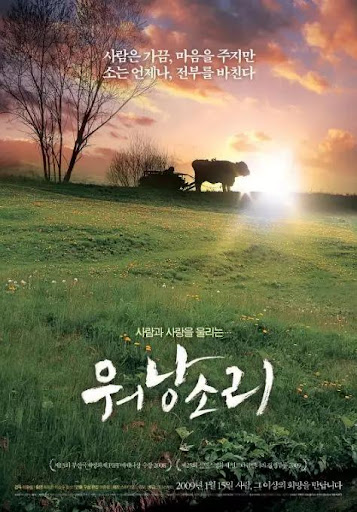
Old Partner (워낭 소리, 2008) Available on Watcha The 2008 film Old Partner (워낭 소리, literally “Cowbell Sound”) is a documentary that focuses on a 40-year-old cow and a rural, low-income, octogenarian farmer. The farmer adores his cow, rejecting pleas from his wife to sell it for retirement money. Their children, who have moved out of the rural countryside to urban areas, also attempt to persuade him to sell.
💚 Support us! 💚
|