#Rocket Delivery #Coupang #Couriers #Republic of Celebrities
Hello, reader. This week, we are covering: 🍀A workplace where people are dying - 3 Minute Read 🍀Celebrity dependence -6 Minute Read 🍀Slang: "Don't cross the line" in Korean? 🍀What's trending now? : 떡볶이 Masters 🍀Headlines 😏 Don't forget to leave your feedback at the end of the newsletter! Quick survey. Which do you prefer for the links? Rocket Delivery: Bloodstained 🍀3 Minute Read
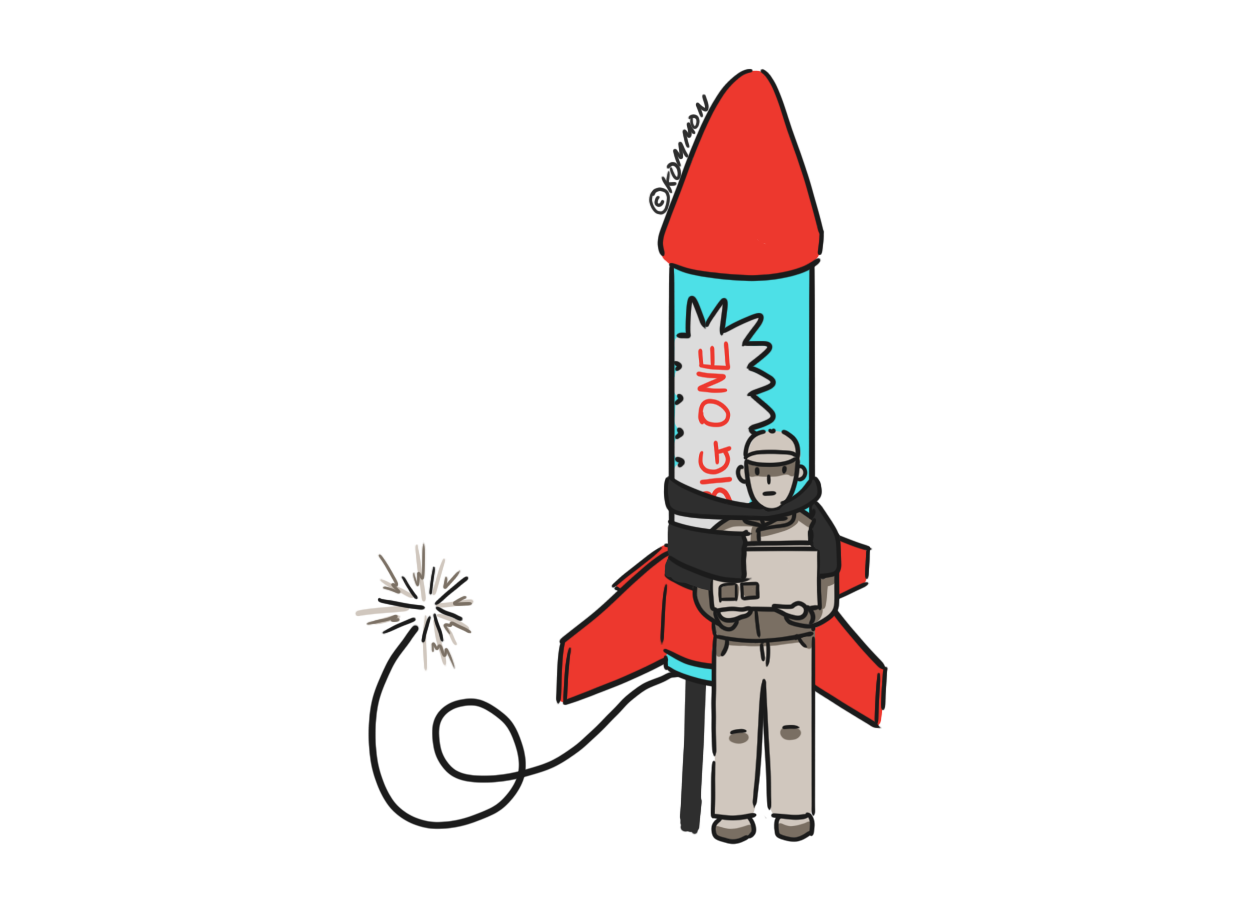
[Illustration by O.T.O] #EarlyMorningDelivery #RocketDelivery Have you ever received your parcel at 7 AM, even when you ordered it at 11:30 PM the night before? This delivery service, called "새벽배송" (early-morning delivery) or "로켓배송" (rocket delivery) amazed people when it was first introduced and is now popular nationwide. *🎁Early-Morning Delivery: When you order something online until a certain time (usually between 8 PM and midnight), you can opt for early delivery. This service is currently available in the capital area, even on weekends. This convenience is made possible by the couriers. 😰However, recently, multiple cases of death from overwork have been reported. Three men died this October alone, and 14 deaths have been counted this year so far. Due to the pandemic, the volume of orders that each courier has to take care of has increased 30%(Korean) compared to last year, and this has led to these tragedies. One of the couriers, reportedly suffering from general life hardships, committed suicide after being harassed by his delivery agency over some work-related conflict.
📦 How many hours do couriers work? Here is a more vivid description of how these people work. We followed a day in the life of an average courier based on this article(Korean). 🚛 A day in the life of a courier 🚚 06:00 Wake-up. 06:40 Commute to a distribution center. 07:00 ['까대기' (sorting) time] Sorting out the parcels that have arrived in the terminal and loading them onto the truck. 11:00 Lunchtime. (👷: Oh, I need to hurry. I have only 5 minutes to eat.) 14:00 Sorting finished. (👷: Now it is time to deliver! I was allotted 300 parcels.😵) 18:00 👷: I could not load all of my parcels onto my small truck. I need to return to the distribution center and pick up the rest. 19:00 Another round (during rush hour). 21:00 All done. Get back to the terminal and do the extra work. 22:00 Go home (finally).
💸 How much do they earn? Couriers often work 15 hours straight, like described, but earn only 200,000 won for a whole day. On days when there is not much to deliver, they can earn as little as 30,000 won for a whole day. This happens because couriers do not get a regular salary but get paid per case. If they work 6 days a week, their average earnings come to 4,580,000 won. However if you deduct all their expenses, such as vehicle maintenance fees and consumables costs, what they take home is about half of that (2,350,000 won)(Korean). The hourly wage they get is in fact lower than the legal minimum wage. Moreover, this "sorting out" process, called "까대기", is unpaid work but takes a long time (7 hours a day). That is 7 hours of unpaid work. Parcel companies insist that the loading is included in the couriers' payment per delivery.
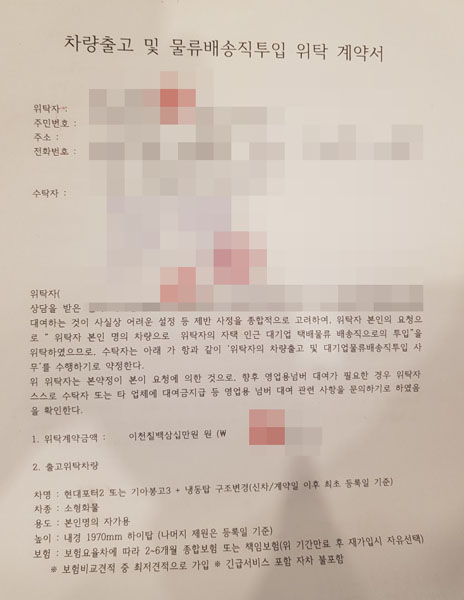
📃 Why do they have to endure such poor working conditions? Here is the real contract of one such courier.
The contract describes the courier as an individual subcontractor, not as an employee of the company. Couriers get paid per delivery case. That means that, strictly speaking, they are suppliers, not employees, of the company. Korean law interprets labor contracts between individual contractors and companies as "coordinative contracts". Companies are not obliged to assure individual contractors' working conditions. This means that individual contractors' (e.g. couriers') working conditions are less well protected than those of normal employees. Furthermore, contracts via agencies allow the parcel companies to dodge their responsibility for their couriers' working conditions. The couriers usually sign a contract with the parcel company's agency, which then acts as the contracting party. The parcel company can then legally shift the responsibility to its agency. 😟 We cannot take this anymore Long before the consecutive deaths, a collective of couriers demanded certain measures to parcel companies. They requested to be paid for loading work and that additional workers be hired for the sorting and loading process. They also demanded a system that makes parcel allotment more effective. Some have claimed that the subcontract system needs to be abolished altogether. Couriers are in the hands of the agencies who often act like despots. Abolishing the subcontract system could put the responsibility for the couriers' labor back where advocates argue it belongs, with the parcel companies.
💬 Responses from the government and enterprises 💁The government: Three years ago, the government already announced improvements in the treatment of delivery workers, but nothing has been implemented. Since they were criticized on this issue again recently, the government said there will be "emergency inspections" of courier services. They will also introduce standard contracts for couriers and clarify their work scope. 🙇Enterprises: They argued that they did not do anything wrong at first. However, as public criticism grew louder, they apologized and promised to make improvements. We would like to see everyone being treated fairly at their workplace. To every 기사님 (courier): Thank you for your service, always!👍 Republic of Celebrities? 🍀6 Minute Read
[Illustration by O.T.O] Have you heard about her? 👥💬 There was big news in the entertainment industry recently. "Irene" and 'gapjil' have been at the top of the real-time search words on internet portal sites. Irene, a member of the girl group Red Velvet, has been accused of "power trips" and of abusing her staff. It became a big issue because some of her victims testified, with one claiming to have a recording of a bad incident. The Internet was shaking until the case was publicized, the public handed out criticism, and Irene apologized. Are you not interested in the entertainment industry? Then you might not know! By the way, have you ever heard people talking or saying, "How can you not know!" It is impossible to imagine our society without celebrities. People are really interested in celebrities. 👓 Republic of Celebrities Korea is a real "celebrity republic". Celebrities are everywhere in Korean daily life. Celebrities appear on TV, on the streets, and even in chicken boxes. All kinds of TV programs and advertisements were taken over by celebrities. People enjoy programs where celebrities date, raise children and travel. Celebrities are even used to advertise part-time jobs that have nothing to do with them. Controversies over celebrities become quickly heated and, like this incident, they also dominate the internet portal site's trending topics for days. It seems this society revolves around celebrities. 🙎 Why did this happen? There are several reasons why Korea became a "republic of celebrities". 1. How the industry became this huge 😮 Well, let us take a look at how the Korean entertainment industry has developed. A few big companies, which became hugely successful by "systematically managing" their groups have been leading the industry since the late 1990s. Until the early 2000s, entertainment companies were not an "industry" but just businesses ran by individuals. 👉 However, after the success of H.O.T and S.E.S, companies settled on the "systematic management" strategy and gained huge successes in foreign countries as well. BOA, TVXQ (동방신기), Girl's Generation, and Big Bang are examples of this development. BTS is now the biggest success this industry has ever seen. Since all these groups succeeded by separating themselves from "ordinary people" with the help of the systematic management approach, this system became prevalent across the whole industry. As a result, entertainers are now not merely people who work in popular art. Instead, they are seen as "different" and "superior" figures to "ordinary people", both socially and economically. People want to know everything about them, since entertainers are considered socially important figures. And it is taken for granted that a few entertainers who succeed take home the money and the people around them work for peanuts, since it is entertainers who are irreplaceable, unlike "ordinary people". 2. Obsession with social success 💎 Social success is highly valued in Korea, and the indicators of social success are very limited. Have you ever heard the expression "sa-job"? It describes jobs that end in "sa", such as lawyers (변호'사'), doctors (의'사'), and judges (판'사'), showing the classification of jobs in Korea, with "sa-jobs" rated higher than others. Also, universities are ranked, it is very clear which universities are prestigious, and there is a universal agreement that students have to go to a good university to become a "successful person", leading to fierce competition over education. People who pass the standards for success that are socially defined and evaluated are considered "decent" and treated with respect. Those who fail to meet the standards are treated as losers and afraid of the holidays when they have to face their relatives. Celebrities are unique examples of "successful people", having a great reputation and an astronomical income that is incomparable to that of non-celebrities. It is hard to buy a house in Seoul, even with a lifetime office-worker salary, but celebrities often become owners of buildings at an early age (Korean). The public yearns for the lives of these unrivaled achievers and becomes obsessed with them. 3. Collective culture 👭👫👬 Korea has a strong collectivistic culture. Being treated differently and standing out is not considered desirable. That is why Korea is especially sensitive to trends and why things go viral very fast. For example, when a snack becomes popular, like the infamous Honey Butter Chips, it gets sold out across the country immediately. Likewise, students follow every trend religiously, like when they all wear the same brand of padding. This trait led to a tendency to follow people in the media, namely celebrities. This is how the portal sites’ "trending topics" were created. And as these "trending topics" became more and more dominated by entertainment-related issues, the "celebrity republic" of Korea became consolidated. 💁 Social phenomena that illustrate the "celebrity republic" 1. Too many people want to be celebrities 😍 There are more than 130 departments at universities where students can major in theater, film, and broadcasting entertainment across the country, and more than 1 million people are currently aspiring to be entertainers. There are also a number of audition programs that have been popular for a long time, which are evidence of the high number of aspiring entertainers. Many audition programs have been aired, such as K-Pop Stars, Mix Nine, Mr. Trot, and Superstar K. The characters on the show become the talk of the town, and people follow each episode. 2. A society where everything about celebrities is talked about 👄 Clothes and accessories worn by celebrities and even their favorite foods immediately become hot topics, and people try to buy them. It is common for celebrities to "sell out" what they wear. TV shows every aspect of celebrities, with their families even becoming the main characters of many shows. A program where children of celebrities travel drew some backlash, and the broadcasting industry was criticized for going too far by sending celebrity families on trips. A program called “Point of Omniscient Intervention (전지적 참견 시점)” that shows celebrities and their managers' daily lives has also stirred some controversy. The program's panel, praising the managers for taking good care of their celebrities, has been criticized for solidifying the perception that celebrities should be supported by others. This show is one of the many examples of celebrities being treated as a different class. 3. “Deified” celebrities 👑 Have you ever heard of the word "조공 [jogong] (tribute)"? Originally, the word was used for a subordinate country offering gifts to a suzerain state, but it is now used when fans give gifts to celebrities. Does it not seem strange that the word "tribute" is used instead of "giving", as a favor? This is another sign of deifying celebrities as if they were a different class. The words "celebrity(연예인)" and "general person(일반인)" themselves are examples of this phenomenon. These words describe celebrities not just as cultural and artistic workers like actors and singers, they indicate a hierarchy. Besides, in Korea, celebrities are regarded as the standard of beauty and people tell each other that they resemble some celebrity as a way of complimenting someone’s appearance. For example, if someone tells you that you look like a handsome celebrity, that is definitely a compliment. A few years ago, an app became popular that found celebrity pictures that resembled a user’s face. 4. Celebrity all-aroundism 👗 Food, liquor, and cosmetic brands and even apartment complexes are using celebrities as marketing tools. Not only companies but also government agencies and NGO organizations have celebrities as ambassadors. The government and public organizations have spent 7 billion won for 10 years (since 2004) for celebrity ambassadors(Korean). Most people believe that using celebrities will help with whatever they want to promote and rely heavily on their influence on customers, audiences, or public opinion. 5. Special favors given to celebrities 💫 The government recently announced that they will allow some pop culture artists to delay their military service (our past issue on military exemption of pop culture artist: link). Does that mean that male entertainers usually go to the army just like "ordinary" people? Well, no. There was an "entertainment soldier" system, until it was abolished in 2013 due to public uproar over the privilege of these soldiers. The system was allegedly in place for performances and promotions for the military, but it was also used to give privileges to entertainers. The entertainment soldiers got longer vacations and had a more "comfortable" time at the military than other soldiers. What do you think? Do you agree this culture exists in Korea? Let us know how you think😏 : Mail to Us 👭Korean Slang
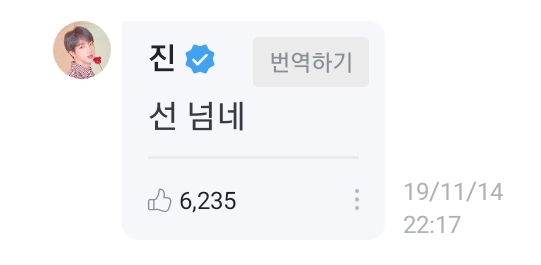
Do not cross the line! "선 넘다" "선 넘다" [seon
neomda] / "선 넘네" [seon neomne]
past tense "선 넘었어" [seon neomeosseo]
adjective "선 넘는" [seon neomneun] Meaning: Generally, this expresses a warning when
someone is impolite or makes unnecessarily blunt or inappropriate remarks,
meaning "Stop it". We can say "Do not cross the line" in English. Usage: In Korea, where age defines the social hierarchy,
this sounds very rude when said to someone older or superior, so be careful! It is often used when
friends are joking with each other, or when a boss or supervisor warns their employee
or junior.
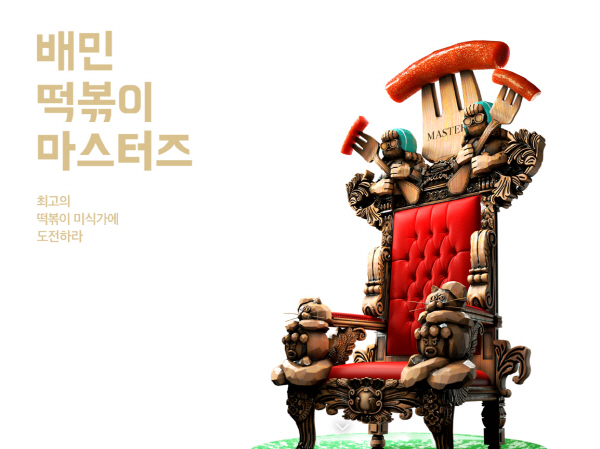
Example: 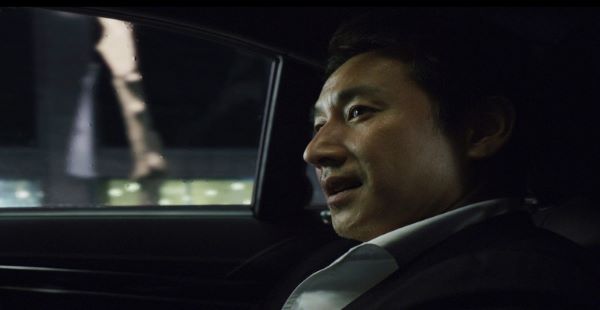 👥 The movie <Parasite> Ki-Taek, the driver employed by Mr.Park, touches on personal detail. Mr.Park replies with this expression with a firm tone: "선 넘었어." 👭What's trending now? The Event. Do you enjoy eating 떡볶이 [tteokbokki], an all-time favorite food of most Koreans? The Baemin,
a delivery application, ìs holding the "Baemin 떡볶이 Masters" event.
*Click the image to visit the website. They say that absolute taste, a sense of
humor in memorizing information about 떡볶이 restaurants across the
country, and a passion for 떡볶이 will be the key
screening factors. They are serious about this, I can tell lol.
Interested? You can do a self-test of your "떡볶이 power" on the website (click the image). You can apply for an online exam from November 4, and the exam will be held on
November 11. If you are a huge fan of 떡볶이, I think you
should apply. The winner will get 365 떡볶이 coupons.
Also, You Might Not Wanna Miss This...😉 1. Samsung chairman passed away
Samsung chairman Lee Kun-Hee died at the
age of 78 on October 25. After his heart attack in 2014, little has been released
about his condition. His heirs will pay around 10 trillion won as inheritance
taxes for just stock assets, and there is an ongoing controversy regarding the
current tax rate (60%). 2. Is it okay to get the flu shot?
More deaths have been reported after flu vaccinations.
So far, 59 cases have been reported in total. The Korea Disease Control and Prevention Agency
announced that no direct link between the death and the vaccine was found and that
they will continue the free flu vaccination program. 3. "K-police" in Thailand
Water cannons being used against protesters
in Thailand turned out to be imported from South Korea. Some criticized the
government for supplying such equipment to foreign countries where it might be
used to suppress democracy. 👉Link (Twitter) 👉Link (Korean) 4. A pastor gets suspended after blessing
LGBTQ
The Korean Methodist Church suspended a pastor for blessing LGBTQ people. Lee Dong-Hwan, who held
a blessing ceremony for LGBTQ people at the Incheon Queer Festival last year, was
suspended for 2 years, which is the maximum penalty. 👉Link (Korean) Wait! Lack of feedback recently. We are waiting for you here👪 KOMMON TEAM 수수🌾 Sans🌻 바코🌊 오티오😈 쟈🍉 군밤🌰 기린🌴 쏘😺 기니👑 프레드 Know someone who would like this newsletter? If people around you have said one of these, they might be interested: 👩"I can't understand why people in Korea act or think like that." 👨"I don't know how to start a conversation with my Korean co-worker." 👱"I want something worth reading about Korea, not just a silly gossip." 👧"I want to read the news without being annoyed."
Does this remind you of someone? Share this link and help them get subscribed. The conversation's always better with more friends💑
|