#Trend #Bukae #lifestyle #two-jobs #유재석 For dark mode users,
Hello, reader! Today, we are covering: Headlines: Virus outbreak at unauthorized missionary institutions, an extra benefit for veterans abolished, and more Cultural Insight: Do Koreans have multiple personas?: Bukae Syndrome Slang: People having multiple jobs: 투잡 & N잡 Do you like today's newsletter? Check out the link at the end of the newsletter🙌
COVID-19 COVID-19 spread again from virus outbreaks of unauthorized missionary institutions On January 30th, there were 350 more reported COVID-19 cases due to the virus outbreaks that occurred at IM Mission, which is an unauthorized facility and a private school dedicated to recruiting and training new Christian missionaries. The city of Daejeon decided to conduct further inspections related to IM Mission’s breach of quarantine guidelines for COVID 19. The current rule stipulates that the social gathering should not happen within a group that has more than 5 people. Another outbreak linked to a religious group occurred in Gwangju, despite the no face-to-face worship rule enforced by the city government. This is part of a string of mass infections caused by religious institutions, following the Shincheonji outbreak in February and Sarangjeil Church outbreak in August. According to research, a total of 33% of outbreaks occurred in religious establishments. Link Politics The government instructs public institutions to abolish the “extra points for military service” In South Korea, those who have served in the military are eligible for extra “points” in employment. According to the National Assembly's Political Affairs Committee, 89.9% of public institutions and government corporations, which receive public funding, recognize the time in the military as work experience. 40.3% of the private sector also count the time spent in the military as a career. The extra points allow the recipients to receive one or two-step increases in salary grades. The system was set up to compensate for the time people have spent during the mandatory military service period. Workers who served in the military typically receive higher salaries and get promoted 1 or 2 years faster. However, the government has instructed public institutions to adjust the extra point system for those who served in the military, saying that the period of military service should not be reflected in the evaluation of employee promotion concerning outside work experience. It was judged that a promotion determined by mandatory military experiences marginalizes those who cannot serve in the military. Link (Korean) Gender Justice Party leader Kim Jong-cheol steps down following allegations of sexual harassment After Kim Jong-cheol of the progressive Justice Party admitted that he had sexually harassed fellow party member and lawmaker Jang Hye-young, he was expelled from the party. Following this incident, Jang said, “There are things that I realized in this case. The most important thing is that there is no fixed form of a victim. Any woman can be a victim of sexual violence. The fact that I am a lawmaker never meant that I could not be a victim.” The Justice Party has been vocal in its support for women’s rights. The revelation has thus caused a wave of shock. Kim Jong-cheol said, “My actions are unacceptable.” He said, “I request strict disciplinary action against me from the Delegation of the Justice Party and the current committee.” The center-left Democratic Party and conservative People Power Party also released statements supporting disciplinary measures. Link Culture Korean Broadcasting System plans to raise its license fee The KBS board of directors proposed an adjustment plan to increase the license fee from ₩2,500 to ₩3,840 per month for the first time in 40 years. KBS, a Korean public broadcasting company, receives a monthly television license fee of ₩2,500 from television-watching households. KBS announced the purpose of the price mark-up is to improve the quality of broadcast related to COVID-19 by driving 57 projects such as reinforcing disaster broadcasting, producing more public content, and expanding services for the disabled and minorities. The current budget, the company argued, was not enough for it to perform its duty as a public broadcasting studio whose tasks are stipulated in the law. The decision was followed by a public backlash. On Naver, the most popular search portal in Korea, “cancellation of the license fee” was the web's most searched topic. Those opposing the price markup argue that KBS does not produce programs worthy of its broadcasting fees. Link
Do Koreans have multiple personas? : Bukae syndrome
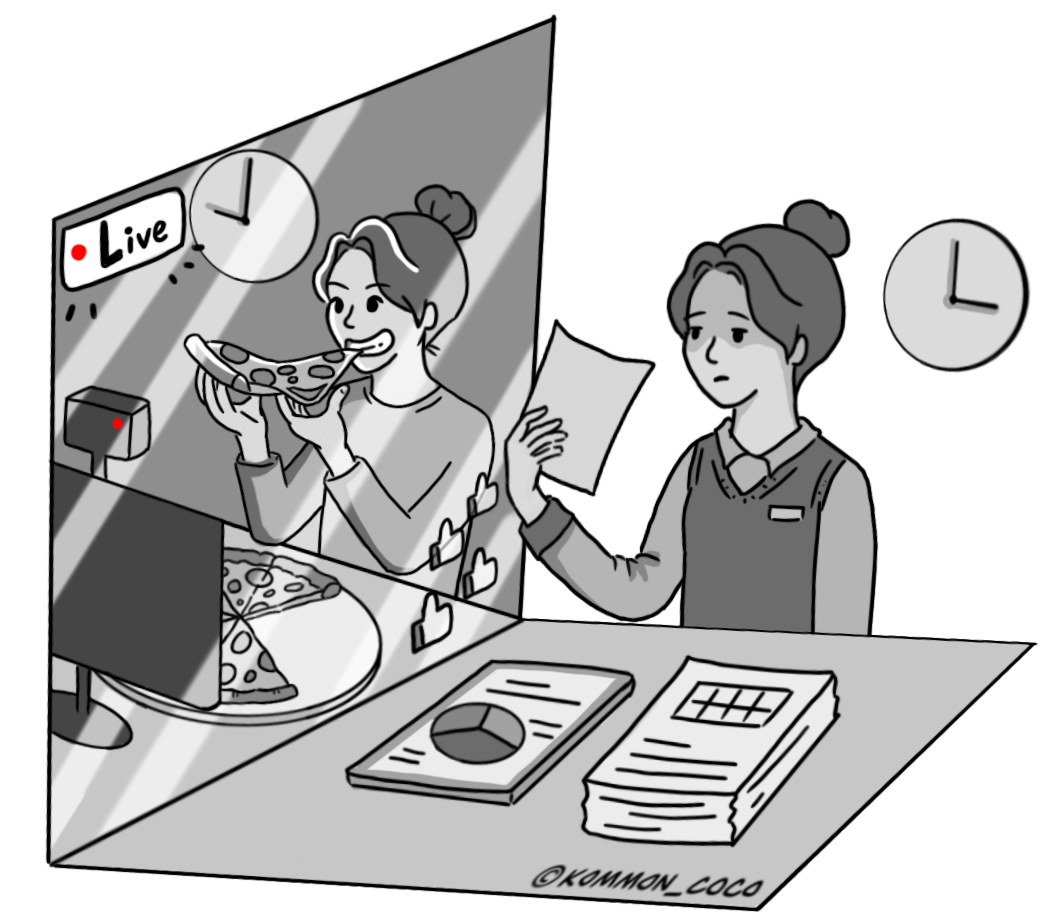
[Illustration by COCO] A Fictional Story of Jin-young Jin-young has been working as an administrative officer for a pharmaceutical company for two years. It is her first job after graduating from university and she spends most of her days in front of a laptop, sitting. She’s a quiet and calm woman of few words at work. After a tiring day at work, Jin-young heads over to a park rather than her house. As soon as she arrives, a group of people welcomes her. Jin-young has been leading a running crew for a year and she goes by the name of “Genie” there. She feels refreshed and invigorated as “Genie,” her bukae. Bukae (부캐) Syndrome Bukae (부캐) is an abbreviation of a Korean word bu-kae-rik-teo (부캐릭터), referring to a sub-character or an alternate character that one has created. It originated from online gaming culture where people create a second game character to support and complement the skills of their main characters. The concept of bukae became popular because of the variety show “Hangout with Yoo” (놀면 뭐하니) last year. Yoo Jae-suk, a prominent comedian and the main cast of the show, performed as several different witty characters and called each of them his bukae. One example was a trot singer. With the stage name of Yoo San-seul, he released a trot single and even did a live show on several different occasions. Yoo Jae-suk also became a member of a 90s-inspired idol band named SSAK3 (싹쓰리) in the program. SSAK3 was especially one of the hottest debuts of 2020 since it was a co-ed trio with two of the most popular singers in the late 90s—Lee Hyo-ri and Rain. All members of the trio used unique stage names that stand for their bukaes—Yooduragon for Yoo Jae-suk, Linda G for Lee Hyo-ri and B-ryong for Rain.
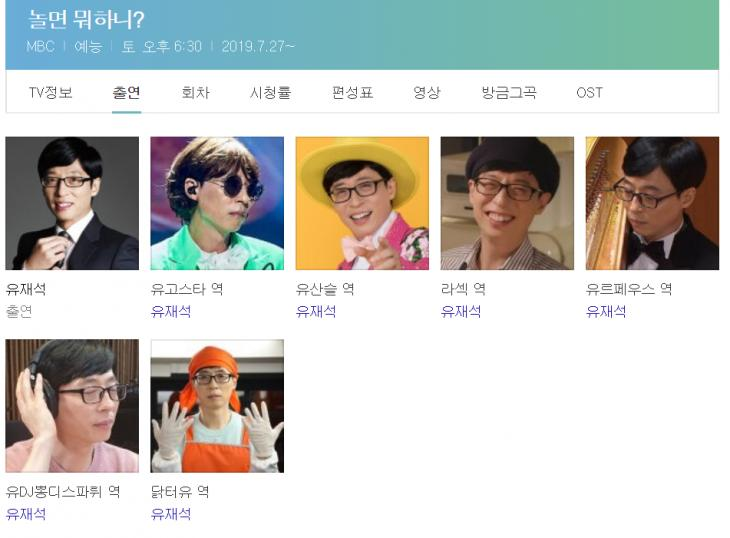
The program description page of “Hangout with Yoo” introduces multiple casts, which are all in fact bukaes of the only main cast, Yoo Jae-suk. Yoo Jae-suk was also a cook, a drum player and even a radio DJ in the program. Each time he challenged himself to a new act, whether it be starting a business as a cook or doing a stint as a radio DJ, he pretended to be a completely different person from his other bukaes. That way, each episode became intriguing: it was fun to find out different sides of an already well-known comedian. Many celebrities then followed his footsteps to create bukaes. Bukae liberated them from their fixed public personas to try new things. Wishing to express personal characteristics in a fun way as shown in variety programs, ordinary people also began applying the concept of bukae in their lives. What they used to enjoy in their free time were great sources for bukaes. Unlike celebrities though, ordinary people creating bukae doesn’t necessarily involve naming it. They can simply decide to become runners, YouTubers, or writers apart from their day job. Keep Active and Express Your Alter Ego For ordinary people, life as a bukae usually starts when they leave work. Having a bukae means that there are more than two different types of social persona that can be switched on and off. For instance, one can be a sensitive abstract painter during the night contrary to a cool-headed and analytical businessman during the day.
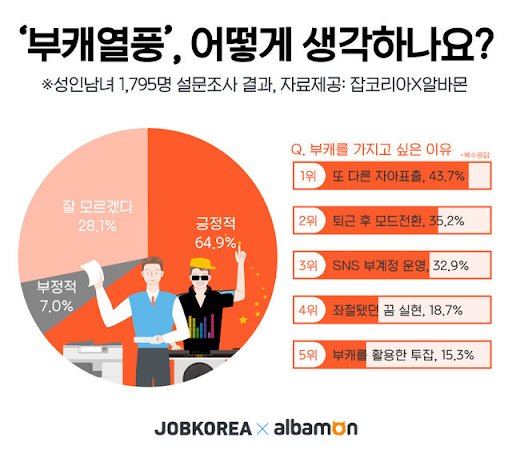
According to a survey conducted by Job Korea, a recruitment information website, 64.9% of adults had a positive response toward Bukae Syndrome. Among them, 43.7% responded that they want to have a Bukae in order to express their individualities more. About one-third of the Korean population (Korean link) works in an office, where the hierarchical structure is still rigid. The emphasis on hierarchy tends to put individuals behind the company’s collective goals. Bukae focuses on unfulfilled dreams and self-satisfactions. Not everyone can afford to choose a low-paying dream job over a lucrative one. In terms of this, bukae is an accessible tool to freely explore and express one’s identity. Sometimes, creating a bukae itself can be an effective motivation. Just as writing down New Year’s resolutions to be more determined, it helps people get down to action and take a step outside from their comfort zone. Bukae leaves one’s regular work intact. While not sacrificing anything, it helps to strike the balance between work and fun. People can hence fully focus on one thing at a time and better figure out who they can be. At the same time, bukaes are often complementary to one’s regular work. It allows small but meaningful achievements in daily lives, such as running 5km everyday as a runner. People can ease depression and boost passion while enjoying what they truly love. Thus, it helps them become more confident and productive even at work. One Step Closer to the True Self Having a bukae sometimes leads one to have numerous jobs. For instance, an accountant’s bukae (Korean link) is a free-diving instructor. It was her hobby at first but she gradually developed it and became a professional. There’s also an example of a businessman working for an electronics company who started earning a small income by drawing caricatures as a painter after hours. The expanded public discussions on bukae reflect a change in Korean society. Beyond the narrow focus on work, beyond seeking the work-life-balance, a variety of individual characteristics are appreciated than before. More and more people are paying attention to the multiple talents and interests that one has. People with bukaes often say that they certainly got busier and more tired. Nevertheless, they say they feel alive more than ever. Bukaes are opening up new possibilities for many people to redefine their lifestyles.
Slang 투잡 Tu-jap (Two-jobs, 투잡) & N잡 N-Jab (N-jobs, N잡) When you work two jobs, then you say you have “tu-jap (Two-jobs, 투잡)”.
People normally put the verb “ttwinda (뛰다)," which means to run or work hard, with 투잡.
So the common Korean expression for holding two jobs would be “tu-jap ttwinda (do two-jobs, 투잡 뛴다)”. If you have more than two jobs, then it is called the "N-Jab" (N-Jobs, N잡) and people who do n-job are named “n-Jab-leo (nth-job-er, N잡러)” Examples A: 요즘 영어학원강사로 투잡 뛰고 있어. 나중에 이걸 메인으로 할까봐. B: 좋은 생각이야! A: I work two jobs. After my nine to eight is over, I teach English to little kids. I am thinking of becoming a full-time teacher. B: Good idea! A: 요즘 저녁에 택배 기사로 투잡 뛰느라 바빠 죽겠다. B: 그러다 n잡러 되겠다. 건강 조심해! A: I have taken up working as a delivery worker after my work recently. B: Wow you will end up as an nth-job-er. Please take care of your health.
KOMMON TEAM 수수🌾 Sans🌻 바코🌊 오티오😈 쟈🍉 기린🌴 쏘🐥 기니👑 프레드🍰 부엉🦉 타코🌮 Sunny🌞 호야🐻 케이☕ 코코🐦 Gumball🍬 💗Support us!💗
|