Preparatory Issue 6
February 2022 |
|
|
Everyday, Korea has over 100,000 confirmed COVID-19 cases. Yet, experts state that we haven’t yet hit the peak. Fatality rates may have dropped, but as the figures skyrocket, the absolute number of the severely ill and dying keeps increasing. How are things globally? Every day, 1 to 2 million cases are confirmed with over 10,000 dying.
Lost in these simple figures is a deeper reality: the unequal impact of the COVID-19 pandemic. Within countries, those most severely affected are the poor. Globally, countries in the Global South are hit hardest. Africa's vaccination rate is only 11% even as Pfizer earns $24.1 billion (a 134% increase from the previous year) in 2021 by prioritizing vaccine sales to rich countries and pushing unfair vaccine contracts, which we explored in our December Progressive Forum: “How Vaccine Inequity Created Omicron”.
However, unlike big pharmaceutical companies putting profits before people's lives, one country is actively fighting back the pandemic with solidarity. In Cuba, the Henry Reeve Brigade, founded by its Ministry of Health in 2005, has continuously dispatched health workers to natural disaster and epidemic sites around the world. Despite crippling US economic sanctions, Cuba has been dispatching doctors and nurses around the world since the beginning of the pandemic, prioritizing life and solidarity over profits. So far, 57 teams have been dispatched to 40 countries. In addition, Cuba has distributed Cuban vaccines to low-income countries with low vaccination rates while dispatching the Henry Reeve Brigade to provide the necessary vaccination support and training. In fact, according to the Cooperative for Assistance and Relief Everywhere (CARE), in developing countries, many donated vaccines go unused due to a lack of distribution capacity in their health systems.
Furthermore, Cuba is in conversation with over 15 countries to transfer vaccine-related technologies to produce vaccines locally, and has negotiated technology transfer contracts with countries such as Argentina, Vietnam, and Nicaragua. Unlike vaccines produced by big pharmaceutical companies, Cuban vaccine technology doesn’t need refrigeration and is easy to produce in a low resource setting. Cuba is fighting to end the pandemic through vaccine internationalism.
These days, all over the news, experts talk about what we need to do to end the three-year long pandemic. They talk about greater quarantine measures and increasing vaccination rates. Yet, if carried out in just one country or region, these measures can’t end the pandemic. What then do we need to end the pandemic? Cuba has shown us the answer: solidarity through action. |
|
|
Disability and Deinstitutionalization:
Why Must the Disabled be Locked Up in Institutions?
|
|
|
Cha Hanseon (Policy Research Team) |
|
|
Deinstitutionalization is not simply a matter of physical space that calls for the dismantling of large-scale care institutions. The institutionalized disabled must return to their families, and to society at large. The reality is that many deinstitutionalized disabled rely on the support of their families. However, care from their families is not enough, and society and the state must take responsibility. If the government simply postpones this process as it readies itself, then the process will never begin. The government must recognize deinstitutionalization as a responsibility and then actively begin its implementation.
There can be no dignity for anyone, without dignity for the disabled.
|
|
|
A Plan to Save the Planet
Insecurities of various kinds grip the planet. The impact of the COVID-19 pandemic has produced the greatest economic downturn since the Great Depression. This downturn is not reflected in stock prices or in the earnings reports of the major multinational corporations, but in the data on unemployment and inequality, in rising hunger rates, and in rising feelings of desolation and anger. It is estimated that hundreds of millions of people will be pushed into absolute poverty by the impact of the COVID-19 pandemic. This is only one data point in an avalanche of bad news for those who are watching the slide of too many countries into catastrophic debt and despair. An emergency global programme must be undertaken to prevent this result. It is crucial that countries put aside narrow nationalist concerns and engage in a common, cooperative response to this crisis.
Three apartheids – of money, medicine, and food – govern the immediate situation in the world.
We, a network of research institutions that have been looking closely at the long-term crises of neoliberal austerity, induced debt regimes, and maldevelopment, have produced a set of policies towards a new world order. Our plan – drawing from the lineage of the NIEO – puts forward a vision for the present and the immediate future centred on twelve key themes: democracy and the world order, the environment, finance, health, housing, food, education, work, care, women, culture, and the digital world. This is the skeleton of a much fuller plan that we will produce in the year ahead.
|
|
|
[ Februray Progressive Forum]
Ukraine on the Brink: from the Soviet Union,
"Deficient" Revolutions, to the Crisis Today
|
|
|
Interview with Volodomyr Ischenko
“ It’s very difficult to find any hope.” |
|
|
To help explain the crisis in Ukraine, the International Strategy Center (ISC) interviewed Volodomyr Ishchenko (Ishchenko), a Research Associate at Osteuropa-Institut Berlin and a member of PONARS Eurasia. Ischenko’s work on deficient revolutions and Ukrainian protest movements have made him a sought out left wing voice on Ukrainian politics, including interviews and articles with the Jacobin Magazine, Al Jazeera, and Truthout. Below is an excerpt of an interview published in the online publication Midwestern Marx with Ischenko by the International Strategic Center for our monthly Progressive Forum. |
|
|
In 2013, Ukrainian President Viktor Yanukovych rejected a pending free trade agreement with the EU and pursued closer relations with Russia instead, thus sparking the protests that would become Euromaidan. The pro-Russian eastern parts responded with Anti-Maidan protests, with the situation escalating into a military conflict between pro-separatist groups with Russian support and the Ukrainian government. Recently, Russian troop movements towards the Ukraine border have re-ignited fears of an invasion. Russia has stated it will not invade and is simply responding to NATO expansion.
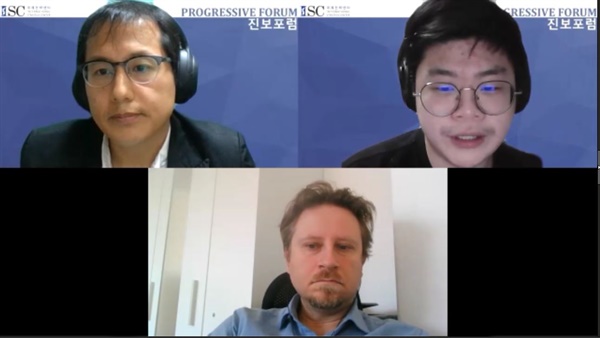
To explore Ukraine's crisis from the fall of the Soviet Union, to "deficient revolutions," and the geopolitics and reality of the crisis today, we have Dr. Harun Yilmaz, a researcher and writer on Ukraine, the Caucasus, and Central Asia; and (through a prerecorded interview) Volodymyr Ishchenko, researcher of protests, social movements, revolutions, radicalization, right and left politics, nationalism, and civil society at the Institute of Eastern European Sutdies, Freie Universitat Berlin.
Date & Time : Sunday February 27, 7-9 PM
Programs: Interview + audience Q&A (English & Korean interpretation)
INFO: progressiveforum@goisc.org
|
|
|
2F, 2 Dosin-ro 47-gil, Yeongdeungpo-gu, Seoul International Strategy Center
|
|
|
|
|