Why do you need a hardware wallet?
Most users have likely taken the first step into the cryptocurrency is by purchasing coins from exchanges. Exchanges may appeal for many for the benefits of convenient management, however, leaving your funds there may not be a great idea. To better understand, we need to have a clear understanding of the famous expression “Not your Keys, Not your Bitcoins!” which hints to the notion of ownership.
When you own cryptocurrencies, what you really own is the “private key”, a secret information used to authorize the outgoing transfer from your account that exists on the blockchain network. Anyone who has this secret key can spend the funds. When you leave your funds on an exchange, you are actually entrusting the third party to keep your private key safely.
In short, whoever has the private key in possession has the real ownership to the associated funds. Think of it this way, when the private key is in your possession, you are the one who authorizes the transaction. Conversely, when your private key is entrusted to an exchange, you are asking the exchange to authorize the transaction on your behalf.
What is a Hardware Wallet?
There are several types of wallets existing in various forms; a paper wallet, software wallet, or a hardware wallet.
One way to remove the threats that come with Internet connectivity is to use a paper wallet. A paper wallet is simply a piece of paper where the private key and the account address information is printed on. This type of old school approach in digital assets management may work for few long term holders, but for the most, it is definitely cumbersome to use on a daily basis.
- Software Wallet (Hot Wallet)
Many people are content with using the software wallets on their mobile phones. These kinds of wallets are called “hot” wallets because they are on devices directly connected to the Internet and subject to malware and other increasingly sophisticated threats. When you use a software wallet, safe keeping of your funds is highly reliant on the level of protection provided by your phone. According to data from the FTC in the United States of America, in one month alone 2,658 incidents of mobile phone account hijacking were reported. These data only enumerate one type of attack that mobile software wallets are subject to.
- Hardware Wallet (Cold Storage)
D’CENT Wallets are hardware wallets. These cold storage devices are the antithesis of a paper wallet. Hardware wallets are all high tech. Hardware wallet is an offline storage device that is not directly connected to the Internet and it stores the private key to your cryptocurrency funds.
How D’CENT Wallet protects your cryptocurrency assets
D'CENT Wallet is designed and built on the State-of-the-Art security technologies.
Secure Element technology is a crucial component of the hardware that inspires confidence in D’CENT Hardware Wallet. A Secure Element (SE) is a microprocessor specifically designed for protection against physical attacks and to mitigate side-channel attacks. A Secure Element must be a certified product (ie: Common Criteria EAL5+) which means that the security chip is proven to resist attacks based on state-of-the-art techniques.
- Isolation Security (Cold Storage)
The security chip embedded in D’CENT Hardware Wallet and the countermeasures technology applied is an industry standard for protecting sensitive data. This ensures the highest level of isolation, an environment that can securely process cryptography operations and also store the private keys in encrypted state.
Firmware is like an Operating System but much smaller in size and strictly confined to the minimum functionalities that makes the hardware device to function as intended. The SE in the D’CENT Hardware Wallet verifies the integrity of the device, the firmware image goes through signature verification before it can be loaded. Unauthorized image loaded on the hardware wallet will render the device non-operable.
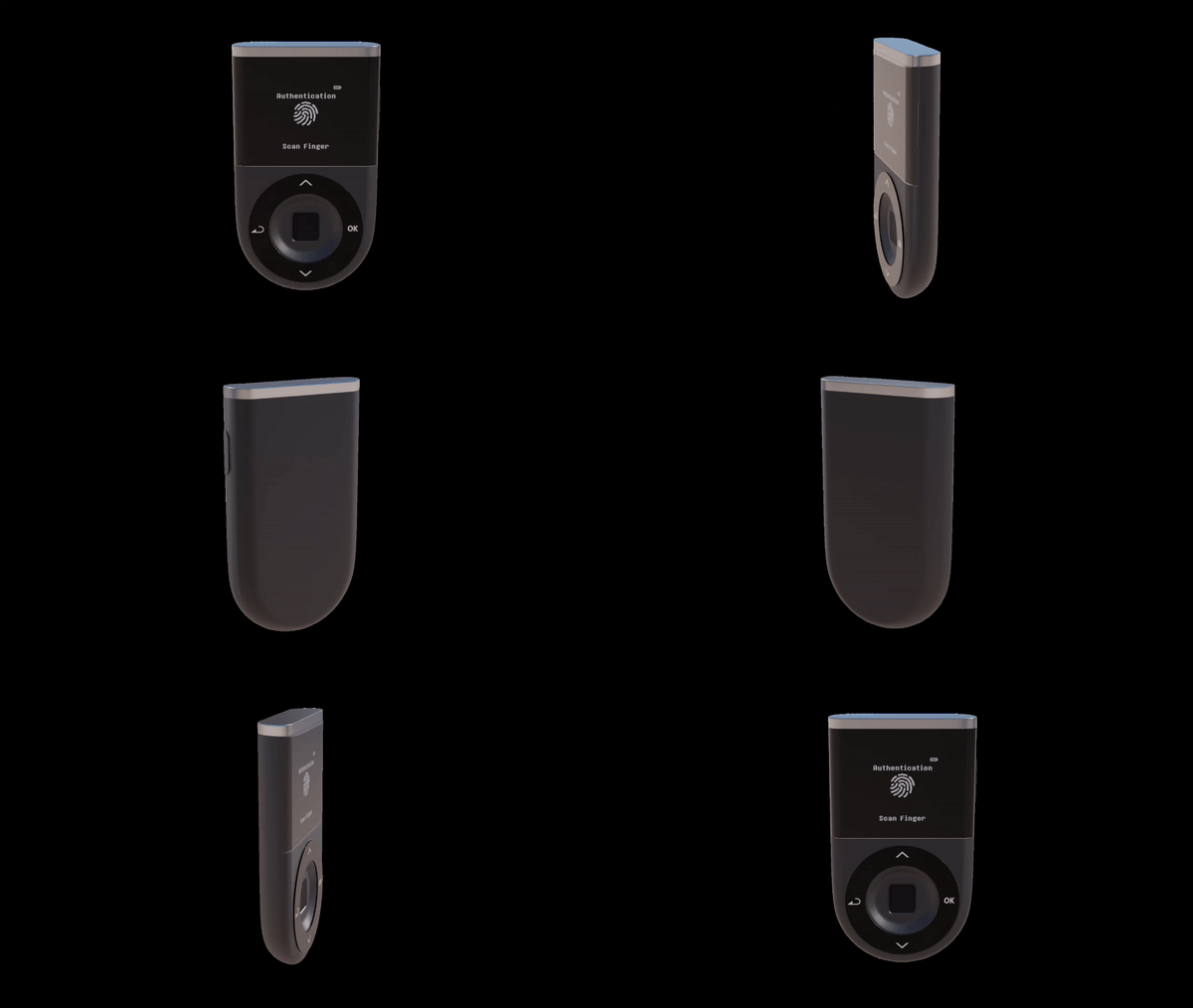
D’CENT Biometric Wallet is the first hardware wallet in the world to provide built-in fingerprint sensor for enhanced security and privacy. Not only does the fingerprint sensor provide higher level of security, but also makes the whole process of cryptocurrency transaction much simple and fast.
What if I lose my wallet or it breaks?
Hardware wallet generates a set of random 24 recovery words when initialized for the first time. You will be prompted to write down 24 words on a Recovery Sheet. These 24 words are also called mnemonic code and they are the human-understandable backup of the Master Key which all your private keys are derived from. These 24 words are essential for recovering the Master Key in the event of loss or broken hardware wallet. You can enter your mnemonic code on a new device to recover full access to your cryptocurrency assets. Mnemonic code must be kept in a safe place and never shared with anyone. Anyone getting access to these 24 words would have full access to the cryptocurrency assets.
Conclusion
D’CENT Hardware Wallet was designed for security and mobile usability in mind. D’CENT Hardware Wallet features uniquely designed hardware architecture that provides robust security by creating highly secure isolation for private key storage. The device works in tandem to a mobile application with support for iOS and Android. Users can connect the hardware wallet to their mobile phone via Bluetooth, an added benefit of improving the portability which allows users to manage their cryptocurrency portfolio on the go. D’CENT Wallet also features a built-in Dapp browser which provides users with the access to various services built as decentralized applications including DeFi, Games, NFTs, and many more.
D’CENT Hardware Wallet currently supports over 40 different blockchain networks and more than 4,000 types of cryptocurrency assets that can be managed. |