|
MEDIAN DIAGNOSTICS · VETERINARY INTELLIGENCE
PEDV
INSIGHTS
Porcine Epidemic Diarrhea — Global Intelligence Report
March · 2026 · FOR VETERINARY PROFESSIONALS
|
|
◆ Severe 2026 Global Resurgence ◆ SHIC: US Positivity Hits 14.0%
◆ Only 21.2%
of Sows Protected ◆ Neonatal Mortality Approaching 100%
|
|
SITUATION REPORT
PEDV Is Back — and Bigger Than the Numbers Show
Official statistics capture only a fraction of real-world outbreaks. A paradigm shift — from eradication to
active management — is now underway.
|
|
100%
Neonatal Piglet
Mortality Rate
|
21.2%
Sows with
protective antibodies
|
14.0%
US Sow Farm Positivity
(Highest Since 2022)
|
|
|
According
to the 2026 Korea
Swine Veterinary Forum, the swine industry is facing a severe resurgence of PEDV driven by its
persistent 2-year epidemic cycle. While past official counts noted 249 outbreaks, recent 2025/2026 academic
publications (e.g., Frontiers in Microbiology,
2025) emphasize that the lack of effective vaccines against circulating strains continues to cause
mortality rates approaching 100% in neonatal piglets. A nationwide government antibody
survey revealed that only 21.2% of breeding sows maintain protective neutralizing
antibodies, leaving the vast majority of herds effectively unshielded.
|
|
⚠ The "Hidden Infection" Problem
Official Statistics Undercount the Real Burden
Veterinary experts have repeatedly stressed that the actual field impact of PED is far more
severe than official case counts suggest. Because PEDV is a notifiable disease, confirmed
diagnosis triggers movement restrictions — discouraging voluntary farm reporting and
creating a large pool of "hidden infections."
To combat this, the industry is shifting from an
eradication to a management paradigm. Experts advocate for voluntary,
industry-led surveillance networks where farms and veterinarians share diagnostic data
proactively. Active immunity monitoring, rather than reactive reporting, is now the critical
foundation of PED control.
|
|
|
SHIC Alert · United States · 2026
PEDV Surges to Highest US Levels Since 2022
According to the Swine
Health Information Center (SHIC) SDRS reports, PEDV case positivity has climbed
significantly above expected seasonal ranges. Adult and sow farm positivity reached
14.0% — the highest recorded level since the major outbreaks of 2022. This
alarming data underscores that current biosecurity and vaccination protocols alone are
struggling to contain the virus, making proactive mucosal immunity monitoring more critical
than ever before.
|
|
◆ ◆ ◆ |
|
IMMUNOLOGY FOCUS
Two Pathways. Two Antibodies.
One Critical Gap in Monitoring.
Understanding why IgG alone is not enough — and why IgA is the key to protecting newborn piglets.
|

|
|
Fig. 1 · Median Diagnostics — IgG (Systemic Passive) & sIgA (Local Lactogenic) Antibody Transfer Pathways
|
|
|
IM Vaccination Route
IgG — Systemic Immunity
IM vaccine → Regional LN → IgG plasmablast → Blood → FcRn receptor → Colostrum → Piglet gut absorption → Systemic passive immunity
|
Oral Vaccination Route
sIgA — Mucosal Immunity
Oral vaccine → GALT (Peyer's patch) → IgA plasmablast → Gut-Mammary Axis homing → pIgR → sIgA in milk → Piglet intestinal mucosa → Local lactogenic immunity
|
|
|
Clinical Insight
A sow with high serum IgG may still have inadequate sIgA in her milk — leaving nursing piglets vulnerable to intestinal PEDV despite appearing "vaccinated." These two antibody classes must be monitored independently. sIgA persists throughout lactation (21 days), while IgG drops below protective threshold from Day 5 post-farrowing — making IgA the dominant and sustained shield for nursing piglets.
|
|
◆ ◆ ◆ |
|
MEDIAN RESEARCH · PEER-REVIEWED
Effects of porcine epidemic diarrhoea virus vaccination timing and route of administration on colostrum antibody levels and prevention of diarrhoea in piglets on a pig farm with porcine epidemic diarrhoea
Kang BK, Min DS, Kim DI, et al. Journal of Virological Methods 342 (2026) 115360
MEDIAN Diagnostics, Chuncheon, Korea · Published: January 31, 2026 · DOI: 10.1016/j.jviromet.2026.115360
|
|
This field study evaluated five PEDV vaccination programs in a 400-sow farm (Iksan, Korea) with confirmed PEDV genotype 2b infection, measuring colostrum IgA, IgG, and virus neutralization (VN) antibody profiles using Median Diagnostics' VDPro® PEDV IgA ELISA and VDPro® PEDV IgG ELISA kits, alongside the VDx® PEDV qRT-PCR and VDRG® PEDV Ag Rapid Kit for initial diagnosis.
| Vaccination Group |
IgA S/P
(mean) |
IgG S/P
(mean) |
VNT
(log₂) |
| Control (unvaccinated) |
2.39 |
2.09 |
5.82 |
| 1K1L (IM+oral, 1wk before) |
3.60 ↑* |
2.12 |
5.60 |
| 2K2L (IM+oral, 2wks before) |
2.59 (ns) |
2.22 |
6.20 |
| 3K1L (IM×1 at 3wks + oral at 1wk) |
3.41 ↑* |
2.25 |
6.17 |
| 5K3K1L (IM×2 + oral at 1wk) ★ |
4.27 ↑** |
2.45 |
7.00 ↑** |
* p<0.01 ** p<0.0001 vs. control. ns = not significant. ★ = optimal program
|
|
|
Key Findings
1. |
IgA, not IgG, predicts clinical protection. Diarrhoea and growth retardation disappeared only in the 3K1L and 5K3K1L groups — those with significantly elevated colostrum IgA. Average weaning weight improved from 4.1 kg to 7.0 kg after optimal vaccination. IgG levels showed no meaningful difference across groups. |
2. |
Timing of oral vaccine is critical: 1 week before farrowing is the immunological window. Oral live-attenuated vaccine administered 1 week before farrowing consistently produced higher IgA than the same vaccine given 2 weeks prior — because IgA plasmablast homing to the mammary gland is maximized by oestrogen/progesterone hormonal shifts and peak CCL28/CXCL12 chemokine expression in the final week of gestation. |
3. |
IgA persists throughout 21 days of lactation; IgG collapses from Day 5. Longitudinal sampling in 3K1L sows confirmed that colostrum IgA S/P remained at ~3.0 across the entire lactation period, while IgG fell below the positive threshold (S/P <0.5) from Day 5 onward — making sIgA in milk the only sustained passive immune shield for nursing piglets. |
4. |
Virus-neutralizing antibodies (VNT) complement but do not replace IgA monitoring. VNT was highest in the 5K3K1L group (log₂ = 7.0) and correlated with repeated vaccination, but previous literature shows VNT is only weakly correlated with mucosal IgA. VNT serves as a useful supplementary indicator — not a substitute for direct IgA measurement in colostrum and milk. |
|
|
|
Study Conclusion — Kang et al., 2026
"Oral administration of the live attenuated vaccine approximately 1 week before farrowing elicited the strongest IgA-mediated mucosal response. IgG levels showed no marked differences among the vaccination timings, and IgA persisted during the lactation period, highlighting the importance of colostrum IgA in protective immunity. The timing and administration route of PEDV vaccination are critical for establishing maternal immunity in piglets."
Read Full Paper on ScienceDirect
|
|
◆ ◆ ◆ |
|
WHY DIAGNOSTICS MATTER
The "Manage, Don't Eradicate" Era Demands Active Monitoring
As the Korean
and global swine industries shift from outbreak-triggered response to proactive surveillance, three
diagnostic pillars define a sound PEDV management program:
|
|
① Detect Active Infection — Immediately
Every hour without a confirmed diagnosis is time the virus spreads to neighboring pens.
Pen-side antigen rapid testing eliminates the diagnostic delay — enabling same-day
isolation, movement control, and farm-level response before spread becomes catastrophic.
|
|
② Monitor Sow Immunity — Before Farrowing
The
Kang
et al. (2026) study demonstrates that colostrum IgA is the decisive protective
factor — but it is invisible without testing. Routine pre-farrowing IgA and IgG ELISA
screening reveals immunity gaps in time to adjust vaccination timing, preventing the next
cycle of neonatal diarrhea and productivity loss.
|
|
③ Confirm and Trace — with Molecular Precision
qRT-PCR provides the quantitative viral load data needed for outbreak severity assessment,
genotyping, and epidemiological surveillance — the backbone of any voluntary monitoring
network modeled on the MSHMP.
|
|
|
DIAGNOSTIC SOLUTIONS
MEDIAN Diagnostics PEDV Portfolio
Five validated kits — covering every stage from pen-side detection to laboratory confirmation.
|
|
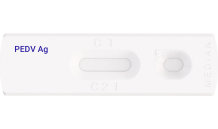
Rapid Detection · On-Farm Point-of-Care
VDRG® PEDV Ag Rapid kit
Rapid chromatographic immunoassay for on-site PEDV antigen detection. Delivers reliable
results in just 10 minutes without laboratory equipment. Validated in the
Kang et al. (2026) field study.
|
Target
PEDV N protein
|
Test time
10 minutes
|
Specimen
Pig feces
|
Cat. No.
PS-PED-11 | 10 Tests/Box | APQA Approved
View
Product →
|
|
|
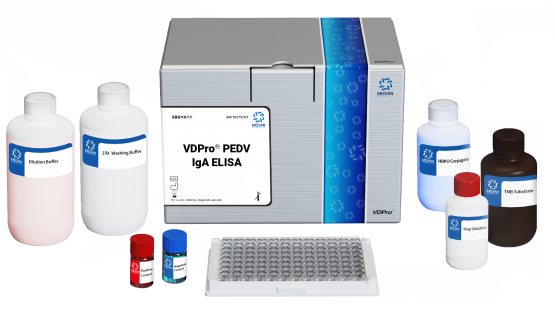
ELISA · Mucosal Immunity
VDPro® PEDV IgA ELISA Kit
Indirect ELISA to quantify PEDV-specific IgA. Accurately measures mucosal lactogenic
immunity, proven by Kang et al. (2026) to be the
most critical predictor of piglet protection.
|
Target
Anti-PEDV IgA
|
Method
Indirect ELISA
|
Specimen
Serum / Milk
|
Cat. No.
ES-PED-01 | 192 or 480 Tests/Kit | Export only
View
Product →
|
|
|
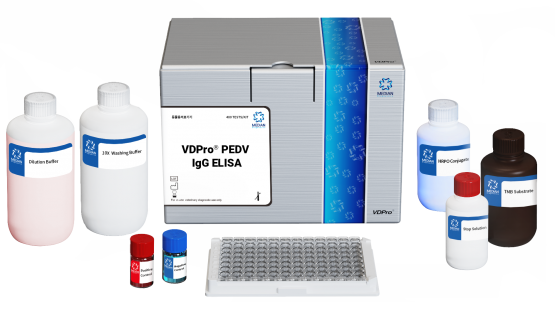
ELISA · Systemic Immunity
VDPro® PEDV IgG ELISA Kit
Indirect ELISA to monitor PEDV-specific IgG in sow serum and colostrum. Essential for
assessing systemic humoral immune responses and evaluating overall herd vaccination
compliance.
|
Target
Anti-PEDV IgG
|
Method
Indirect ELISA
|
Specimen
Serum / Colostrum
|
Cat. No.
ES-PED-02 | 192 or 480 Tests/Kit | Export only
View
Product →
|
|

|
Real-Time RT-PCR · Genogrouping
VDx® PEDV qRT-PCR
Multiplex real-time RT-PCR for the simultaneous
detection and differentiation of PEDV Genogroup 1 and Genogroup 2 strains.
Delivers definitive confirmatory diagnosis and reliable strain tracking.
|
Target
PEDV G1 & G2
|
Method
Multiplex qRT-PCR
|
Specimen
Feces / Tissue
|
Cat. No.
NS-PED-31 | 96 Tests/Box | APQA Approved
View
Product →
|
|
|
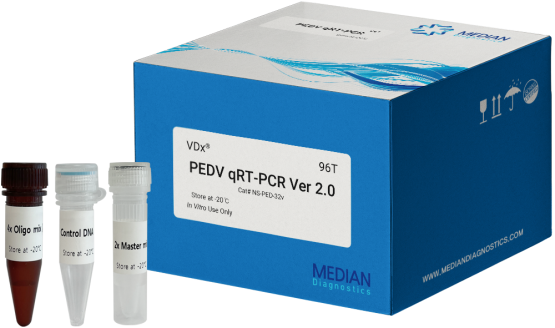
Real-Time RT-PCR · N Gene Target
|
VDx® PEDV qRT-PCR Ver 2.0
|
NEW
|
Advanced TaqMan-based real-time RT-PCR targeting the PEDV N gene. Features
dual Internal Positive Controls (Endo & Exo) for unmatched diagnostic
reliability. Used for definitive diagnosis in Kang et al. (2026).
|
Target gene
N gene
|
IPC
Dual (Endo+Exo)
|
Specimen
Blood/Serum/Feces
|
Cat. No.
NS-PED-32 | 96 Tests/Kit | Export only
View
Product →
|
|
|
The path forward begins with a test.
As the swine industry embraces active surveillance over reactive reporting, Median's five-kit PEDV portfolio provides the scientific foundation for a complete on-farm and laboratory-level monitoring program — validated by peer-reviewed field research published in the Journal of Virological Methods (2026).
|
|
MEDIAN Diagnostics
Head Office: 878, Sunhwan-daero, Dongnae-myeon, Chuncheon-si, Gangwon-do, Korea
Tel. +82-33-244-0100 | Fax. +82-33-244-4634 | E-mail. median@mediandx.com
Seoul Office: C-1114, SK V1 GL Metrocity, 128, Beobwon-ro, Songpa-gu, Seoul, Korea
Tel. +82-2-3401-0110 | Fax. +82-2-3401-0112
© 2026 Median Diagnostics · All rights reserved · For veterinary professionals
|


