November 27, 2025, Thursday
Your daily dose of Bitter News has arrived. We’ve gathered the key economic stories you'll want to know today, so grab a warm cup of coffee and ease into the day with us. |
|
KOSPI ▲3,957.82 │ KOSDAQ ▲877.32│ KRW/USD▲1,467.33 |
|
|
Nasdaq ▲23,214.69 │ S&P 500 ▲6,812.61│ Dow Jones ▲47,427.12 |
|
|
As of 3:30 p.m. on the previous trading day |
|
|
✴ Quadmedicine╎Medical microneedle technology based pharmaceutical and pharmacology R&D company Quadmedicine has entered its book building process, and expectations for FI recovery are rising. As the offering price is being finalized and the listing schedule approaches, attention is focusing on the value of major FIs’ stakes and the size of their potential exit.
✴ Kiwoom Investment╎In 2021, it used a $95 million fund including Mother Fund participation to secure 10.8 percent of Quadmedicine. With the IPO price set, meaningful exit returns are expected, and early conversion raised listing expectations.
✴ Shinhan Venture Investment╎From 2019 to 2022, it invested $5.8 million through the “Shinhan-Neo Market-Frontier Fund II” and holds 10.2 percent. If listed, it may recover $7.95 million to $9.92 million, with additional sale potential after the lock-up.
✴ SK D&D╎Quadmedicine, a pharmaceutical and pharmacology R&D company based on medical microneedle technology, has entered its book building process, and expectations for FI recovery are rising. As the offering price is confirmed and the listing schedule approaches, attention is also focusing on the value of major FIs’ stakes and the scale of their exits.
✴ K-Growth╎In 2025, it committed $135.9 million to the K-Content Media Strategic Fund II, pushing the creation of sub-funds exceeding $339.7 million. When GP selection is completed, results are expected in content/IP acquisition and technology investment expansion.
✴ Playtag╎In 2025, it raised $4.42 million in a bridge round, continuing 200 percent quarterly growth through AI behavior-analysis upgrades and expanded R&D. Growing demand for early-childhood education solutions supports future business expansion.
✴ Base Ventures╎In 2025, it formed a $38.6 million new fund and executed seed investments in Kindoff and Bonn, rapidly expanding its early-stage technology portfolio.
✴ CJ CGV╎In 2019, it raised $226.6 million from FIs but failed to meet listing and call-option conditions by 2023, leading to stake sales and declining trust. A 2016 $67.9 million financing round also saw the call option abandoned, increasing its capital-market burden.
✴ Aplus Asset╎It explored fundraising from PEFs in 2025, and the possibility of an exit by Skylake, which invested $34 million, is being raised. Moves to secure allies in response to Align Partners’ tender offer are emerging.
|
|
|
SK Siltron, completion of new plant raises questions about M&A delay |
|
|
⭑ Expansion of new plant CAPA, timing is shifting in a subtle way
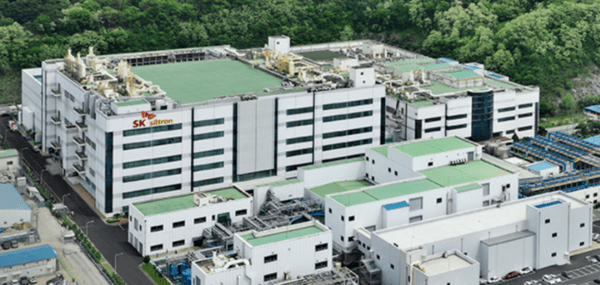
SK Siltron has nearly completed the new 12-inch (300mm) wafer line at its Gumi 3 plant. The building has already been completed, and equipment installation and testing are under way. The operation start is set for next year. Cumulative investment through the third quarter of this year is $341.7 million, and the total project cost is expected to reach about $1.56 billion. After the plant is completed, investment pressure may ease and financial strength may recover. During the investment period, SK Siltron’s financial debt increased to about $2.04 billion.
CAPA is an important production capacity indicator for semiconductor companies. Securing the capability to produce more allows faster growth when a big cycle arrives. However, this point is affecting the sale discussions.
⭑ The valuation gap
SK Group is pushing for the sale of SK Siltron as part of its organizational streamlining strategy. SK Inc. holds 70.6 percent of the company. The issue is price. Potential buyers assume about $1.36 billion based on enterprise value, while SK Group is seen as wanting around $3.4 billion.
With group liquidity improving through the recent LNG power plant asset monetization, which secured $2.04 billion, the view is growing that there is no urgent reason to sell.
Hahn & Company and Doosan Group are being mentioned as candidates. Doosan expects synergy with Electronics BG and Doosan Tesna and is scheduled to conduct an on-site due diligence at SK Siltron this month. In this situation, readers may wonder who will first say, “Shall we adjust the terms further?”
⭑ The semiconductor supercycle… does selling now make sense?
Memory semiconductor prices are rising sharply with the spread of AI. Even DDR4, a general DRAM, is jumping toward HBM-level pricing. SK Siltron supplies wafers to memory manufacturers and operates with long-term agreements of three to five years.
This means its revenue base is relatively stable even if short-term earnings appear weak. Analysts say the recent third-quarter loss was largely due to temporary effects in the SiC wafer business. At this point, internal concerns naturally grow about whether there is any need to sell a wafer company at the beginning of a semiconductor upcycle.
⭑The owner factor adds more complexity
Chairman Chey Tae-won personally holds 29.4 percent of SK Siltron. If the sale price rises, the value of his personal stake also increases, which could affect the scale of asset division in the divorce case. Considering that last year’s appraisal was $509.5 million, it is a sensitive matter.
Ultimately, the SK Siltron M&A is entangled with market conditions, internal financial capacity, and owner-related factors, creating a signal that the company may not be sold if conditions do not align. It will be worth watching over the coming months.
|
|
|
Driving innovation led by the investment division |
|
|
⭑ How did the investment division deploy $101.9 M over four years?
Samyang Chemical Group’s third generation is beginning to reshape the group’s business structure through its investment division. Over the past four years, it has been restructuring the group’s asset portfolio through direct and indirect investments totaling $101.9 million.
Samyang Chemical Group established its investment division in 2021 and has since invested about $101.9 million from its proprietary capital. Its asset allocation has been broad, ranging from offshore fund commitments to venture, private credit, ETFs, and real estate debt.
Notably, it participated as an LP in 17 global funds, and in 10 of them, it was the only Korean LP. Representatives include Greycroft, MVP Partners, Fusion Fund in the United States, Incubate Fund in Japan, and Tin Men Capital in Singapore.
⭑ Independent sourcing of overseas and domestic portfolios
The investment division also sourced its overseas portfolios directly. These include Cambium Networks, which gained attention from Lockheed Martin, Canada’s largest used-car platform Clutch, X-energy, which received a $500 million investment from Amazon, and Lumirenz, a developer of optical transceivers.
Domestically, it has built a portfolio that includes Rznomics (RNA therapeutics), Ditto (data engine), Clustr (AI infrastructure), My Normal (low-sugar foods), and Nania Labs (AI design). This shows a new growth spectrum forming beyond the group’s traditional chemical focus.
⭑ Supporting portfolio companies beyond investment
Samyang Chemical Group supports follow-on funding and overseas expansion for its portfolio companies. Leveraging networks built over 50 years in the defense and chemical industries, it provides practical assistance.
It also renovated part of its Yeoksam building into the DREAUM shared office, offering space to more than 20 startups so far. Next year, it plans to launch an incubation program offering six-person offices for up to one year free of charge.
Key talent recruiting is also ongoing, with Managing Partner Lee Chang-hoon, who joined in 2022, playing a central role.
|
|
|
Samyang Chemical Group shows signs of a shift in direction in recent years. By independently deploying $101.9 million over four years, it is reshaping its business structure, and participating in 17 global funds, often as the only Korean LP, signals a strong intention to change course.
The independently sourced AI company in California, the Canadian used-car platform, and the Amazon-backed energy company show that the group is turning its attention toward areas different from its traditional chemical-centered businesses. Domestically, portfolios in biotech, AI, and data also suggest an intention to transition its structure toward a more future-oriented model.
The organization is also being reorganized. With key investment personnel joining in 2022, the investment division is solidifying its role, and opening the Yeoksam office building as a shared workspace for portfolio companies marks another shift from past practices.
Taken together, these pieces suggest that Samyang Chemical Group is moving beyond simple investment toward building a new corporate structure. It will be worth watching how this shift takes shape over time. |
|
|
🍁A Visit of Maple╎Canada’s Industry Minister at HD Hyundai
Canada’s Industry Minister and the Canadian Ambassador visited HD Hyundai’s Pangyo R&D Center to look around next-generation ships, submarines, and AI-based solutions. HD Hyundai said it’s open to collaboration across shipbuilding, energy, robotics, and AI. Many see this visit as part of Canada’s move to introduce 3,000-ton submarines, and as a natural next step after Korea’s K-Shipbuilding One Team made it onto Canada’s shortlist. |
|
|
⚠️Double Risk Warning╎NH NongHyup in Another Corruption Scandal
NH NongHyup, managing about $475 billion in assets, is facing two major risks at once: the bribery investigation into Chairman Kang Hodong and a joint-loan delinquency rate nearing 20 percent. Its task force announced new reforms, but criticism is growing because a previously indicted figure was appointed to lead it. Many say the recurring leadership scandals and weak internal controls will be hard to fix under this structure. |
|
|
🫧Bubble Alert╎Is the AI Investment Craze Turning Into a Metaverse Déjà-vu?
After the government announced its ABCDEF strategy and a sovereign AI investment plan worth $67.9 billion, public funds have rushed into the AI sector. As capital floods in, even companies with thin technical fundamentals are gaining inflated valuations just by adding AI to their branding. With VCs pressed by fund structures and deadlines, some warn that another bubble like the metaverse and platform boom could be forming. |
|
|
🪙Moving First╎ NH Investment & Securities Deploys $214 million
NH Investment & Securities has already deployed $214 million into AI, semiconductors, deep tech, and mid-sized companies, moving early ahead of the National Growth Fund’s launch. With a dual-track strategy combining high-risk innovation investments and stable growth financing, the firm is positioning itself as a leading player in productive finance. |
|
|
⛓️💥Split and Spin╎Essex Solutions Calms the Market Ahead of IPO
LS plans to list its U.S. subsidiary, Essex Solutions, through a direct subsidiary-level IPO, raising concerns about share dilution and volatility, similar to past Samsung Bioepis and Samyang Biopharm cases. LS says the listing will help secure capital without increasing debt and promises moves like canceling 1 million treasury shares, raising dividends, and improving ROE. But since these commitments aren’t legally binding, investors are still questioning LS’s execution power and its ability to protect shareholder value. |
|
|
🍪Bite of Technology╎SK Hynix Expands Brand Fun with HBM Snack
SK Hynix introduced a semiconductor-concept snack called HBM Chips in collaboration with 7-Eleven, turning its technology image into everyday fun while increasing participation through nationwide convenience-store release and prize events, and it is expanding its brand universe by linking the snack with an HBM humanoid character to be unveiled next month, showing a strategy to create a friendly experience for consumers who find semiconductors difficult and to prompt them to recall SK Hynix naturally. |
|
|
“Seeking an owner for 330,000 people”
No one is bidding for Homeplus |
|
|
⭑ Drifting for 8 months
No bidders in the main auction... The sale of Homeplus has been drifting for eight months. Even after entering the main bidding, not a single company submitted a proposal. Harex Infotech and Snowmad, which participated in the preliminary bidding, also did not submit final proposals, so the first sale failed.
In the market, some pointed out that both companies lacked acquisition intent or financial capacity from the beginning, and even questioned whether it was noise marketing.
*Harex Infotech – revenue ₩300 million, operating loss ₩3.3 billion
*Snowmad – net loss ₩7.3 billion
*Homeplus – assets ₩6.8 trillion, debt ₩2.9 trillion
Homeplus is currently under rehabilitation procedures. The court has extended the deadline for submitting the rehabilitation plan five times, but there is not much time left now. The final deadline is December 29. By this date, a new buyer must be found.
However, there are not many companies capable of operating a nationwide retail network like Homeplus, and high interest rates and weak consumption make large retail acquisitions a major risk. This is why the industry is increasingly skeptical about whether Homeplus can find a new owner within the deadline. Because of this, alternative scenarios besides securing a buyer are being mentioned.
Options include the existing major shareholder injecting additional funds to take responsibility for rehabilitation, creditors adjusting debt to restructure the plan, or, if the situation drags on too long, selling only certain stores through a split-sale scenario. But each option faces practical issues such as social cost, conflicts of interest, and financial burden, so securing a buyer remains the top priority.
⭑ The real problem lies elsewhere
The reason this situation is not just a failed sale is because of jobs. The mart labor union estimates that if Homeplus collapses, around 330,000 people could lose their jobs, including the decline in sales of surrounding commercial districts.
When a large mart closes, not only employees but also logistics, partner companies, delivery, cleaning, security, and nearby shops are hit in a chain reaction.
This is also why the government sees this issue as burdensome. Homeplus is the second-largest hypermarket in the country and a retail company with a nationwide logistics network, so its collapse would create a large spillover risk. The union has begun a hunger strike urging government intervention, and public polls show Nonghyup as the most suitable new owner, but Nonghyup has already withdrawn from the acquisition.
|
|
|
Options: Basic Concepts
Call Options and Put Options |
|
|
An option is a derivative that gives you the right, but not the obligation, to buy or sell a specific asset at a pre-set price, called the strike price, at a future date.
The buyer can choose whether to exercise this right, and the seller must fulfill the contract if the buyer decides to exercise it.
When you buy an option, you pay a premium to obtain that right. When you sell an option, you receive the premium, but you also take on the obligation to carry out the transaction if the buyer exercises the option. |
|
|
✴ Call Option ╎ The right to buy an asset at the strike price
Investors buy call options when they expect the asset price to rise above the strike price. If the market price goes up, the buyer can purchase the asset at the lower strike price or sell the option in the market for a profit.
Even if the price falls, the buyer doesn’t have to exercise the option, so the loss is limited to the premium paid. The seller, however, must sell the asset if the buyer exercises the option, and the seller’s loss can grow significantly if the asset price rises sharply. |
|
|
✴ Put Option ╎ The right to sell an asset at the strike price
Investors buy put options when they think the asset price will fall below the strike price. If the market price declines, the buyer can sell the asset at the higher strike price or sell the option itself to capture the price difference.
If the price rises, the buyer doesn’t need to exercise the option, so the loss stays limited to the premium. The seller must buy the asset at the strike price if the buyer exercises the option, and may face large losses if the asset price drops significantly.
Both call and put options are used to profit from price movements, and at the same time, they are widely used as hedging tools to manage the risks of individual assets or portfolios. |
|
|
Send us any suggestions you’d like to share while reading Bitter’s newsletter! |
|
|
Advertising, inquiries : viter@thevistapartners.com / Published by Newstop. Unsubscribe |
|
|
|
|