OpenAI / NVIDIA / Google / MS / Meta / xAI 2023 Sep Week 3 Datumo Newsletter |
|
|
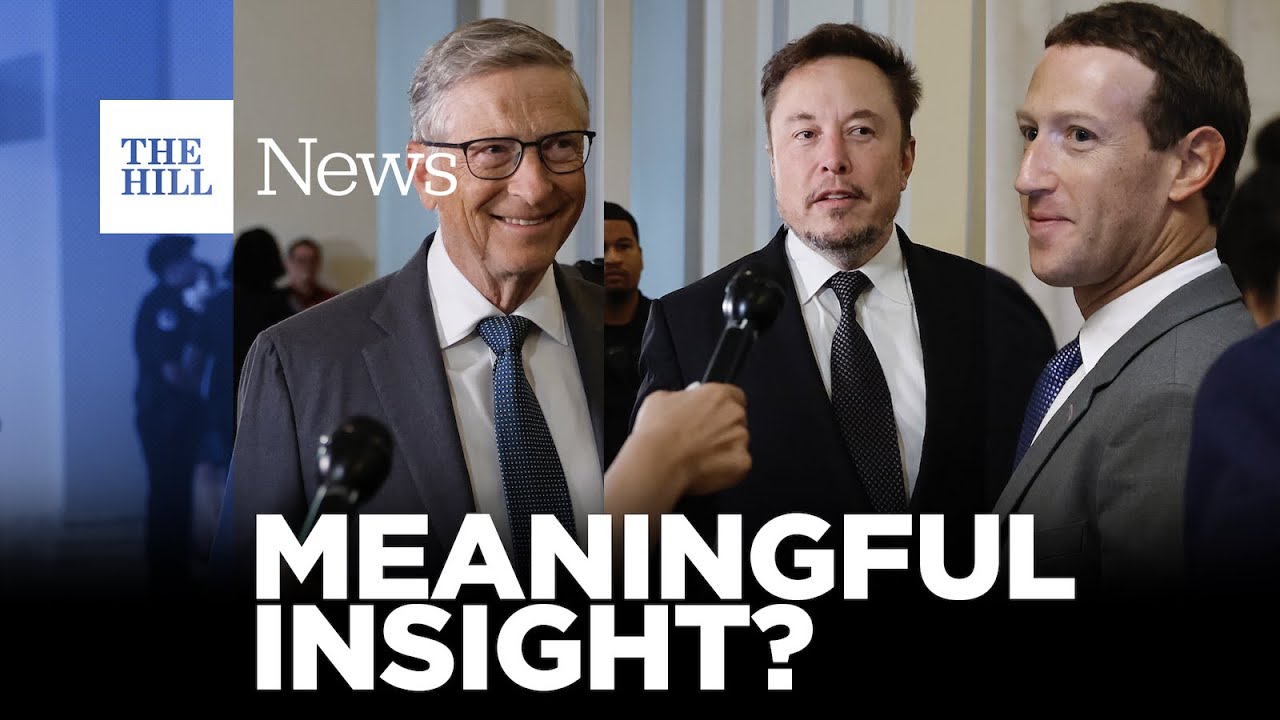
Big Tech Leaders Gather for 'AI Insight Forum' |
|
|
Source: The Hill, Youtube, 'RIGHT NOW: Musk, Zuckerberg,
Gates Discuss Artificial Intelligence In CLOSED DOOR U.S. Senate Forum'
Last week, leading figures from major US tech companies converged in Washington DC.
|
|
|
Proactive Sam Altman on AI Regulation |
|
|
Source: CBS News, Youtube,
OpenAI CEO Sam Altman testifies at Senate artificial intelligence hearing | video
It's not the first time discussions about AI regulations in the US have seen participation from big tech leaders. On May 16th, Sam Altman took a proactive stance on the matter during the first-ever AI hearing in the US Congress.
At the time, Altman expressed, "I think if this technology goes wrong, it can go quite wrong. And we want to be vocal about that. We want to work with the government to prevent that from happening (...)", suggesting the ① establishment of an international AI regulatory agency and ② introduction of an AI development licensing system.
Altman's attendance and comments at his first AI hearing drew considerable attention. At the same time, it raised concerns about the creation of a new power structure to set global AI standards and manage licenses, potentially infringing upon the rights to free research and development.
It's natural for regulations to emerge as new technologies arise and industries and markets mature. However, it's exceptional for those who have directly developed the technology and products, as in the AI industry, to advocate for its regulation. It recalls the times of the initial development of nuclear weapons, reminiscent of the movie Oppenheimer.
Some speculate that regulations formed around big tech companies might create a competitive advantage, hindering newcomers from entering the market. Still, the ongoing discussions on the threats and regulations of AI and the scale of research are indeed serious.
|
|
|
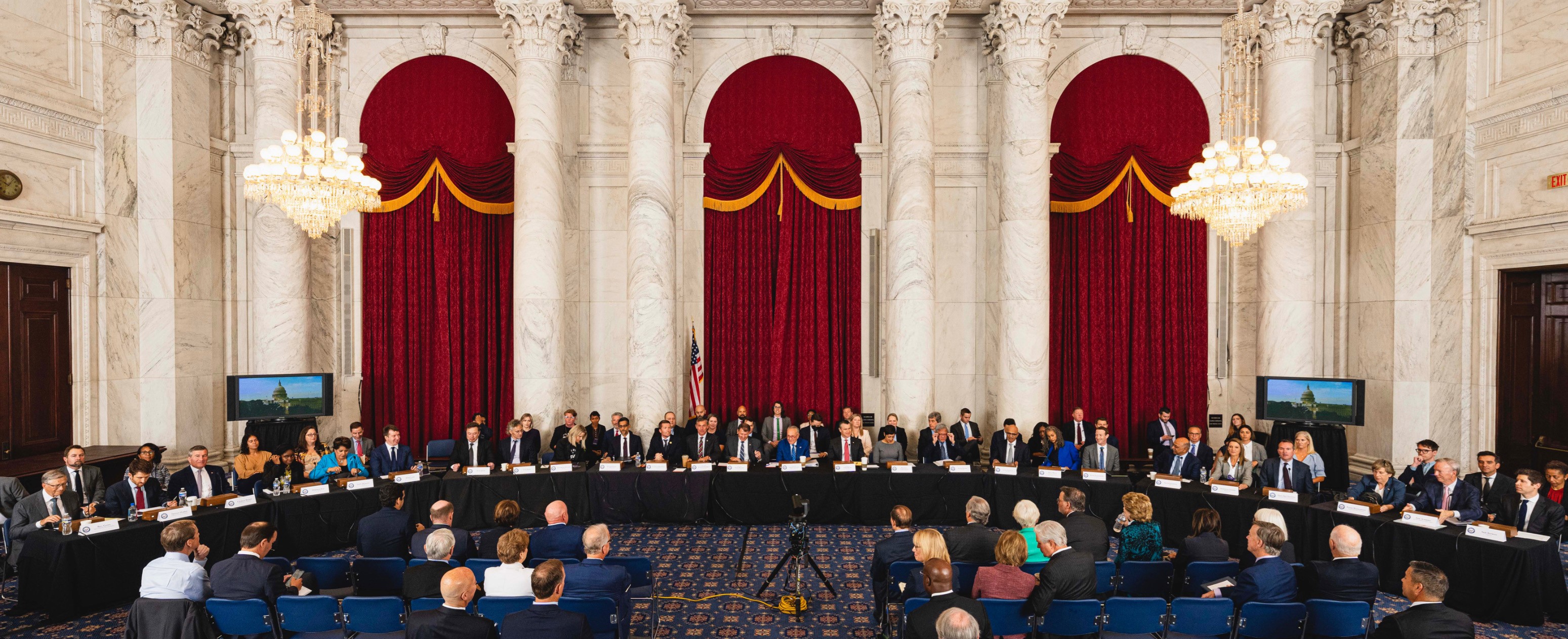
Threats and Diverse Perspectives on AI |
|
|
Source: Senator Chuck Schumer's SNS. link
There are three main threats posed by AI in the present and near future: ① societal concerns about AI-assisted crimes and fake news, ② economic disruptions stemming from job losses due to AI, and ③ apocalyptic scenarios where highly advanced AI might eliminate or dominate humanity.
Opinions are divided on each of these three issues. Some argue that AI-related crimes can be adequately addressed within the current legal framework, while others believe that AI crimes using indistinguishable voices and images are entirely different from previous offenses.
There are concerns that AI technology might exacerbate inequality by serving capital, yet historically, technological revolutions have often led to job creation and population growth. Some optimists believe that ultimately, AI advancement will liberate labor.
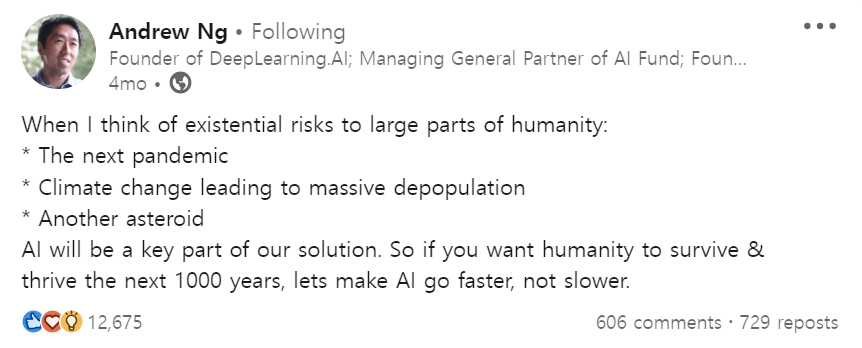
In May, Dr. Hinton, known as the 'father of AI', left Google after leading it for over a decade, voicing concerns that AI technology could even make killer robots a reality. Around the same time, Professor Andrew Ng from Stanford University argued that by accelerating AI development, we could address global challenges like climate change, asteroid impacts, and pandemics.
|
|
|
Source: A snapshot from Professor Andrew Ng's SNS.
|
|
|
The Safest AI: xAI Aiming to Understand the Universe |
|
|
|
The third 'apocalyptic scenario' appears to be where most of the current research and investment are focused. The research field dedicated to ensuring that AI behaves as intended by humans and reduces unforeseen risks is called AI alignment.
In July, OpenAI announced its commitment to use 20% of its computing resources over the next four years to address the superintelligence alignment problem. Elon Musk founded xAI with the goal of creating an AI that understands the nature of the universe. Musk's thoughts on the alignment problem were shared through Twitter Spaces (now X Spaces).
He stated, "To avoid the inverse morality problem, if you try to program a specific morality, you can essentially invert it and get the opposite. This is sometimes called the 'Waluigi problem'”
The statement implies that if you try to create a 'good AI' through programming, by reversing the process, you can easily produce an 'evil AI'
He also stated, "I believe the safest way to build AI is to create one that is maximally curious and seeks truth. While striving for truth, acknowledging potential errors is crucial. My theory is that being genuinely curious and truth-seeking is likely the safest approach."
This quest for understanding is Musk's ultimate goal with xAI. Rumor has it that xAI is also planning services for the general public, much like ChatGPT. We're eagerly waiting for the next updates from xAI :) |
|
|
The Data for Smarter AI
Datumo is an all-in-one data platform for your smarter AI.
|
|
|
Datumo Inc.
📋 contact@datumo.com
|
|
|
|
|