#Stalking Protection Act #vocabulary #그것이 알고싶다 For dark mode users,
Hello, reader! Today, we are covering: Index Zoom In “I think someone is following me” Today's Vocabulary Sun-aebo (순애보) This Week's Recommendations Unanswered Questions (그것이 알고싶다) Don't forget to leave your feedback below!
“I think someone is following me” Writer: Sunny Um Senior Editor: Regine Armann Editor-in-Chief: Fred McNulty Researcher: Yul Jun, Heejin Ahn Illustrator: Ah-young Kim
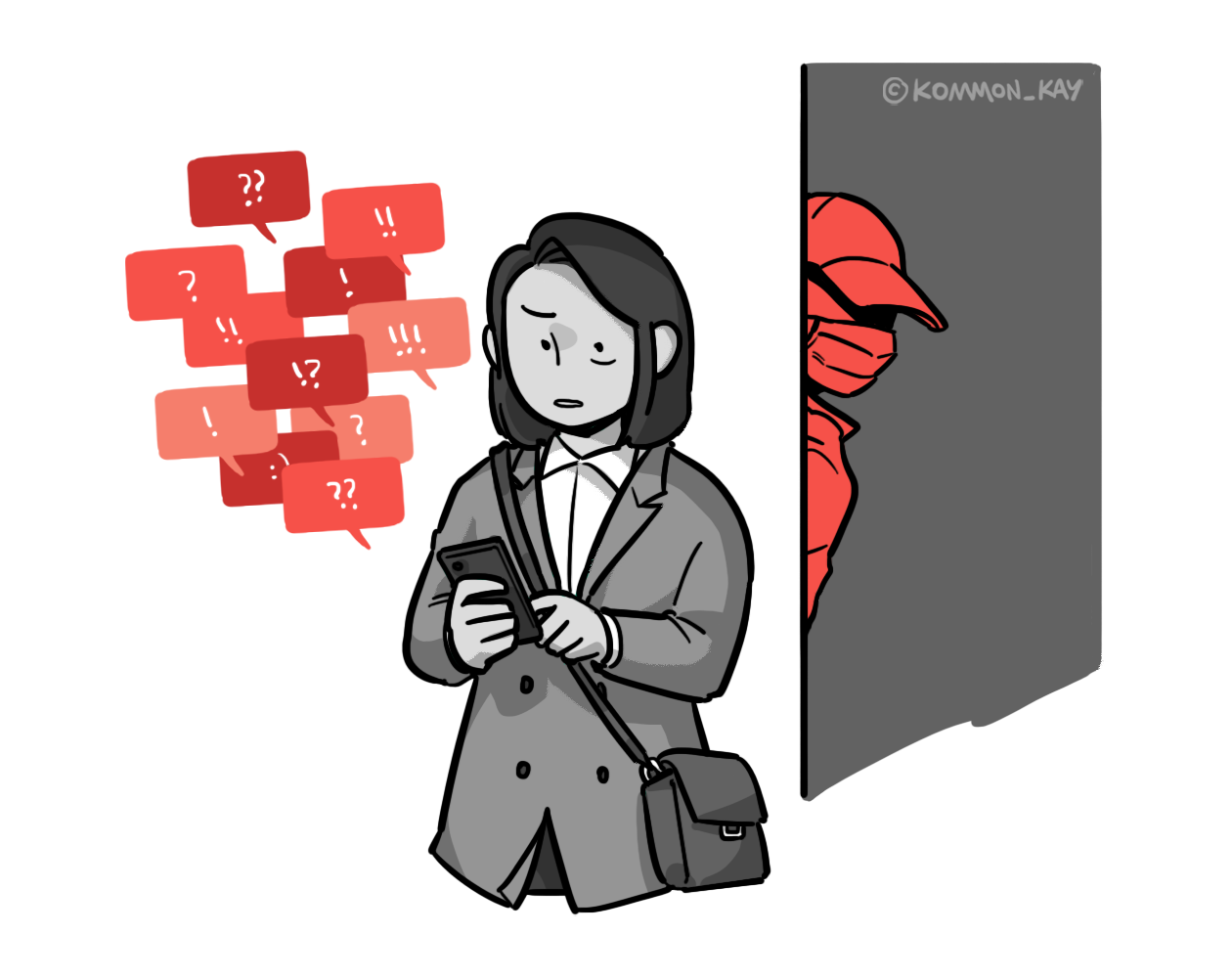
[Illustration by Ah-young Kim] In the first week of April, the police completed their investigation of the case of a 24-year-old man who was accused of killing three women from the same family in March. The police concluded that the man, named Kim Tae-hyun, committed stalking and premeditated murder and transferred him to the prosecutor’s office. Kim was arrested at the victims’ home on March 25, where he killed a woman, her younger sister, and her mother two days before the arrest. The Nowon District Police said that Kim had stalked the woman for months and planned the murder at least one week before the event. The police officials also reported that Kim had searched how to kill a person on the internet and had tried to find out whether the woman was at home or not. What shocked the public the most was how calculating this man was in the killing of the victim and her family that he barely knew. Kim claimed that he got to know the victim while playing an online game. They met in person last November and started to exchange text messages via KakaoTalk. Kim and the victim met three more times in January and had a big fight during their last meetup. The victim refused to talk to Kim after that and blocked his number and KakaoTalk ID. She later even changed her phone number to avoid talking to Kim ever again. However, Kim found the victim’s address via a photo that she had once sent to him. The photo showed a package (Korean link) with the victim’s home address. After finding out where the victim lives, Kim stalked her for two months. Eventually, on March 23, he disguised himself as a delivery man, entered the victims’ home, and stabbed the three women to death. Some experts say that this murder could have been prevented if the legal punishment for stalking was stronger. About two weeks prior to the event, Kim was fined two million won for spamming women with text messages and images that contained sexual content, which is categorized as stalking under Korean law. “If the criminal punishment for such stalking behavior was stronger (Korean link), Kim might have been more cautious and the outcome could have been different,” an anonymous official of the Seoul Metropolitan Police Agency told the Hankook Ilbo. How Stalking Has Been Punished in Korea Until Now The Korean legal system has been lenient with stalking offenders for a long time. Accused stalkers were often sentenced to pay a fine but rarely put behind bars. Currently, stalking is defined as “consistent bullying (지속적 괴롭힘)” in the Korean law and those who are found guilty are fined up to ₩100,000 or sentenced to up to 29 days in jail. Unless the offender commits other crimes, such as physical violence, the punishment for stalking cannot be increased. Some victims are reluctant to get the police involved, out of fear of their case being treated as a “personal problem” rather than a crime. They also often are concerned about possible retaliation. Last May, a 59-year-old woman who owned a restaurant in Changwon, South Gyeongsang Province, was brutally murdered by a 43-year-old man, surnamed Choi, who had stalked her for more than 10 years. The woman had not reported Choi to the police during the period as she did not want to “worsen the relationship with a young man who lives in the same neighborhood” and make her family “worry about her.” The victim eventually reported Choi when he went on a rampage in her restaurant, infuriated by some customers staying there late into the night. However, Choi was released after a basic interrogation at the police station. The next morning, Choi went to the victim’s restaurant again and killed her. According to data from the National Police Agency, the way the police handled Choi’s case is the norm rather than an exception: While over 4,500 stalkers were reported in Korea in 2020, almost 90% of cases were closed without further action, and only 1 in 10 offenders were eventually punished. As the fact that many stalkers just get fined or are let go without being punished at all could lead to more serious crimes, the National Assembly recently decided to pass a new law that imposes heavier punishment on those who are found guilty of stalking. The Stalking Protection Act (스토킹 범죄 처벌법) The Stalking Protection Act (스토킹 범죄 처벌법, which directly translates to “Stalking Crime Punishment Act”) was introduced to impose heavier punishments on stalkers and prevent them from committing related crimes. This new law was first introduced 22 years ago to define stalking as a crime in the Korean legal system but only passed the National Assembly in the last week of March, after Kim's case went viral and the public raised their voice demanding heavier penalties. Under this law, the act of stalking is more clearly defined than before. According to the new law, which is expected to become effective in September, “approaching, following, or blocking a victim against his or her will; waiting for or observing a victim in and around his or her residence, workplace or school; and causing anxiety or fear through mails, telephone or IT networks” will be categorized as acts of stalking. Consistently repeating these acts will constitute a “stalking crime.” The punishment for these acts was also raised. Offenders can be sentenced to a fine of ₩30 million or up to three years in prison. When violent weapons or “dangerous objects” are used in the acts or when the victim is a minor, offenders could face up to five years imprisonment or a ₩50 million fine. The police will also be given more power when it comes to preventing stalking crimes. The new law includes that the police may take preemptive emergency measures, for example, giving restraining orders to accused stalkers, offline and online, to stop stalking acts early and ensure that they do not develop into serious crimes. The law also states that the police can implement emergency measures that can be authorized by a court later. What Took Korea So Long? There are several reasons why the new stalking law was only passed now, nearly two decades after its introduction. One is that acts of stalking have often been viewed as an expression of “affection” or an attempt to gain attention from a victim. In Korea, there is an old proverb that says: “No tree will stand firm if chopped at ten times (열 번 찍어서 안 넘어가는 나무 없다).” While this proverb emphasizes the constant effort that one has to put in to achieve one’s goal, many Koreans use it when talking about repeated attempts to win the heart of the person they love. Even an ill obsession with a person, like stalking, has therefore often been understood as a result of being “madly in love.” Money Today recently pointed out that even Korean dramas commonly portray stalking acts as an attempt to “awaken” someone’s love, and that this re-establishes and strengthens the common but incorrect perception many Koreans have of stalking. The women’s rights activist group Womenlink found 62 cases of violence that could be categorized as stalking (Korean link) in 120 Korean dramas in 2018. Although this may not be the only reason, this view on stalking can partly explain why the new stalking law was passed so late and why punishments have been so weak for such a long time. Also, as mentioned above, stalking has long been considered “personal business” that should not be openly discussed with others. Even if victims do report their stalkers to the police, the majority of cases are closed at the police level and do not result in trials. Last year, 90 percent of reported offenders went free without charges (Korean link) after the initial investigation. “Victims are often concerned about potential retaliation (Korean link), as the current law does not impose heavy punishments,” Lee Dong-gwi, a psychology professor at Yonsei University, said during an interview with Money Today. “Even when the offenders are punished, victims worry that the light punishments could make them angrier and trigger them into committing more serious crimes,” he said. “We Can Do Better Than This” Politicians explain that the new stalking law, the Stalking Protection Act, provides a better legal foundation to punish the offender. Rep. Jung Choun-sook of the ruling Democratic Party told reporters that “The biggest success (Korean link) from passing this law is that now we have a legal basis for the police to protect the victim by emergency and provisional measures.” However, anti-stalking activists say that the law could be improved in some respects to better apply to the complex nature of stalking crimes. "Under the new law, acts of stalking must occur repeatedly in order to be treated as a crime. But victims can experience horror and anxiety even from a single incident," Korea Women's Hot Line, a victims' advocacy and protection group, was quoted by Yonhap. The law also does not provide much protection for the victims’ families and no rehabilitation support programs, such as therapy sessions, for the victims. The group said: "A more effective law centered around stronger punishment and protection of victims' rights should be introduced.” Some experts are concerned about the wording of the law, which contains the requirement that acts are being done “against the victims’ will,” meaning that victims might have to prove that the acts were done against their will. “The punishment of acts of stalking is decided upon by (the court), not the victims, ” said lawyer Jang Yun-mi during an interview with YTN. “But the current law leaves too much of a burden on the victims’ shoulders (Korean link) to determine whether the acts were really done against their will in the legal proceedings.”
Today's Vocabulary Sun-aebo (순애보) Sun-aebo can be translated as “unwavering love” or “pure love.” The word is used to describe a strong sense of devotion of people who can sacrifice anything for the one they love, mostly his or her lover. By people who do not understand the severity of stalking crimes, stalking acts are unfortunately often referred to as Sun-aebo. Example: A: 내일 여자친구가 시험 볼 때 먹을 도시락 만들고 있어. B: 너 정말 순애보구나! (😊) A: I’m making a lunch box for my girlfriend who is sitting for a big exam tomorrow! B: You are such a Sun-aebo! A: 나는 걔한테 관심 없는데 계속 연락하고 쫓아다녀서 무서워. B: 걔가 널 정말 좋아하나봐. 완전 순애보네. (🤮) A: I have no interest in this person, but he continues to send text messages and follows me everywhere. B: He must be madly in love with you. A total Sun-aebo. This Week's Recommendations Unanswered Questions (그것이 알고싶다, 1992 to present) Unanswered questions is an investigative documentary television series that seeks to unravel the truth in many sectors, ranging from societal conflicts to heinous crimes. By reviewing cases and conducting interviews with relevant officials and experts, the series points out issues that might have been overlooked by the police or prosecutors. The series has brought many neglected subjects into the limelight and has countless die-hard fans. We recommend watching one of their recent episodes that covered Kim Tae-hyun’s stalking acts (see above).
💚 Support us! 💚
|