Preparatory Issue 2 October 2021
Pfizer, Putting Profit Over People's Lives Hwang Jeongeun (General Secretary, ISC) The whole world struggles to overcome the COVID-19 pandemic. Currently, of the world's population, over 240 million are confirmed infected with and nearly 5 million are dead due to the pandemic. Despite lock-downs and strong quarantine measures, the end of the pandemic remains uncertain as new strains of the COVID-19 virus emerge and spread. Earlier this year, with the development and distribution of vaccines, governments focused their efforts on increasing vaccination rates. The Pfizer vaccine (jointly developed by US Pfizer and German Bioentech) was the first approved by the World Health Organization for emergency use on Dec. 31, 2020. This Oct. 19, the US nonprofit consumer advocacy organization, Public Citizen, released a short but shocking report analyzing Pfizer's contracts with Albania, Brazil, Colombia, Chile, the Dominican Republic, the European Commission, Peru, the US, and the UK. The report revealed that Pfizer used its oligopolistic status to secure unfair contracts with provisions that infringed upon national sovereignty. This report is particularly alarming given that more than half of the world's population remains unvaccinated. In particular, in low-income countries, the average percentage of the population who've received at least the first dose of a vaccine is 2.8%. The report clearly reveals how Pfizer put its interests before people's lives. With the whole world in crisis due to the pandemic, more than ever, now is the time for international solidarity. Through solidarity between governments and civil society, COVID-19 vaccines should be exempted from intellectual property rights, and be widely produced and distributed to provide access to everyone.
The International Strategy Center: a Platform for International Progressive Policies The ISC is beginning a new project to research and disseminate progressive policies from around the world. In the process, we hope to better understand, diagnose, and strengthen policies by Korean progressives and civil society organizations. Ultimately, our goal is to become an international platform for communicating relevant and strong progressive policies around the world in an easy and accessible manner. Look out for our monthly policy research on our website, newsletter, and social networking sites! Currently, our researchers are exploring the following topics: ○Hong Seung-hyun: Comparison of social housing in the Netherlands and South Korea to explore the possibility of social housing through housing stability policies ○Cha Han-seon: Research on ways to mitigate the labor problems (e.g. employment insecurity) in the de-institutionalization of workers with disabilities that've been institutionalized ○ Seon Jong-pil: Comparison on the purposes for participatory budgeting in different countries ○ Bae Jae-hong: Comparison of protections in Korea, Japan, and Germany for commercial tenants ○ Song Dae-Han: Research on the past, present, and future of social housing in Vienna ○ Shim Tae-eun: Research on the strengths and weaknesses of Small Modular Reactors (SMRs)
'Fantastic!': Berlin Votes to Expropriate 240K Apartments From Corporate Landlords From: Common Dreams By a margin of 56% to 39%, Berliners approved a referendum that instructs the municipal government to purchase housing from mega-landlords, or private real estate companies that own more than 3,000 units. If implemented, the move would bring approximately 240,000 homes, or about 15% of the city's stock, into public ownership. The referendum was secured by the Deutsche Wohnen & Co. Enteignen (Expropriate Deutsche Wohnen & Co.) campaign, which gathered 343,000 petition signatures to ensure the measure made its way onto the ballot for Sunday's elections in Germany. A World without Hunger From: Tricontinental Institute
for Social Research
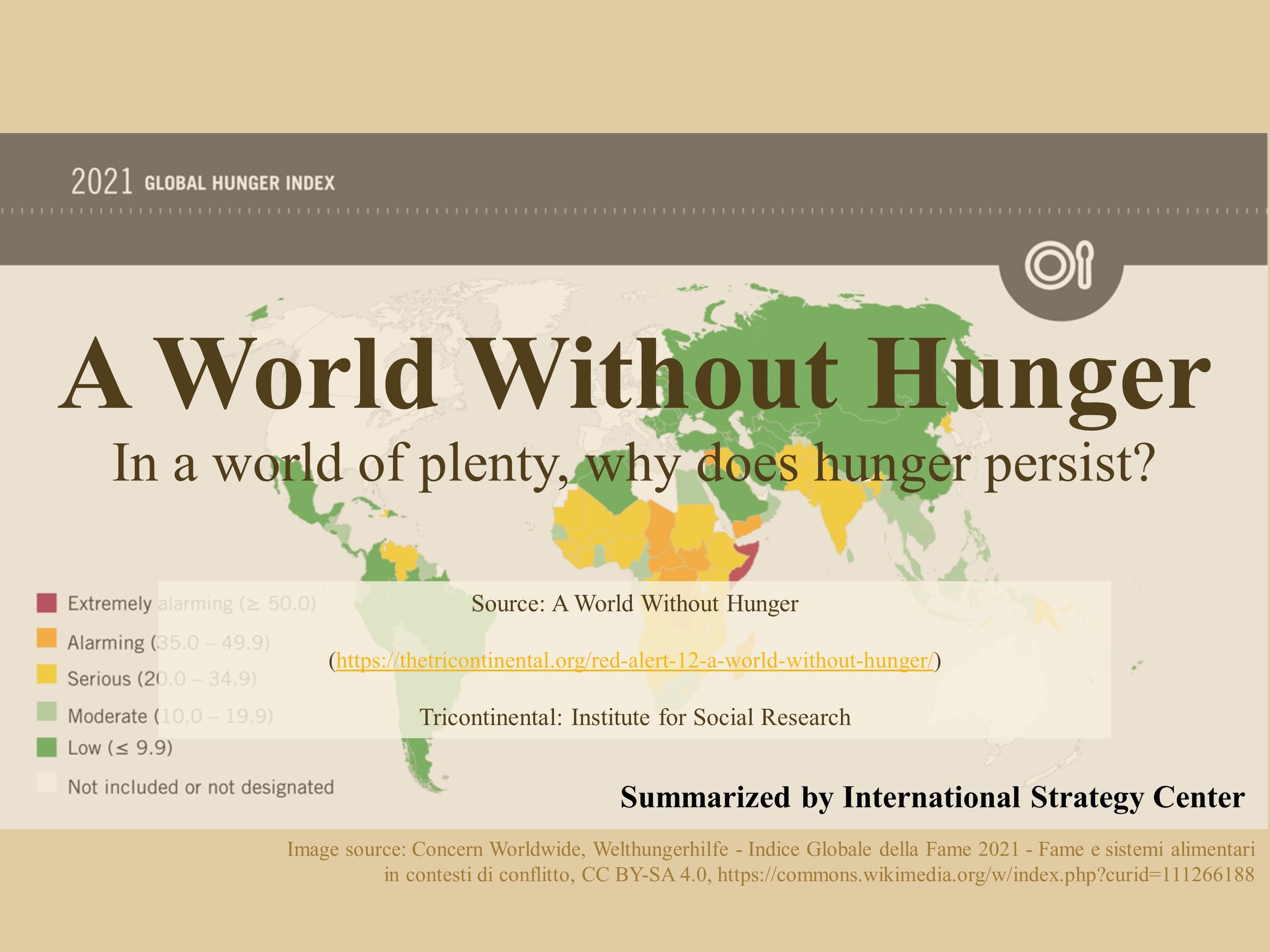
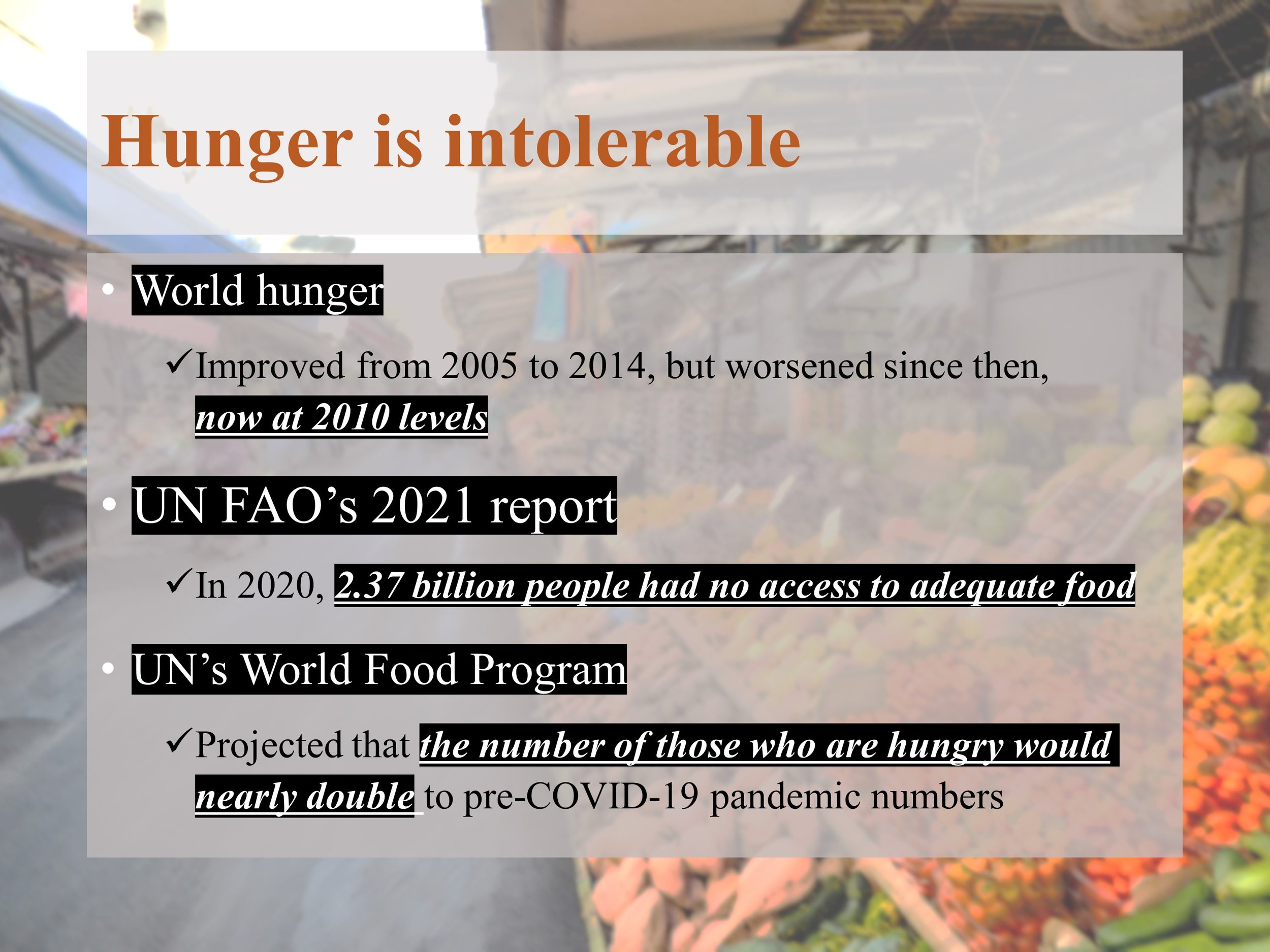
All historical research shows that famines are not primarily caused by a lack of the food supply, but by the lack of the means to access food. As the FAO wrote in 2014, ‘current food production and distribution systems are failing to feed the world. While agriculture produces enough food for 12 to 14 billion, some 850 million – or one in eight of the world population – live with chronic hunger’. This failure can be measured, in part, by the fact that one third of all food produced is either lost during processing and transportation or it is wasted. It is not overpopulation that causes hunger as is often argued, but rather inequality and a profit-driven, agribusiness-dominated food system in which the basic material need for food for hundreds of millions of people – at minimum – is sacrificed to quench the hunger for profit of the few.
[October Progressive Forum] Afghanistan: Yesterday, Today, Tomorrow
On Oct. 7, at 7 pm, our monthly Progressive Forum conversed with Vijay Prashad: author, journalist, international solidarity activist, and director of the Tricontinental Institute for Social Research. He joined us from early in the morning on the other side of the globe in Santiago, Chile to speak about Afghanistan's past, present, and future. We appreciated his great passion as he provided a comprehensive and historical understanding of Afghanistan, centered on its people's self determination and their role in making history – something that has been missing from mainstream media coverage. We'd also like to thank the 30+ participants for their interest and active engagement. In one memorable instance, Vijay challenged us to consider: after 20 years of US control, "50% of Afghans live in poverty, 70% of them don't have access to electricity, and only 1% have been vaccinated. What is the question we have to ask now?...Who is the real barbarian?" [November Progressive Forum]
Housing is being exploited for extreme profits all over the world. Yet, on Sep. 26, Berliners achieved a victory in the struggle to reclaim our homes: 56.4% of Berliners voted to socialize 240,000 units (or 15%) of housing. Armed with the German Constitution’s mandate that property “shall also serve the public good,” Expropriate Deutsche Wohnen & Co. organized a broad coalition to achieve the electoral victory. Nonetheless with the referendum non-binding, the struggle continues.
Web Site : www.goisc.org E-mail : iscenter2015@gmail.com 2F, 2 Dosin-ro 47-gil, Yeongdeungpo-gu, Seoul International Strategy Center Unsubscribe     |