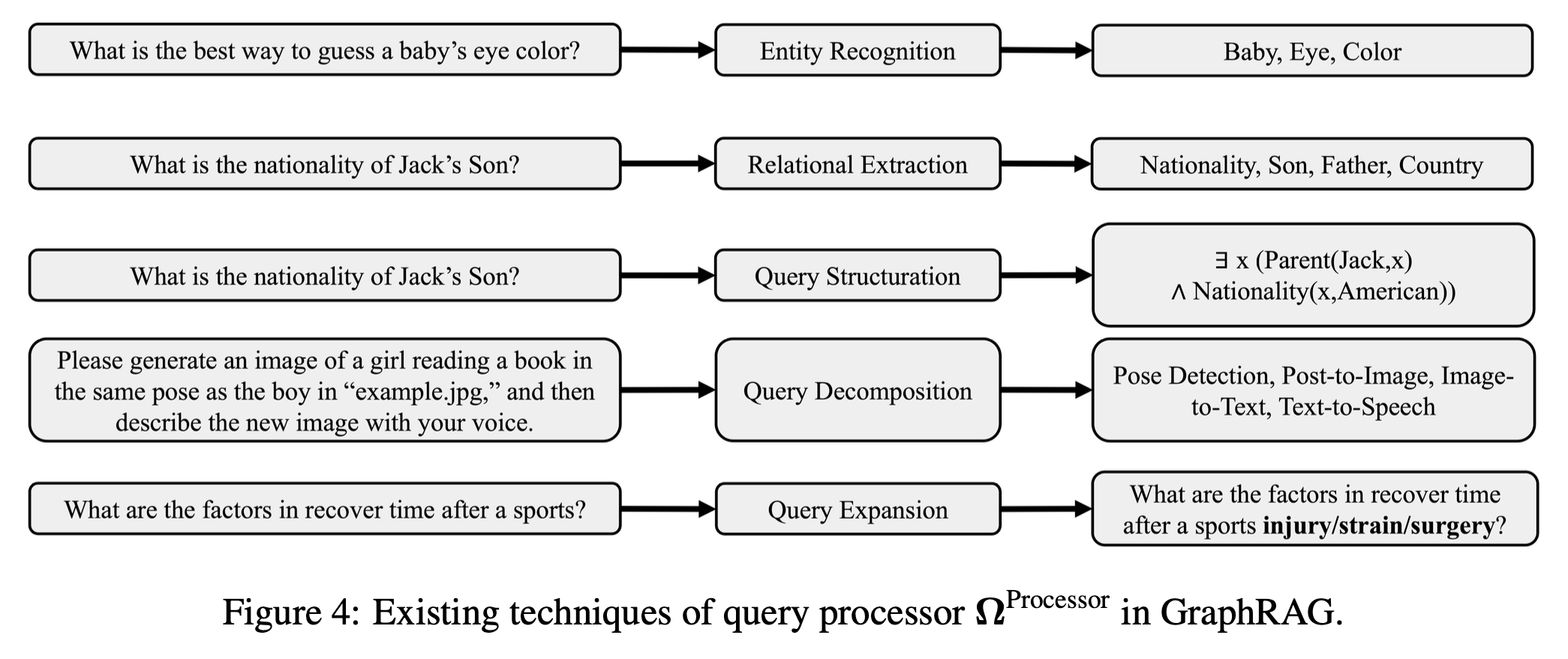
Once the query has been preprocessed by the Query Processor, it enters the Retriever stage, where the actual search across the graph takes place. Instead of relying solely on vector similarity, the system uses the structure of the graph to guide its exploration. Let’s look at the key approaches that drive this process. 🤓
1. Graph Traversal-Based Retrieval
GraphRAG can perform direct traversal within the graph structure, starting from nodes relevant to the query. Common techniques include path-based strategies like Breadth-First Search (BFS), Depth-First Search (DFS), and Monte Carlo Tree Search (MCTS). The traversal scope is typically defined by l-hop neighborhoods or specific relationship paths.
Example: If a query mentions both a gene and a disease, the system can trace the connecting paths between them to identify related drug nodes in the graph.
2. GNN-Based Embedding Retrieval
To capture both structural patterns and node-level features, Graph Neural Networks (GNNs) are used to generate context-aware embeddings. These embeddings incorporate information from each node’s neighbors, enabling similarity calculations that reflect both content and position in the graph.
Some GraphRAG implementations such as GNN-RAG and REANO go a step further by integrating the query into the GNN’s message-passing process. This allows node representations to adjust dynamically based on the query, enabling more precise and context-sensitive retrieval.
3. Hybrid and Adaptive Retrieval
Recent systems combine rule-based graph traversal with neural embedding techniques to create hybrid retrieval methods. One approach is to extract a subgraph relevant to the query, then refine the results using embedding-based similarity. Adaptive retrieval enhances this further by adjusting traversal depth (l-hop) or strategy (such as BFS or GNN) depending on the complexity of the query.
In GraphRAG, retrieval is no longer just about finding related documents. It is about following relationships, reasoning over structure, and applying domain-aware search strategies.