For dark mode users,
Hello, reader! Today, we are covering: Index Zoom In Afghanistan Refugees to Korea Today's Vocabulary 난민 (Nan-Min) Refugee This Week's Recommendations Exhibition: “You Could Have Been Me” Don't forget to leave your feedback below!
Afghanistan Refugees to Korea Writer: Haram Lee, Chaewon Park Editor: Aleya Sharif Senior Editor: Regine Armann Editor-in-Chief: Fred McNulty Researcher: Yul Jun On August 27, Operation Miracle (미라클작전) brought several hundred Afghans to South Korea. These individuals were identified as local staff and their family members that cooperated with the South Korean government in the region before the Taliban took control. The military operation was carried out in four steps, including a “0 step” preparation stage. The preparation started with the government preparing “behind the scenes” for the smooth evacuation of the civilians. During the first step, three aircrafts were prepared for different purposes: evacuating, bombing to defend the evacuation, and flying for tactical defense. The second step highlighted the US-Korea alliance in changing the assembly area of the Afghans’ evacuation. Instead of gathering the refugees in the Hamid Karzai International Airport where different groups of terrorists have been attacking, people gathered in a zone near the airport with the help of the US at South Korea’s request. The third step was the welcome the refugees received from the foreign ministry at their arrival at Incheon International Airport. The last step refers to the aftermath of the Operation Miracle and the effect it had on Korea’s “image”. South Korea has now established itself as “a country that gives help” rather than “a country that needs help”. A total of 391 Afghans that were feared to be at risk of Taliban retaliation have been saved by South Korea because the previous reconstruction work was supported by Afghanistan. Nevertheless, a big controversy, flamed largely by anti-immigrant sentiment, erupted over exactly who these people are, on what grounds they were evacuated, and why their situation should be considered a “foreign affair” of such high importance. To make matters difficult, polls show that most people in Korea generally hold negative views towards Muslim refugees. This week, we therefore want to examine attitudes towards and perception of Afghans and where the Korean population’s views on refugees–in particular refugees from majority Muslim countries–come from. Source of the “controversy” Persons of “special merit” The Ministry of Foreign Affairs designated the evacuated Afghan personnel as “persons of special merit” (특별공로자) instead of “refugees” (난민). This entails some benefits that are different as compared to other types of refugees. They were issued C-3 visas (valid for 90 days from arrival) and will later be granted F-2 visas (Korean link) that will allow them to stay in Korea for up to 5 years. Then, they can apply for the F-5 permanent residence visa, if they wish to do so. Looking at the word “special” (특별) being used to label the new arrivals to Korea, some critics have questioned why these individuals should be eligible for supposed “special treatment” from the Korean government. According to the South Korean statute, “persons of special merit” like Afghans who provided services to Korea have the privilege of benefitting from special immigration measures, which is in stark contrast to the rules that apply to general refugees. This means that unless the government had already planned to provide all of these benefits as they are stated in the law, they had no reason to use the legal term. This therefore triggered a heated debate and, as a result, the government somewhat backpaddled and changed the term from “persons of special merit” to “special contributors (특별기여자), which refers to a newly created status of a refugee who is still exempt from going through the usual application and recognition process, will be allowed to stay in the country for 5 years, and benefits from special support measures.” As Bae Jin-seok, a lawyer from Dasol Lawfirm in Seoul and a critic of what the government is doing, told the conservative-leaning Hankook Ilbo “It is problematic for the government to misuse the term “special merits” just because people are not aware.” However, not everyone is so critical. Jang Ji-hyang from the Middle East Research Center at The Asan Institute for Policy Studies told TBS that the Korean government decided to call them “persons of special merit” because of the Korean public’s negative perceptions (Korean link) towards refugees. “The term “refugee” implies that those people are seeking political asylum,” she said. “As many Koreans tend to consider asylum seekers a burden, the government must have decided to call Afghan refugees “persons of special merit” to emphasize that these people are different from other refugees.” Politicians also expressed the necessity to accept more Afghan refugees to Korea. Rep. Jang Hye-young from the Justice Party posted on Facebook on August 20 that “Korea should actively search for what they can do in order to lessen the burden of Afghan refugees for the sake of international cooperation and solidarity.” On the same day, Kim Jae-won from the People Power Party also left a post on Facebook (Korean link) saying: “Korea should accept Afghan refugees on humanitarian grounds, or at least should not define Afghan refugees as illegal immigrants and banish them.” Unclear identity of the arriving Afghans, critics charge According to Choi Jong-moon, a Ministry of Foreign Affairs undersecretary, Korea “initiated airlifting 391 Afghans who have contributed to the Korean government in Afghanistan.” The right-leaning Hankook Ilbo who reported on the briefing argued that the contributions of the Afghan refugees were never clearly explained to the public, leaving some to doubt the Afghans’ legitimacy of being let into South Korea. The best explanation the government gave, according to Hankook Ilbo, was “those who have actively cooperated with South Korea.” However, supporters dispute the claim that the government is being opaque, pointing out that most refugees have connections to Korea (Korean link) through their work at the South Korean embassy in Afghanistan, the Korea International Cooperation Agency (KOICA), and the Korean Job Training Center, or as part of the Province Reconstruction Team (PRT). Among them are doctors, nurses, IT experts, and interpreters. The Ministry of Foreign Affairs further mentioned that they have worked tenaciously with the South Korean representatives in Afghanistan for at least 1 and up to 8 years. Negative perception of refugees Anti-refugee advocates foment fear of crime According to a survey (Korean link) conducted by the United Nations High Commissioner for Refugees (UNHCR) and Hankook Research among 1,016 South Koreans, those who opposed accepting the refugees amounted to 53% of respondents. No group of respondents, including gender and age subgroups, were in favor of accepting refugees. The reasons included: economical burden (64%), crimes (57%), and fake identities (49%). The recent outburst of anti-refugee sentiment harkens back to 2018 when a group of refugees from Yemen arrived on Jeju Island and applied for asylum. While 39% of the Korean populace was in favor of accepting the refugees, 49% opposed doing so, according to The New York Times. Opponents viciously smeared the asylum-seekers, claiming that they were “fake refugees” attempting to take advantage of the kindness of South Koreans. Stereotypes of Muslims in Korea Anti-refugee advocates point to alleged incidences of Muslim immigrants supposedly ignoring Korean cultural standards. These anecdotes have led to some Koreans perceiving an absence of respect towards Korean cultural standards. According to a story appearing in News1Jeju, some conflicts occurred (Korean link) on the island when local businesses started hiring Yemeni refugees in 2018. The Jeju Immigration Office stated that “some business owners have complained that they are experiencing conflicts with the immigrants they hired because of their strong religious convictions. One said he told his workers that it is a courtesy to bow your head when greeting customers, but the workers refused and were adamant that they do not bow their heads except to God. Also, a farm owner said that his workers suddenly disappeared while feeding livestock because they had to go pray, which left the owner speechless.” However, anecdotes such as this are typically one-sided. In this instance, the News1Jeju story did not even reach out to any of the accused Muslim workers for comments. As more immigrants fill jobs that Korean citizens refuse to do, advocates argue that it should be incumbent on employers to make accommodations for workers who are doing difficult jobs. Not all anecdotes have been negative. A 36-year-old Yemen refugee named Mohammed told Hankook Ilbo (Korean link) that he wanted to challenge the stereotype that Muslims refuse to embrace other cultures. He told the paper, “Islam teaches to get along with others with different cultures and religions. As I’m here in Korea, I’m complying with Korean customs.” Also when asked if it would be fine for his son to learn the teachings of other religions, he answered, “The teachings of all religions share similar characteristics. It will be good for my son to learn the concept of loving and sharing.” Opponents of refugees raise questions about tax money Anti-refugee advocates claim that refugees are supported with tax money, with some going as far as to claim that refugees receive social and financial benefits that Korean citizens rarely get. Other critics have made a “reverse discrimination” claim, arguing that the government is discriminating against its own people. Several petitions opposing the allowing of any Afghan evacuees into Korea have been posted on the Blue House petition website recently. These attempt to argue that the difficult economic situation many Koreans find themselves in right now justifies withholding support for refugees from other countries.
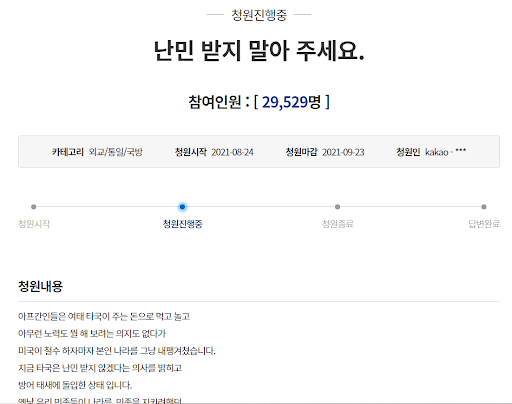
This petition was uploaded prior to the South Korean government launching Operation Miracle. The poster opposes accepting the Afghans because they “do not deserve it” and alleging that they “have not shown any efforts of rebuilding their country while foreign aid was there.” The uploader contrasts this allegation with how hard their Korean predecessors fought against foreign oppression throughout history. The uploader also believes that accepting these refugees will harm the country as many Koreans are already having a hard time because of the pandemic and there many are in desperate need of assistance the government is not providing. The Afghans’ religion is also mentioned as a problem. The uploader claims that the country is already suffering from religious “zealots” like the members of the Shincheonji Church of Jesus and that accepting Muslims into Korea will exacerbate the issue and expose the country to terrorism.
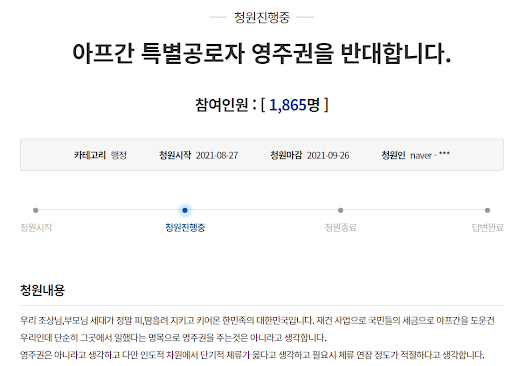
This petition was uploaded after the Afghan evacuees were accepted into Korea. It opposes granting permanent residence to the evacuees, the main argument being that it was South Korea that aided Afghanistan and that having worked together is not enough to be granted permanent residency. This poster says that humanitarian short-term visas and granting rights to extend their stay is appropriate but that permanent residency would be excessive. However, the proportion of refugees who can receive support for living expenses in Korea is low, and the period of support is short–only up to six months. In 2019, only 609 refugee applicants (Korean link) were supported by the government with living expenses, which is 3.9 percent of all applicants (15,452). In addition, last year, the average length of time that refugee applicants were provided with living expenses was only three months. The amount of money successful applicants receive is not that large either. According to the Ministry of Justice, the cost of living expenses in 2021 is ₩432,900 per month for a single-person household. In the case of refugees living at support facilities, it is reduced to ₩216,450 per person per month. This is about one fifth of the minimum cost of living for a one-person household (₩1,096,699), calculated as 60 percent of the median income this year. Compared to other countries, South Korea still has a very low acceptance rate of refugees. This is particularly startling in light of the fact that Korean refugees during and after the Korean War were numerous. As the Ministry of Foreign Affairs mentioned the idea of “the stature of an advanced country with dignified human rights”, this seems to be the right time to prove that Korea is such a country.
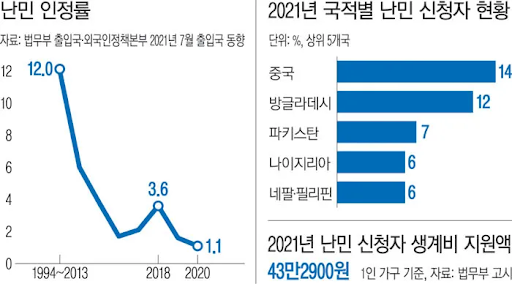
Refugees acceptance rate 1994-2013: 12.0% 2018: 3.6% 2020: 1.1% Top 5 countries with the highest applicants rates for Refugees to South Korea in 2021 China: 14% Bangladesh: 12% Pakistan: 7% Nigeria: 6% Nepal/Philippines: 6: Amount of financial aid provided to the accepted (per family): ₩432,900 During the Korean War, the United Nations established an organization in Korea to restore the country, called the “United Nations Korean Reconstruction Agency (UNKRA).” The UNKRA took the responsibility of restoring Korea to the pre-war condition and taking care of war refugees and orphans. The UNKRA served as a model for today’s UNHCR. Morocco, Haiti, Ecuador, Ethiopia, Luxembourg, and 67 other countries supported Korea during and after the war with refugee resettlement. The Korean War is listed in the Guinness World Record for the war with the highest number of overseas allies participating in a refugee program. Right after the UNKRA was established in Korea, the United Nations Relief and Works Agency for Palestine Refugees in the Near East (UNRWA) was established in Palestine to support refugees there as well. Unlike the UNKRA, the UNRWA is still in charge to this day. After all those years, South Korea was recently invited to a G7 summit, and promoted to a “developed nation” status. All of this may not have been possible if it weren’t for the assistance of Korea’s allies. It might therefore seem hypocritical to some that even though South Korea has received more foreign aid than many other countries over the course of its history, it is, in comparison, taking a very reluctant approach towards refugees.
Today's Vocabulary 난민 (Nan-Min) Refugee A: 전쟁으로 인해서 우리나라로 이민 하는 사람이 많다고 들었어. B: 그럴때는 보통 이민이 아니라 난민 유입이라고 하지 않아? A: I heard that there are lots of people immigrating to our country from the war. B: Don't we usually call those people refugees rather than immigrants? This Week's Recommendations Exhibition: “You Could Have Been Me” Two photojournalists recently held an offline exhibition of their photos that captured the lives of refugees. Cho Jin-sub and Harry Chun’s exhibition, “You Could Have Been Me”, took place from August 19 to 29 in Insa-dong, Seoul. The same exhibition has also been available online (link: Dialogue Factory) since last December with the support of the United Nations High Commissioner for Refugees (UNHCR). The journalists, who have covered refugees and conflict zones for many years, documented the lives and hardships of people from war-torn countries, such as Iraq and Syria. They hope their exhibition can correct some of the misconceptions that Koreans have against refugees, as those refugees’ stories are not “any different from ours”. (link: 'Refugees we met are just like us, far from being terrorists' - Korea Times) The exhibition can be viewed at their website👉 https://www.dialogue-factory.com/
💚 Support us! 💚
|