#Donghak Ant Movement #Stock trading in Korea #영끌 #빚투 #손절 For dark mode users,
Hello, reader! Today, we are covering: Index Trending News Stock Trading Frenzy in Korea Zoom In Why Are Korean Millennials into Risky Assets? Today's Vocabulary Sonjeol (손절) This Week's Recommendations Parasite (기생충) (2019) Don't forget to leave your feedback below! 🔊Notice: KOMMON is starting a new project! Find out at the end of the newsletter👀
Stock Trading Frenzy in Korea
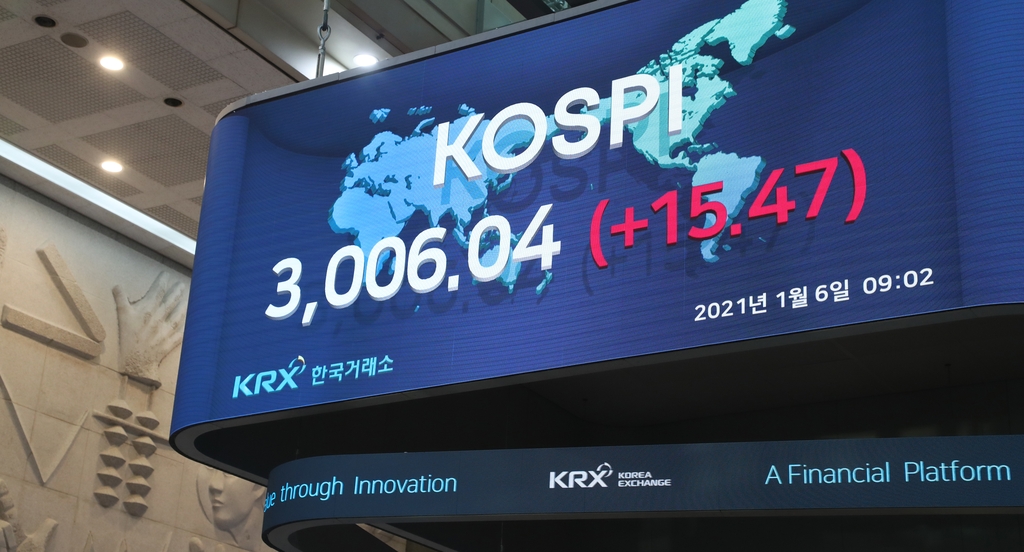
[Photo by Yonhap] KOSPI Touches 3,000 In early January, investors rejoiced when they heard the news that the Korea Stock Price Index, or KOSPI, passed the 3,000-point threshold. The KOSPI is a capitalization-weighted index of all common stocks exchanged on the main board of the Korea Stock Exchange. As a benchmark index of the Korean stock market, it follows a variety of industries, bonds, options, and futures. When the KOSPI was first introduced in 1983, it was traded at 122.52 points. It reached its worst point, 31.96, during the 1998 financial crisis. In 2020, with the quick spread of the COVID-19 virus, the KOSPI dropped to 1,457.84 points on March 19. However, it rebounded and reached the 3,000-point plateau in the first week of January. The index increased by 30.8% (Korean link) over the year, which is the highest increase rate among the G20 countries’ stock indices. The main driving force behind this remarkable increase seems to be individual investors purchasing local stocks on the mainboard, as Yonhap reported. Individual investors purchased a net ₩38.1 trillion worth of local stocks from March 1 to December 30, 2020. In contrast, during the same period, non-Korean stockholders sold a net ₩21.5 trillion and institutions discharged a net ₩8.2 trillion. Young “Ants” Swarming into the Stock Market A particular aspect of this increase is that a vast number of individual investors newly jumped into the market. To describe this phenomenon, internet slang expressions such as the “Donghak Ant Movement (동학개미운동)” emerged. The Donghak Ant Movement is a compound of two words: “Ant” and the “Donghak Movement”. Ant as a slang term refers to individual investors who don’t know much about the stock market compared to professional, full-time investors. The Donghak Movement is an uprising that took place in 1894, during the Joseon Dynasty. The movement was led and organized by peasants against feudalism and the invasion of foreign powers. The new, rather inexperienced ants were instigated to participate in the happenings on the stock market by an influx of newly launched mobile trading system (MTS) applications (Korean link). MTS applications allow users to trade small shares of a company’s stock, which enable them to start investing with a small amount of seed money with no transaction fees charged. Users can also open bank accounts for stock trading, or share accounts via the applications, without visiting banks. What’s more, many of these applications adopt artificial intelligence or other systems to provide consulting services (Korean link) and recommendations for their users. Thanks to the improved accessibility to the stock market through MTS applications, the number of individuals making small investments in stocks has increased in the country. Compared to 2019, more than four times (Korean link) the number of individual share accounts were opened in 2020. MTS applications are also the main channel to the stock market in general. According to the Korea Exchange, MTS applications represent 40.66% (Korean link) of all transactions, followed by the home trading system (38.89%), branch terminals (10.44%), and automated response service (0.23%), in 2019. The home trading system refers to computer software for stock trading. Notably, more people in their 20s or 30s, mostly inexperienced in stock trading, recently jumped into the stock market with the help of these MTS applications. The term julin-i (주린이), a union of the prefix ju- (주식, stock) and the suffix -lin-i (short for 어린이, child), started to circulate on the internet as the number of young investors increased. The term denotes “newbies” who don’t have a good understanding of the stock market yet. Unstable Growth High interest in risky investments reflects a society that is caught up in a “get-rich-quick” mindset. Not only that, with the increase of individual investors, the stock market is now facing greater volatility and uncertainty. People are taking dangerous risks to get that sweet high return, mostly demonstrated by an increasing amount of debt. Terminologies such as yeong-ggeul (영끌) or ssak-ggeul (싹끌) spread among online communities to describe this tendency. They are each an abbreviation of “collecting to the last bit of our souls (영혼까지 끌어모으다)” and “sweeping up to the last bit (싹쓸이해 끌어 모으다),” demonstrating how desperately people are investing in a stock or real estate. Creating debt in order to invest in the stock market has become such a trend that there is even a word for it: Bittu (빚투), short for “being in debt to invest (빚내서 투자하다)”. What’s worse, more and more young people are doing bittu. The amount of credit balance borrowed by those in their 20s has increased by 40% (Korean link) compared to the end of last year. They are unafraid to take on huge debt that they won’t be able to pay back without the unguaranteed, high profit from stock trading. When the debtors cannot pay back their money in time, the investment companies are forced to sell the stocks the debtors have bought, which can cost not only the debtor himself but also cause a huge disruption (Korean link) in the market as a whole. The get-rich-quick mindset has a high risk of disrupting the economy. The increase of high risk, high return investment overheats the economy, leading to a bubble that will inevitably burst. Excessive debt can lead to a crash of assets as people lose the ability to redeem their debts. The government, though wary, is still positive about its response to the situation. The Ministry of Economy and Finance of Korea contended that its remedial policies would be enough to procure market stability. Sohn Byeong-du, chairman of Korea Exchange, suggested that the breakthrough of KOSPI is not a bubble, but a re-examination and normalization of undervalued stocks in Korea. Korean stocks, he said, have a tendency to be undervalued due to ongoing national security issues.
Why Are Korean Millennials into Risky Assets?
[Illustration by 케이] High Risk, High Reward -- The Survival Strategy of the Korean Youth Korean millennials have been investing in risky assets as a way to climb up the social ladder. Many Korean millennials are facing economic hardships due to the high unemployment rate and a rise in property prices. 😔Unemployment In 2020, the unemployment rate among Koreans between 15 and 29 was 9% (Korean link), more than twice the average unemployment rate (4%) in Korea. For the past 5 years, the unemployment rate among Korean youths hovered around 9%. Even when young Koreans get a job, many of them are part-time or contract positions. In 2019, 40% (Korean link) of all job vacancies were part-time or contract-based positions. Part-time or contract workers do not only get paid less, but their jobs are also less stable than full-time positions. Read our old newsletter for more information here. 🏠Rise in Property Prices Property prices are on the rise in the Seoul metropolitan area. According to Numbeo’s data from July 2020, the world’s largest cost of living database, Seoul has the third-highest property prices (Korean link) per area. Also, last year, Seoul had a price-income-ratio of 12.04 (Korean link), higher than Vancouver’s of 11.9 and London’s of 8.2. The price-income-ratio is the ratio of median housing prices to median familial disposable income. The higher the price-income-ratio, the less affordable housing becomes for people. 💰Low-Interest Rates Most countries are experiencing very low interest rates at the moment. The United States has an annual interest rate of 0.25%, nations like France and Germany have an annual interest rate of 0%, and Korea’s annual interest rate is 0.5% (Korean link). This means that depositing money in a savings account does not bring back much profit. Many people are thus turning to the stock market instead. 📱Millennials Are Tech-Savvy Millennials are more tech-savvy than previous generations. They can use technology (Korean link) to get real-time information and use online trading apps to trade stocks at a low commission fee. Small but Definite Happiness Many Korean millennials use the term sohwaghaeng (소확행) to describe “small but definite happiness.” This refers to finding things that give you short-term pleasure, rather than planning for the future. The term sohwaghaeng is indicative of economic hardships faced by many young people in Korea. Because they are unable to climb up the social ladder, they focus on using their income to pursue happiness. This can be seen as a “Low Risk, Low Reward” approach to life.
In short, millennials are responding to economic hardships in two extremes. On one extreme, there are those who try to take on high risk to move up the social ladder. On the other extreme, there are those who have given up on social mobility and have chosen to focus on the little things in life. How Older Generations View Millennials Many from the older generations do not understand the economic hardships that young people go through. Many of them tell young people to endure the struggle or to work harder, rather than empathizing with their difficulties. A good example of this is the “pain is what makes you a youth (아프니까 청춘이다)” syndrome. Pain Is What Makes You a Youth (Korean link) is a book written in 2010. It discusses the struggles that Korean youth go through, and it was one of the national bestsellers in 2011 and 2012. However, many people criticized (Korean link) the book later because it advised the youth to individually fight through their hardships, rather than focusing on the societal problems that cause hardship. The fact that the author of the book is a professor at Seoul National University, one of the most prestigious universities in Korea, only strengthened the idea that the author was not able to properly empathize with the struggles of the average Korean youth. Many people argued that it’s not necessarily “normal” to suffer during one’s youth. Here’s an interesting story that illustrates a similar idea: Baco🌊 from KOMMON talked to her parents about finding a job. Baco’s father told her that it is not a proper full-time workplace if she doesn’t join Samsung Electronics, considered to be one of the most successful companies in Korea. Baco told her father that it is difficult to become an employee of Samsung Electronics, to which her father said, “I thought it wasn’t that hard to get into Samsung Electronics, you just need to take the TOEIC.”😑😬🤯😫 What Millennials Need Stocks and Bitcoin are very risky investments, but many young people invest in them without a clear idea of the risk they’re taking. There have even been cases of inexperienced investors who demanded to get a refund on the stocks they bought when they realized they didn't go up as expected. This illustrates how naive many investors are. Many Koreans lack proper knowledge of the financial market. If finance were taught at an earlier age, people would be more likely to make wise decisions when making investments.
Today's Vocabulary Sonjeol (손절) Sonjeol originated from the word “sonjeolmae,” which refers to selling a stock at a loss. Sonjeol means to give up or break ties with someone or something. Example: A: 너 요즘은 그 바비라는 친구랑 왜 안 어울려 다녀? B: 어우, 나 걔랑 손절했어. 남 험담을 너무 많이하고 다녀. A: Why aren’t you hanging out with your friend Bobby? B: Oh, we’re no longer friends. He gossips too much. This Week's Recommendations Parasite (기생충) (2019) This is the famous 2019 South Korean movie directed by Bong Joon-ho that won the Academy Award. It showcases a rich family and a poor family that live drastically different lives. The movie is unique in that it breaks the stereotype that the “the weak are nice, while the powerful are evil” by showing the dark side of all social classes. The movie represents the huge social division and the desire for social mobility in Korea. 👉Watcha
Hello readers! KOMMON is on the search to find a better medium to reach out to more people. We are planning a new project where we can provide activities and resources about Asian culture and societal issues. If you are interested in joining this project in meeting people who are also interested in Korean culture and society, click the link below to register! KOMMON TEAM 수수🌾 Sans🌻 바코🌊 오티오😈 쟈🍉 기린🌴 쏘🐥 기니👑 프레드🍰 부엉🦉 타코🌮 Sunny🌞 호야🐻 가가🍒 케이☕ 코코🐦 Gumball🍬 💚 Support us! 💚
|