#Education #School_Culture #Online_Lecture For dark mode users,
Hello, reader! Today, we are covering: Headlines: Sewol ferry suspicions cleared, the head of Samsung got sentenced, and more Cultural Insight: Fierce competition and celebrity teachers: Ingang market in Korea Slang: Most used slang in the field of Ingang - 인강, 현강, 1타 강사 Don't forget to leave your feedback at the end of the newsletter🙌
💥Announcement💥 To improve the quality of our newsletters, we have decided to publish them every Wednesday and Friday, instead of on Tuesday and Friday. See you every Wednesday and Friday from next week!
Politics Most of Sewol ferry suspicions cleared A special investigative team that was set up in November 2019 to solve questions related to the Sewol ferry disaster has now wrapped up a 14-month probe. Immediately after the Sewol ferry incident in 2014, the government was criticized for its insufficient and delayed response, and suspicions were raised that the government had externally pressured subsequent investigations and conducted illegal investigations of civilians. The suspicion of external pressure from the administration of Park Geun-hye stems from Ministry of Justice instructions sent to the Gwangju District Prosecutors, who were investigating Coast Guards, to omit the charges of professional negligence resulting in death. Other accusations included the suspicion that intelligence agencies such as the Defense Security Command and the National Intelligence Service had illegally inspected the families of the Sewol ferry through tailing, illegal monitoring, and hacking. In lieu of the mistrust, a special investigation team was launched in November 2019 to re-investigate the case but have succeeded very little in resolving the suspicion. Of many unresolved issues, first is the allegation that the Coast Guard and the Navy altered CCTV footage and another is that the Federation of the Korean Industries supported the conservative party to have opened the anti-Sewol ferry demonstration. Link Economy
Samsung heir Lee Jae-yong sentenced to 2 years and 6 months for bribery Samsung Vice Chairman Lee Jae-yong was sentenced to two years and six months on bribery charges committed during the former Park Geun-hye's presidency. According to Samsung, the executives of major affiliates, including Samsung Electronics, are planning to hold an emergency meeting soon and find ways to respond to the sentencing of Lee. A senior executive at Samsung was quoted as saying, “Most of us are in shock. We expected [he would receive] probation.” The conservative-leaning business community expressed concern that his imprisonment could hurt the economy. Legal professionals and progressives, on the other hand, criticized the leniency of Lee's sentencing. Link International Relations
New foreign affairs minister, new policy toward the North? President Moon Jae-in has chosen Chung Eui-yong, an ex-national security adviser, as the new Minister of Foreign Affairs. The confirmation hearing for him is scheduled for next month. Chung took leading roles in two recent summits with North Korea. Some anticipate his experience can improve South Korea's relationship with North Korea. At the new year's press conference, President Moon addressed denuclearization and the declaration adopted at the 2018 North Korea–United States Singapore Summit for peace and cooperation of the Korean Peninsula. This nomination is interpreted by many as the administration's will to improve the strained triangular relationship between South Korea, North Korea, and the United States. Link Labor Delivery workers are no longer in charge of package classification work Delivery workers and management have finally signed an agreement to prevent the deaths of workers from overworking by shifting the responsibility of sorting work to courier companies. Sorting work has been regarded as the biggest reason for causing the higher intensity of the work. More than 65 percent of delivery workers sorted packages for more than 5 hours during holidays. They even had to pay some fees for the sorting job. In addition, there is criticism that the income structure is distorted. For each shipping fee of ₩2,500, the companies take around ₩1,700 and courier workers take about ₩500. The new agreement shifts the sorting responsibility to the company, It also states that the costs and responsibilities of sorting will not be passed on to the courier. The agreement also includes information on working hours and shipping costs, as well as sorting tasks. Link 👉Our past issue on delivery workers: Link Human Rights Migrant workers living in vinyl houses Following the death of a Cambodian worker who was living in a vinyl greenhouse, employers who provide foreign employees a vinyl greenhouse as accommodation will not receive permission to hire foreign workers in the future. The death of this Cambodian worker, named Sok Heng, was determined to be due to cirrhosis of the liver. But the question was raised that the death was caused by compounding factors of vinyl greenhouse accommodation, high-intensity labor in poor conditions for 4 years, and not being able to receive timely medical treatment. The Ministry of Employment and Labor said that it has started to refuse employment permits to foreign workers when their employers provide temporary buildings as a shelter. Temporary structures refer to containers, assembled panels, and facilities in vinyl greenhouses. In fact, according to the results of a survey on the housing environment of foreign workers in the agricultural and fishery sector disclosed by the Ministry of Employment, 69.6% of migrant workers who responded to the questionnaire answered that they live in temporary buildings. Link
Fierce competition and popular teachers : Ingang market in Korea
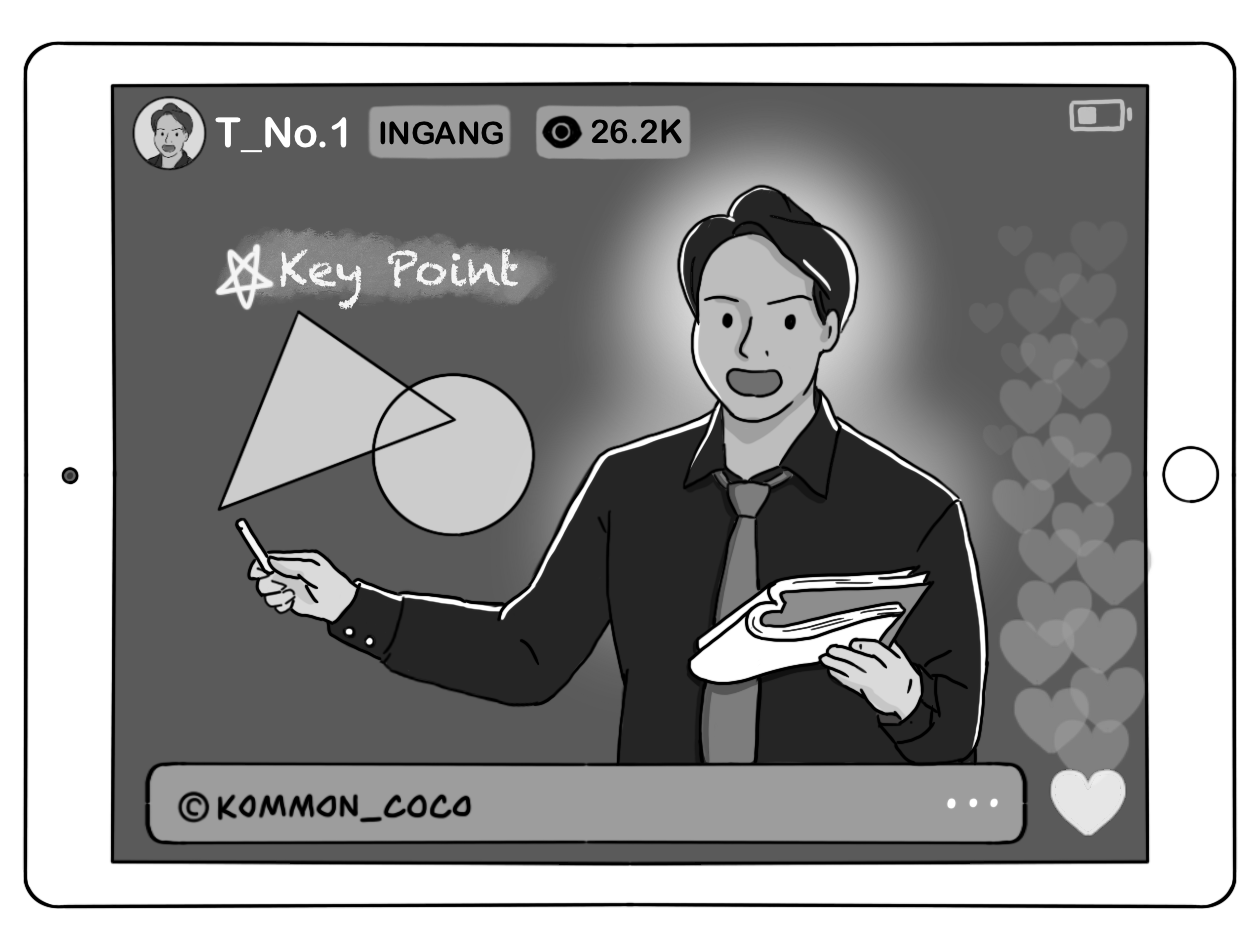
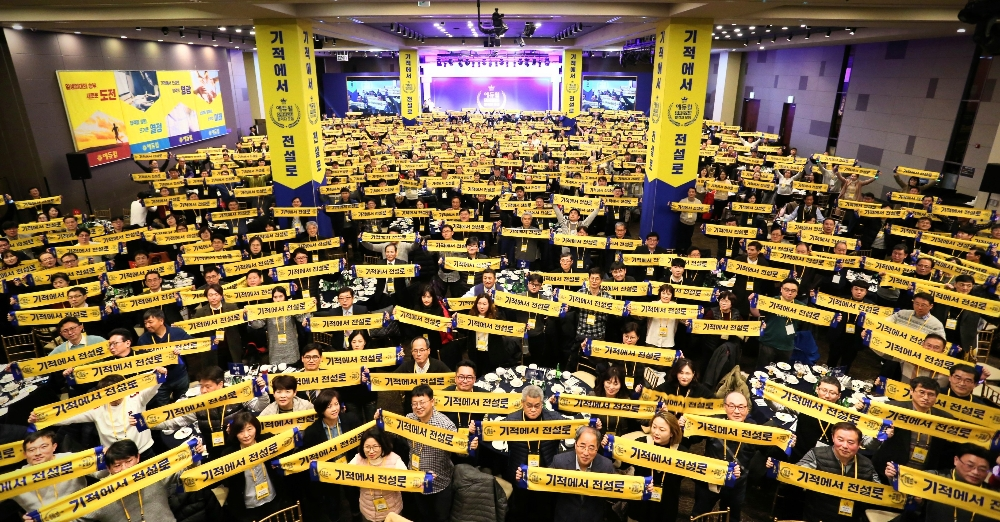
[Illustration by COCO] Successful Candidates invited! In December 2019, 700 newly certified housing managers gathered to celebrate passing the license exam. Their host, surprisingly, was an online education company called Eduwill.
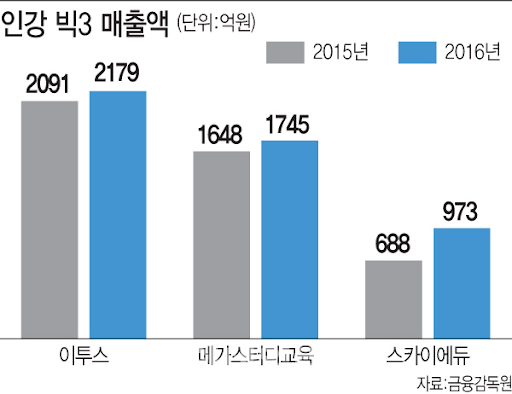
All participants were in a festive mood holding yellow signs on which “from miracle to legend” was written. Yellow is a symbolic color of Eduwill. Source: http://www.globale.co.kr/news/articleView.html?idxno=3254 Eduwill runs a website that offers online lectures of many different licensing exams. Lots of other online platforms do the same and taking online courses for exams was already a thing in Korea even before Covid-19. Among 4,101 new housing managers in 2019, around a quarter paid for online lectures to prepare for the exam. Ingang(인강), Korean online lectures Ingang (인강) is an abbreviation for a Korean word Internet Gangui (인터넷 강의) which means online lectures—Gangui meaning “lecture” in Korean. It usually refers to pay-per-view pre-recorded online lectures. The only requirement for the users is the internet. This may sound similar to YouTube or other open online course platforms but while these two are charge-free, ingangs are provided on a closed, fee-charging platform. It is known that Korea is the country where the value of education has been exceptionally emphasized. Like in many other countries, education level is often closely tied to one’s economic and social status. To get a well-paying job, one is expected to have a diploma from prominent universities, high scores on English exams, and lots of certificates. Driven for success, and facing intense competitions in the job market, many Koreans are more than willing to open their wallet to gain advantages over others. In one study (Korean link), 63% of middle and high school students were known to take private tutoring both from offline and online resources. It demonstrates people’s demand for quality education. People tend to believe that ingang teachers who have taught millions of students are more competent than nearby hagwon teachers. People are more willing to pay for that. Accordingly, the size of ingang industry is tremendous. Suneung (수능), the College Scholastic Ability Test (CSAT) in Korea, is certainly the biggest domain in the market. The sales figures of ETOOS, one of the online education companies for high school students, went beyond ₩217 billion in 2016. It is larger than the revenue that the 6 billion dollar revenue the movie Parasite has earned worldwide.
[Chart: Top three revenues] From left to right, ETOOS, Megastudy Education, SKY EDU. Sounrce: https://www.edaily.co.kr/news/read?newsId=01357926615900056&mediaCodeNo=257 Koreans are already quite familiar with taking ingangs for exams starting from their school days. Therefore, people choose to do the same even when they grow up. University students go for TOEIC online classes, jobseekers go for lectures that cover civil service exams and national certificates. Unique policies of ingang As the demand for ingang is massive, in-market competition is fierce. There are two popular products that ingang companies provide to attract more students. (1) Freepass Students usually have to study multiple subjects for one exam. For example, the police exam covers five subject areas: national constitution, criminal law, police administration, Korean history and English. Instead of buying individual lectures for each subject area, freepass offers a one-size-fits-all option that covers all lectures related to the police exam. It’s both convenient and cost-efficient for students. (2) Refunds You’ll often come across ingang advertisements offering “zero price”. It means you can get refunds if specific conditions are fulfilled. For example, if you have chosen to take a TOEIC course that targets scoring over 750, you can get a full refund if you get 760. Refunds often come along with a freepass policy. For instance, high school students usually sign up for freepass to take lectures of all subjects in Suneung. If they are accepted in top three universities—Seoul National University, Korea University and Yonsei University—or namely SKY, students can get up to 300% refund at the end of the year. This 300% refund includes not only the fees paid for the lectures, but also includes extra scholarship money from the ingang company as well. Are ingang companies charities? No, definitely not. Since the companies obligate particular requirements for the refunds, there are more students who don’t get paid back than who does. A refund policy is a minor loss they can take considering the effectiveness of advertising to appeal to more students. The number of students getting refunds also shows that the company is the choice of best students—the company is likely to be chosen again by other students in the future. The fee for freepass is not at all cheap. Students and parents pay millions of won for a free pass. Then can students choose the lectures they need, not opting for a free pass? Yes, but a combination of some major lectures easily surpass the charge of freepass. ingang fees are also gradually increasing year by year. It’s partly due to the companies striving to recruit “celebrity teachers” to secure more students on their platform. In short, the lure of the cheap package option is nothing more than a facade. Celebrity Teachers
Bus advertisement for popular math and social studies ingang lecturers Sounrce: http://blog.daum.net/adlamp/16012588 Celebrity teachers refer to teachers of online courses that gained massive popularity. Due to the large size of the ingang market, lots of people start teaching on different online platforms. Among them, exceptional ones with engaging teaching skills attract an enormous number of students. They’re called “celebrity teachers” (스타강사) because they are treated like celebrities among students and parents. They even have fans and most students know who they are even if they don’t directly take classes from them. Celebrity teachers are students’ go-to choices. They systematically analyze past test questions and predict what’s gonna be important in upcoming exams. They even publish their own teaching materials and sell them. Thus, it is important for ingang platforms to secure as many as renowned teachers to be competitive. For instance, students who desperately need help in Math will choose Megastudy, an ingang website where a well-known Math teacher Hyun Woo-jin works, over other platforms. Naturally, celebrity teachers earn a big fortune. Lee Jiyoung, a social studies teacher of ETOOS who was chosen by 2.5 million high school students so far, is an example. On her youtube channel last month, she disclosed her ₩13 billion bank balance during a Q&A video and remarked that her annual income has never been below ₩10 billion since 2014. It’s no wonder there are intense competitions to be a celebrity teacher. Recently, Park Gwang-il, who teaches Korean language and literature for high school students, was arrested for fabricating negative comments online that shamed and criticized his competitors. Since the lecture is conducted online, good reviews of students decide if they’re preferred over others. It was a shock to many people because Park Gwang-il is already considered one of celebrity teachers. The number of unrevealed cases of review fabrications might be larger than people think. The Republic of Ingang? Ingangs often emphasize that they are the best shortcuts for high scores. Thus, the heat over the ingang market and celebrity teachers imply how much Korean society is focused on exams and obtaining a marked advantage over others. These days, learning how to code through ingang has become popular among office workers. Demands to learn new things and acquire certificates are always high in Korea; it guarantees that you are at least one step ahead of others. Accordingly, the demands for ingang to learn something easily and quickly will never cease to exist.
Slang Ingang (인강), hyeon-gang (현강), and il-ta-gang-sa (일타 강사) When you experience ingang (인강) culture in Korea, you can also see two words hyeon-gang (현강) and il-ta-gang-sa (일타 강사) sometimes. As you read above, ingang (인강) is an abbreviation for the Korean word Internet Gangui (인터넷 강의) meaning online lectures; Gangui means a lecture in Korean. Hyeon-gang (현강) means an offline lecture. Before Internet technology has developed, an offline lecture was the main way of tutoring students. Students used to go to lots of academies to attend more lectures even after school. Students and their parents shared information about who is the best lecturer and which academy is the best. If an academy or a lecturer becomes well known for them, a competition starts. Students (Korean link) try to apply for a famous lecture and wait for the opening of the classroom to get front seats. Here’s the example of conversation using Hyeon-Gang.
😄A: 너는 인강이랑 현강 중에 뭐가 더 좋아? 😸B: 난 직접 듣는 게 좋아서, 현강이 좋아.
😄A: Which one do you prefer between ingang and hyeon-gang? 😸B: I like Hyeon-gang because I like taking field classes and hands-on experiences. Meanwhile, the term il-ta-gang-sa (일타강사) is the best or the most popular lecturer of each subject. The more students take classes of il-ta-gang-sa, the higher il-ta-gang-sa gets paid and popularity. The term il-ta-gang-sa can be used in this case.
😄A: 요즘 수학 일타 강사가 누구야? 😸B: 현우진 강사래. 😄A: Who is the recent math il-ta-gang-sa? 😸B: People say it's Hyun Woo-jin.
How was your read? Did you find it insightful and interesting? KOMMON TEAM 수수🌾 Sans🌻 바코🌊 오티오😈 쟈🍉 기린🌴 쏘🐥 기니👑 프레드🍰 부엉🦉 타코🌮 Sunny🌞 호야🐻 케이☕ 코코🐦 Gumball🍬
|