For dark mode users,
Hello, readers! Today, we are covering: Index Zoom In Stop Preventable Deaths - Serious Accident Punishment Act in Korea Today's Vocabulary 노가다 (nogada) This Week's Recommendations Workman (워크맨) Don't forget to leave your feedback below!
Stop Preventable Deaths - Serious Accident Punishment Act in Korea Writer: Yeon Woo Lee, Solwon Pyeon Editor: Aleya Sharif Senior Editor: Regine Armann Editor-in-Chief: Fred McNulty Researcher: Yul Jun In our last newsletter, we discussed “Man-made Disasters and Evasion of Responsibility.” Recently, Korea has been rife with discussions concerning how to prevent disasters at construction sites. Why is this suddenly such a big deal? What is the Serious Accident Punishment Act? The Serious Accident Punishment Act (중대재해기업처벌법), or SAPA, aims to prevent serious accidents among workers by establishing safety management systems and enhancing processes in advance. If the business owners or chief executives fail or violate the obligation, certain punishments are imposed. If an accident results in the death of a worker, there will be at least a year of imprisonment or a fine of up to ₩1 billion. In the case of serious but non-fatal damages, accidents can result in up to 7 years of imprisonment or a fine of up to ₩100 million. Reasons Behind the Action - the Kim Yong-gyun Case
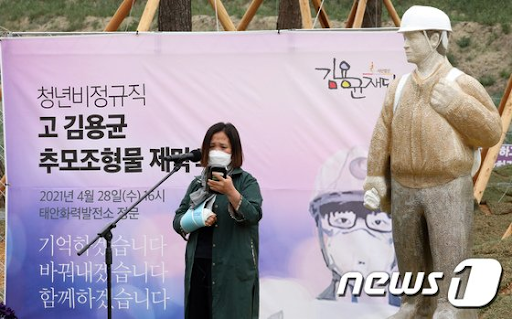
Memorial ceremony of Kim Young-gyun, with Kim’s memorial sculpture Source: News1 Kim Yong-gyun (김용균) was a contract worker at Korea Engineering & Power Service (한국발전기술). On December 10th, 2018, he died while he was clearing coal from under a conveyor belt by himself. The Special Labor Pre-Investigation Committee (특별노동안전조사위원회) was called for an investigation of Kim’s death and suspected extensive outsourcing of work to subcontractors as the cause of the accident. They claimed that the outsourcing of various processes cuts off communication within the worksite and therefore exposes workers to industrial accidents. After Kim’s accident, the issue of safety at industrial sites rose to the surface, and 3 years later, the new bill passed the legislature. This accident kicked off practical prevention and management strategies of further serious accidents within and surrounding industrial sites and reinforced the heavy involvement of corporate executives and head managers. Importance of SAPA The SAPA assures the safety of workers and civilians and prevents heavy accidents that are caused by a lack of corporate participation or safety systems. Although it does not have a direct relationship with how the actual work is done, it requires corporations to implement a safety management system within their business system and sanctions business owners or corporate executives who do not ensure that such systems are in place. Since corporations put site directors or plant managers in charge of safety management, the heads of corporations were not officially in charge and did not have to take responsibility when industrial accidents occurred, and are thus rarely sanctioned. From now on, however, the head manager or the chief executives are obliged to take the first action for industrial accident prevention, which also means they will be the ones to be sanctioned (Korean link) if they violate the rules. Dissenting Views The SAPA targets companies with more than five employees. However, as the application of the new rules to companies with 5-50 employees is delayed until 2024, only companies with more than 50 employees can be monitored at the moment. Some critics charge that current number limits will weaken the SAPA’s effectiveness. Around 80% of serious accidents happen in companies with less than 50 employees. Korean companies are complaining as well. According to a survey of the Korea Enterprise Federation (KEF, 한국경영자총협회), 90.9% (Korean link) out of 654 companies responded that they oppose the act, while 63.6% responded that the act will pose a risk to the industry if owners are sentenced to imprisonment. Legal experts agree that some parts of the law are vague and open to interpretation. For example, Jeong Jin-woo (정진우), a professor at Seoul National University of Science and Technology (서울과학기술대학교) said during an interview with the Korea Herald: “If an employee has an accident while on a commuter bus, it remains unclear whether the top management is to be held accountable, as it could be deemed either the bus driver’s fault or the company’s mismanagement or faulty operation of the bus.” After all, not all injuries caused during work can be counted as industrial accidents. Major companies have prepared new safety manuals and hired legal experts to avoid punishment under the new law. However, it is not easy for small and medium-sized companies to financially invest in such issues. Professor Gwon Hyuk (권혁) from Pusan National University Law School (부산대 법학전문대학원) said, “Laws about industrial safety and health (Korean link) should direct businesses to put efforts in preventing accidents and utilizing professionals rather than excessively penalizing the business.” Companies Already Booked to Get Punished Under the New Law
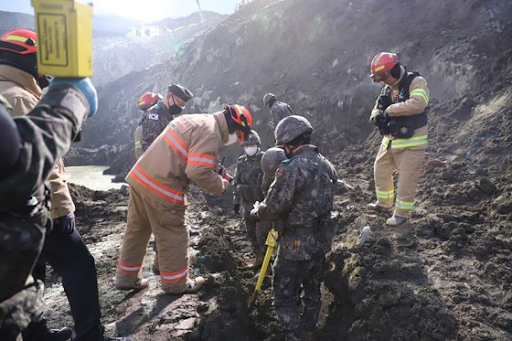
Scene of the Sampyo industry’s accident Source: Money Today After the SAPA was enforced on Jan 27th, a landslide happened at a quarry slope operated by Sampyo Industry (삼표 산업) in Yangju (경기도 양주시) on Jan 29. It left two workers dead and one worker missing, while they were drilling holes for demolition work. The missed worker was later found dead as well. On Jan 31st, labor ministry officials raided the Yangju office of Sampyo Industry. On Feb 9th, Lee Jong-shin (이종신), the CEO of Sampyo Industry, was booked for allegedly violating the SAPA. On Feb 11th, Labor ministry officials raided the headquarters of the Sampyo Industry in central Seoul as well.
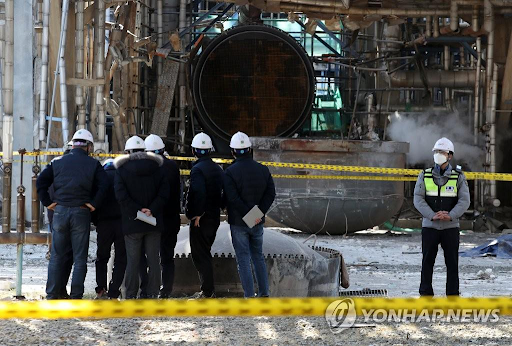
Scene of the LCC accident Source: Yonhap News Right after the Sampyo case, another accident happened on Feb 11 at Yeocheon NCC (여천 NCC), a chemical plant located at the Yeosu National Industrial Complex (여수 국가 산업 단지). It left four workers dead and four injured. The accident occurred during a pressure test of heat exchangers, which was conducted to confirm whether the cleaned heat exchangers were working properly. As the heat exchangers were put under pressure, a round metal cover—which weighed over 1 ton and was 2.5 meters in diameter—popped out of an exchanger and hit eight workers. The explosion did not lead to a subsequent fire. The police are investigating the case on suspicion of a lack of safety guidance at the worksite. Usually, workers are not allowed to enter the site when heat exchangers are tested. Labor ministry officials later raided the office of Yeocheon NCC. Whether Sampyo and LCC had appropriate safety measures in place and had given proper guidance to their workers will be a key to how the companies might be punished. The Ministry of Labor is expected to use this accident as a symbolic case of violating the new law. Sampyo has asked the counsel of Kim & Chang (김앤장) and Lee & Ko (법무법인 광장), the two largest law firms in Korea. The ministry’s application of the law will become an important guideline for other companies in the future, too. Prospects of the New Law Labor communities are going to push the government to include companies with under five employees in the law. However, economic and industrial communities are asking to supplement the current law with more clarifications on details. Interestingly, half of the global corporations operating in Korea are expected to scale down their business and put their financial investment in Korea on hold if CEOs now get punished under the law. Some global corporations worry that the new law is too vague, even if they want to follow all rules and regulations. James Kim, the CEO of the American Chamber of Commerce in Korea (주한미국상공회의소), said in an interview with Chosun Il-bo (조선일보), “More details should be provided for business owners to prevent false charges. If there is no clear evidence that a serious accident has occurred due to the business owner's malicious intention, the law should relieve them by including exemption clauses.” Moreover, some worry that employers will become more hesitant to hire older workers. According to the statistics on industrial accidents and death in 2020 (Korean link) by the Ministry of Labor, almost 72% of the industrial deaths occurred among older employees above the age of 50, and 39.3% occurred among workers above the age of 60. After the SAPA’s legal implementation, it is now expected that workers’ safety will be considered a more serious issue than ever before. However, since this is just the beginning and since there are no exemplary decisions yet, we'll have to wait and see how things proceed and what further changes will be made to the law.
Today's Vocabulary 노가다 (nogada) The word “노가다 (nogada)” originates from the Japanese word “どかた (dokata)”, meaning mining laborers. The word nowadays refers to unskilled work at construction sites such as carrying bricks and cutting wood. A: 너 팔이 왜 그래? B: 나 어제 노가다 뛰다가 다쳤어. A: What’s wrong with your arm? B: I was hurt doing nogada yesterday. This Week's Recommendations
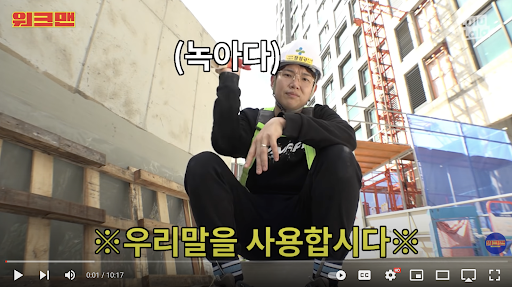
Source: https://youtu.be/RjGbCptFlFM Workman (워크맨) is a quirky and entertaining YouTube variety show featuring former announcer Jang Sung-kyu as he navigates the demands of the workplace. In this episode, he spends the day doing some heavy lifting at a construction site and learns all about the difficulties and risks that the job entails. You can watch this episode of Workman on YouTube.
💚 Support us! 💚
|