For dark mode users,
Hello, readers! Today, we are covering: Index Zoom In The A to Z of Korean Education Today's Vocabulary 개천에서 용 나다: A dragon that is born in a stream This Week's Recommendations Episode of Asian Boss Don't forget to leave your feedback below!
The A to Z of Korean Education Writer: Haram Lee, Daeho Park Editor: Aleya Sharif Senior Editor: Regine Armann Editor-in-Chief: Fred McNulty Researcher: Yul Jun
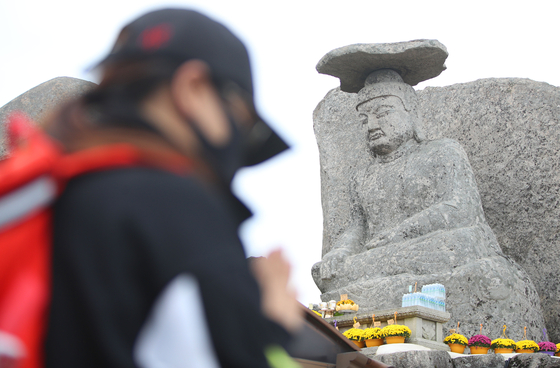
Photo by Yonhap During November of every year, many people from all over the country gather in Daegu (대구) to visit the Gatbawi Rock (갓바위) in Palgongsan Mountain (팔공산) to offer prayers for their children who will be undertaking the College Scholastic Ability Test, CSAT (대학수학능력시험) or what is commonly known as suneung (수능). The test took place on the 18th of this year, and due to the heavy traffic that floods the area, local residents face many inconveniences during this time of year. Kim (49, Dong-gu, Daegu) said, "I visit Gatbawi Rock on weekends to pray 108 times for a good 수능 score for my second daughter," adding, "My eldest child also came and bowed almost every day before taking the 수능, but this year, I visited Gatbawi with my husband only, early on weekends, due to concerns about COVID-19." According to the Palgongsan Natural Park Gatbawi Management Office (팔공산 자연공원 갓바위 관리사무소), the number of visitors has halved compared to this time last year due to the outbreak of COVID-19. In November, the number of visitors to Gatbawi Rock amounted to about 3,000 on weekends and 1,000 on weekdays (Korean link). 수능 is an abbreviation for 대학수학능력시험, the Korean College Scholastic Ability Test, which is usually required to get into college. Parents who visit Gatbawi Rock hope their children will get into high-ranking universities such as Seoul National University (서울대학교), Korea University (고려대학교), and Yonsei University (연세대학교), better known by the acronym “SKY”. They believe that admission to a high-ranking college will pave the way for their children's success. For more information on this, check out our earlier KOMMON article on the 수능 here. But does a high score on the 수능 really guarantee success in Korean society? And why are people so obsessed with education? Today, let's look at the overall school curriculum in Korea, high enthusiasm for academic achievements, and the side effects of this focus on education. Introducing the Korean school curriculum Let's introduce the story of A, who grew up as the child of parents with very high “academic enthusiasm”, as Koreans call it. A's parents are graduates of Seoul National University and therefore considered “elite”. 1) Before entering kindergarten A's parents hired native English speakers to play with her in English and create an environment where she can be exposed to English naturally, by interacting with people who may not speak Korean, to jump-start her English skills. Even when you have only just entered kindergarten, you can already be ahead of your peers with this kind of support. 2) Kindergarten From the age of five, parents try to send their children to special “elite” kindergartens such as those connected to schools that follow international curriculums, or kindergartens that teach children entirely in English. Since students have to take an exam or an interview to get in, most families hire a tutor to prepare their children for this. How big the English kindergarten market has become: Korea's English education expenditure amounts to trillions of won per year. Especially, the expenditure for English academies for infants, the so-called "English kindergartens," are hundreds of billions of won by itself. According to the office of congressman Ahn Min-seok (안민석) of the Democratic Party of Korea (더불어민주당), who is a member of the Committee of Education (교육위원회), there were 410 English kindergartens (Korean link) in Korea with monthly tuition of about ₩570,000 as of April 2016. In some places, the tuition fee for all-day classes for children aged 6 to 7 exceeds ₩2 million—in a country where public kindergarten tuition fee is practically free. The market size of private kindergarten education reaches ₩250 billion per year. If you narrow it down to Seoul, the cost of English-teaching kindergartens is even higher. According to the civic organization “World Without Worrying about Private Education” (사교육 걱정 없는 세상), the average cost of tuition in Gangnam, Seocho, Gangdong, and Songpa-gu, where most English kindergartens are concentrated, was ₩1,023,000 (Korean link) as of last year. In terms of annual costs, it is 6.4 times the costs of general private kindergartens (₩1.895 million per year) and twice the average four-year college tuition (₩6.71 million per year). The most expensive places are two language institutes in Gangnam-gu that cost ₩2,243,000 each. 3) Elementary school A then entered an elementary school that many people assume is free (as public elementary school education is provided by the government); however, many prominent private elementary schools have paid tuition and are not covered by the government. There are nine private elementary schools nationwide with annual tuition of more than ₩10 million. According to the results of a survey released on the 20th of September, 2016 by Park Kyung-mi (박경미), a member of the Education, Culture, Sports and Tourism Committee of the National Assembly (교육문화체육관광위원회), Younghoon Elementary School in Seoul was the most expensive in the country, at ₩11.57 million per year (Korean l ink). The top 10 elementary schools in Korea:
Now, at age 13, A is entering a whole new world of private education by enrolling in an international middle school along with an English academy. Mathematics hagwons (학원) are already considered mandatory, as they have to make up for lackluster high school curricula. When you add well-regarded extracurricular activities such as violin, ballet, taekwondo, and soccer classes, a student’s day grows exponentially longer. A's day already begins at 8 a.m. and ends at 11 p.m.—even though she is just finishing elementary school! 4) Middle School Most Korean students still attend regular public middle schools, but those parents who want their children to receive “advanced” education go as far as sending their kids to international middle schools. A was set to enroll in an international school but did not make the cut. Determined to provide her with higher-than-average education, A’s parents then considered sending A to an “unapproved” international school. Unapproved international schools are ones that are not regulated and recognized by the education authorities. In that case, the students must then undergo a national exam called the Graduation Equivalency Examination (검정고시), in order to have their academic achievements recognized. Whether A ends up at an international school or public school, A’s life will without doubt be filled with endless classes, academic activities, and milestones to achieve. 5) High School When entering high school, A’s 1st and 2nd years will be fully dedicated to studying, and extracurricular activities will need to be added in preparation for A’s college admissions. The activities can be anything from joining the student body government or the broadcasting club or another kind of student group. Upon entering high school, most Korean high school students start studying for the Korean Scholastic Aptitude Test, also called the KSAT. The toughest part of that preparation period begins in the students’ third and final year of high school. Many third-year high school students then work day and night for their midterms and finals, the scores of which are crucial for college entrance. After spending hectic months studying, the students start applying for college in September, which is when rolling admissions, the soo-si (수시), commences. Depending on how the results turn out in October, students can either bypass the KSAT (as they have made it in without the additional score), or prepare to take the test. Upon the release of the results in October, those who pass the rolling admissions are set to move on and prepare for the next phase in their academic journey. Others must work even harder in preparation for the upcoming KSAT in November. The results of the KSAT are then released in December of every year. Depending on how well they score, students either make it into university via regular admission, which is known as jung-si (정시) or spend another year studying with the aim of achieving better results when they retake the KSAT exam the following year. Problems 1) The rich and the poor have different opportunities when it comes to education Just because much of the process is the same does not mean that the starting position is the same. It is evident that the starting line for the education race is different for children from families with different levels of income. The more money you have, the better the school you send your child to. Children coming from high-income families enjoy the opportunity of attending well-reputed schools and receiving private tutoring to boost their grades and expand their academic outreach as well. According to a report by the Korea Student Aid Foundation (한국장학재단) and the 2018 Yonsei University Students' Income Calculator (2018년 1학기 서울‧고려‧연세대 재학생 소득분위 산출 현황, 한국장학재단), 30% of SKY students that applied for national scholarships are from the highest-income households (earning more than ₩12 million per month), and another 16% are from the second-highest income households (more than ₩7.3 million income per month). Only 6% of students (Korean link) at these schools come from low-income households. On the other hand, among students who applied for national scholarships at universities across the country except at SKY universities, the ratio of students from high-income families in the 9th and 10th percentiles was 13% and 12%, respectively, while the ratio of low-income students at these universities was 8%. That means the SKY universities’ high-income student ratio (46%) is nearly twice as large as the high-income student ratio at all other universities (25%). 2) Wage gap between high school graduates and college graduates Education is seen as a means of accumulating wealth. It is natural that even workers in the same job earn different wages depending on their educational background. The wage gap between high school graduates and college graduates in Korea has widened, surpassing the OECD average wage gap. As of 2016, when looking at the wages of Korean adults (25-64) according to educational background, we see that junior college graduates’ wages were 16% higher than those of high school graduates, and college graduates’ wages were 49% higher than those of high school graduates. The wages of vocational college graduates were below the OECD average, but those of college graduates and holders of postgraduate degrees were above the OECD average; the gap between the wages of high school and those of college/university graduates was also larger than the OECD average. 3) Fewer job opportunities for high school graduates/college graduates Not only wages but also job opportunities vary depending on one’s educational background. In addition, the lower the educational background, the lower the job stability. According to an analysis (Korean link) published in the Economically Active Population Survey of the National Statistical Office (2018 경제활동 인구조사 통계, 대한민국 통계청), the number of employed people with only high school education decreased by 180,000 last year. The number of employed people from junior colleges also decreased by 28,000. The number of middle school-only graduates decreased by 70,000 and elementary school graduates by 31,000. On the other hand, the number of employed four-year college graduates increased by 91,000 last year (Korean link). 4) Collapse of Public Education As students’ academic achievements are directly connected to the quality of private education, A lot of students who attend academies or hagwons receive more targeted education and can familiarize themselves with the materials in advance. Only a handful of textbooks are used to teach in school, while midterm and final exam problems are much more challenging. It cannot necessarily be said that it is wrong to make exams difficult; however, the results point to the unfairness that stems from differences in access to private education: the more private education a student receives, the higher their score. The reason behind this phenomenon is that it is virtually impossible to comprehend the test materials without receiving additional academic assistance. When it comes to literacy, South Korea marks nearly 100%, and 69.8 percent of South Koreans aged 25 to 34 years old have completed some form of tertiary education, which is the highest ratio among OECD countries. These statistics suggest that a high percentage of young South Koreans are highly educated. However, this is achieved with help mostly from the private, not the public, education sector. 5) Excessive Study-Under Pressure Due to the excessive amount of studying that students have to complete, they do not get sufficient time to be around their friends to socialize. They are constantly told to stick to their table and keep studying for that extra score that can possibly determine their future. As a result, most Korean students excel in education compared to global standards. However, they are deprived of social and emotional experiences that are crucial for their life. Korean students are always under pressure to enter not just any college, but a reputable, prestigious college. Much of this has to do with the social stigma attached to colleges that are outside of Seoul. This is referred to with the term “In-Seoul” (인서울), where most prominent universities are located. Faced with so much stress alongside academic and other burdens, South Korea continually tops the OECD suicide rates —making one wonder how much of an influence the constant competition has. Outro After studying so hard and with all the help from her parents, A might successfully enter a SKY university. However, even entering a SKY university will not necessarily guarantee A's success. There are many more complicating factors. Competitors are everywhere. After graduating from college, it is not even certain that A will get a job. A long and winding road is waiting for A. It has only just begun.
Today's Vocabulary 개천에서 용 나다: A dragon that is born in a stream 개룡남: A successful man who was born in 개천 (a stream; also a poor village) (It is used in a negative sense) Example: A: 저 사람 너무 잘난 척이 심한 것 같아. 왜 저러지? B: 너 몰랐어? 저 사람 개룡남이잖아. 본인이 이 대학교에 들어온 걸 엄청 자랑스러워 할 걸? A: I think he's showing off too much. What's wrong with him? B: You didn't know? He's a 개룡남. I'm sure he's very proud of entering this university. This Week's Recommendations
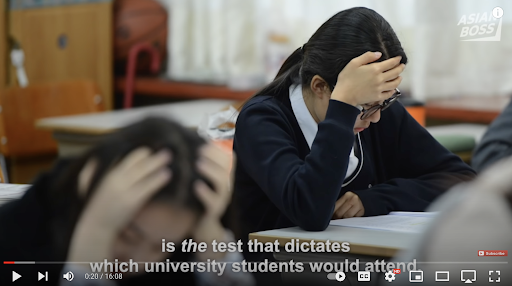
Source: https://youtu.be/D4c5ZRJII68 In this episode of Asian Boss, the interviewer meets with students, parents and teachers to get insights into the most important high school exam in South Korea: the College Scholastic Ability Test (CSAT), or suneung (수능). She takes us behind the scenes to get a glimpse of every stage that students go through in preparation for the CSAT, from studying to the day of examination. You can watch this episode of Asian Boss on Youtube.
💚 Support us! 💚
|