For dark mode users,
Hello, readers! Today, we are covering: Cultural Insight: Snowdrop: Fiction or Fact? Related KOMMON Newsletters This Week's Recommendations 1987: When the Day Comes (1987, 2017) Don't forget to leave your feedback below!
Snowdrop: Fiction or Fact?
Writer: Yeon Woo Lee, Solwon Pyeon Senior Editor: Regine Armann Editor-in-Chief: Fred McNulty Researcher: Yul Jun Illustrator: Ah-young Kim
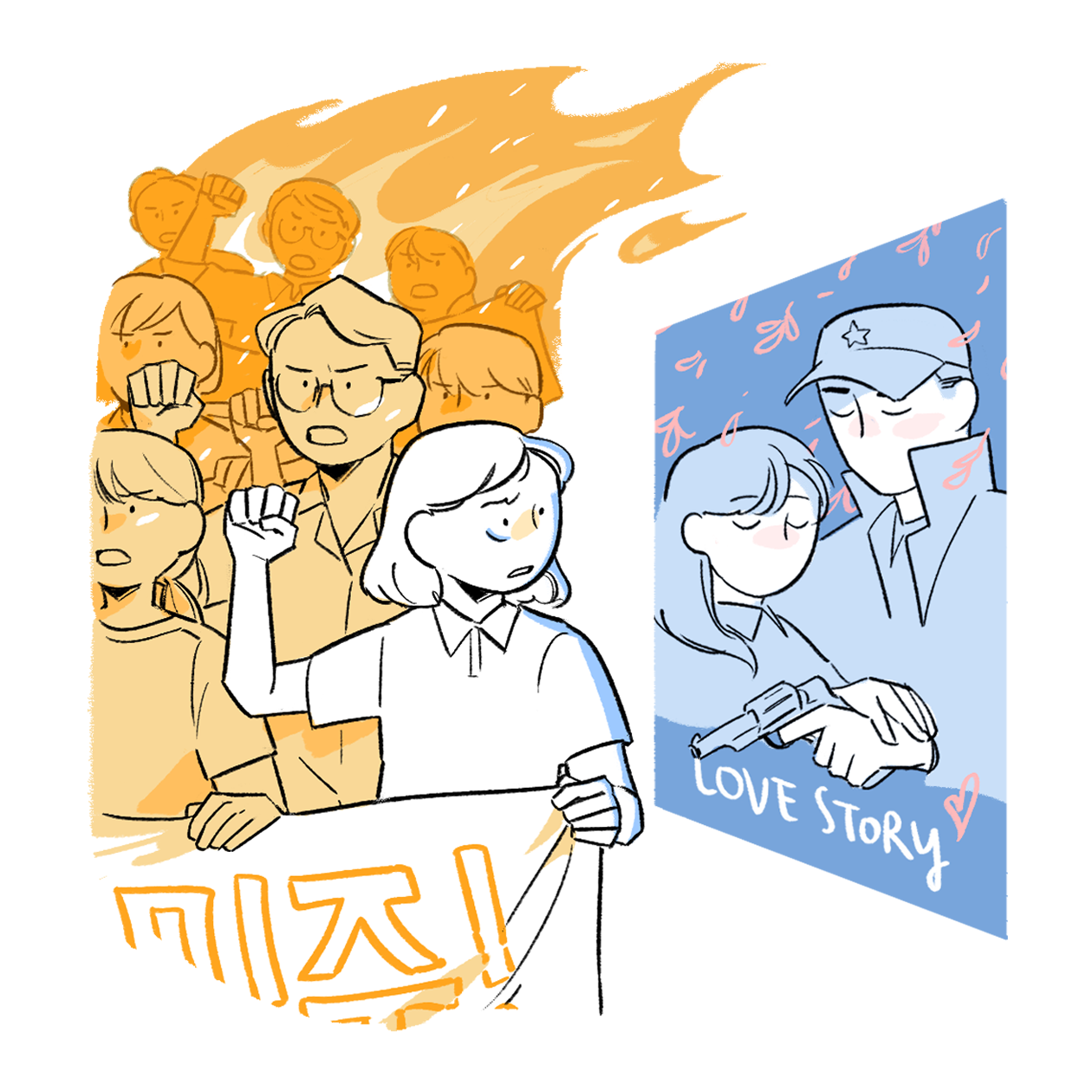
[Illustration by Ah-young Kim] Snowdrop (설강화), an ongoing South Korean television series, has been caught up in a controversy over distortion of Korean history. Regardless of the many celebrities casted for the drama, many people in Korea heavily oppose the broadcasting of the show.
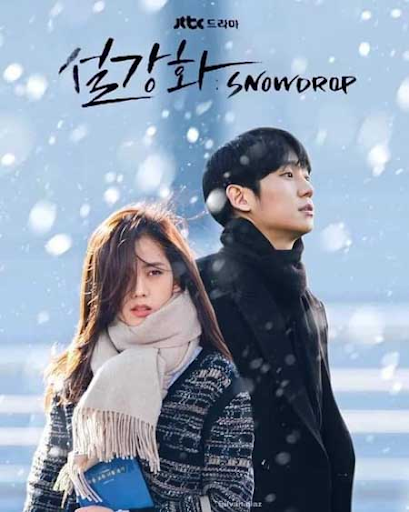
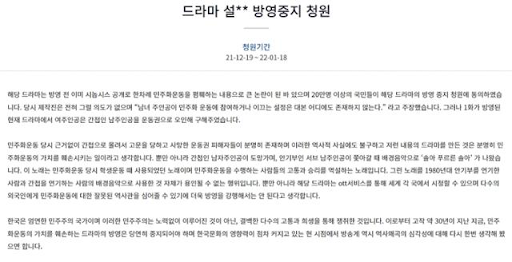
Snowdrop main poster Source: JTBC On December 18, the day it premiered on JTBC, the drama was already accused of disparaging Korea’s pro-democracy movement (based on the synopsis that had been released earlier), and a petition was promptly launched, demanding to cancel the broadcasting. The petition gained over 200,000 supporters within a day, and sponsors who had invested in the show also pulled back their support. The numbers of supporters of the petition are continuously increasing.
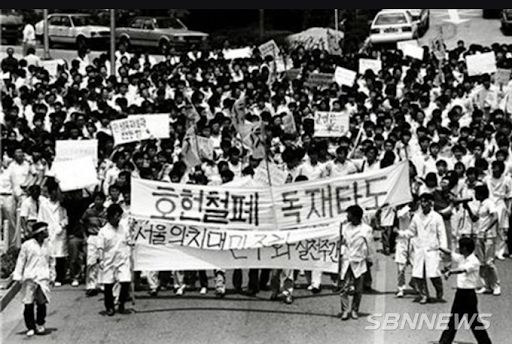
Source: 드라마 설** 방영중지 청원 > 대한민국 청와대 Numerous sponsors asked to remove their products from the drama (Korean link) and withdrew their sponsorship. Ssarijai (싸리재마을), for instance, initially sponsored the TV show with their rice cake products. The day after the first episode of Snowdrop aired, Ssarijai posted an apology on its official webpage stating they had not been provided with sufficient information about the production, except for the title and names of the actors. They further stated that they had noticed the public’s increasing concerns about historical distortion and glamorizing of the Agency for National Security Planning (국가안전기획부, in short, “NSP”), and therefore immediately withdrawn their products. Other brands are taking the same steps. Why is Snowdrop caught up in this controversy? How does Snowdrop (allegedly) distort Korean history? What is the June Democratic Uprising? The June Democratic Uprising (6월 민주항쟁) was one of the biggest democratic movements in Korean history. Organized mainly by a large body of students in 1987, its depiction is one of the controversial issues surrounding the TV show. Then-president Chun Doo-hwan continued to govern the country by martial law, thereby maintaining his dictatorship. He suppressed democratic movements harshly. He also re-established what is known as the Agency for National Security Planning, which abused government power to oppress civilians and interfered with democratic movements. This was in spite of nationwide protests that called for democratic reforms. That is where the June Uprising started. On May 18, 1987, The Catholic Priests Association for Justice (천주교 정의구현 사제단) revealed that the NSP had tortured and killed a student of Seoul National University, Bak Jong-cheol (Korean link), during an interrogation. Although his death was a result of extreme torture, the NSP denied their wrongdoings at first, claiming he died of a sudden and unknown cause. As a response to these events, democratic political party members, religious figures, and non-organization groups including the Reunification Democratic Party, founded by who is now known as the first democratic president of South Korea, Kim Young-sam, formed a socio-political circle called the National Movement Headquarters for the Gain of a Democratic Constitution (민주헌법쟁취국민운동본부) to demolish the dictatorship. The demonstrations included politicians, civilians, and students who all came out onto the streets calling for democracy.
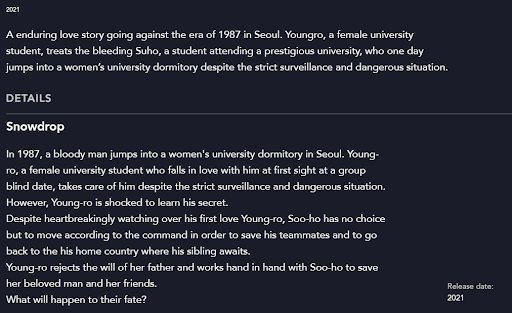
This movement eventually became successful and led to the June 29 Declaration (6.29 선언), which implemented a new presidential election system in South Korea, as well as a democratic government. This is the system that is still in place today. Why is Snowdrop Accused of Distorting History? 1) Characterizing the male protagonist as a North Korean spy The plot of Snowdrop involves North Korean spies being sent to the South. Here is Snowdrop’s synopsis as presented by Disney+, which produced the drama: "’Snowdrop’ is known to be based on the handwritten notes of a man who escaped from a political prison camp in North Korea. In 1987, when tear gas exploded like firecrackers, a bloody man jumped into a female college dormitory and a female student treated him thinking he's an activist student fighting for the generation.” However, after the recent controversy around Snowdrop, Disney+ released a new synopsis that emphasizes the protagonists’ romantic relationship and has obviously been stripped of any reference to the twisted political situation of the time.
The revised synopsis for Snowdrop on Disney+ Source: Disney+ Some insist that by characterizing the male protagonist as a North Korean spy apparently meddling with South Korean politics and democratization efforts, Snowdrop implies that the democratic movement was a North Korean scheme put in place to disassemble the South Korean government. This resembles a far-right conspiracy, which posits that North Korean interference, and not a genuine grassroots movement, was responsible for the student-led pro-democracy movements in the 1970s and 1980s. Credible historians almost unanimously reject this narrative.
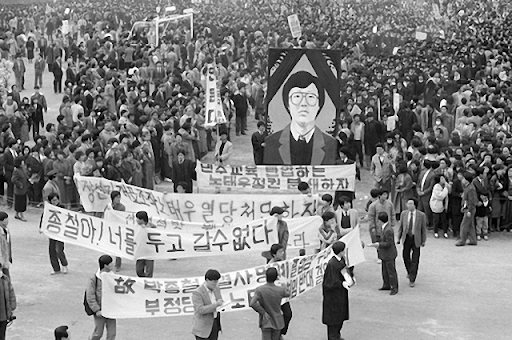
Demonstration sparked by Bak Jong-cheol’s death Source: Yonhap The Bak Jong-cheol Commemoration Service Society (박종철기념사업회) gave an interview to NoCutNews late last year and warned that linking the democratic movement to North Korean spies constitutes secondary victimization (Korean link) of people who have suffered during the time. The representative of the group said: “A lot of activists were killed or seriously injured by the government. They said the reason for the suppression is that we are spies. (But we weren’t.) Snowdrop is justifying the then government’s violence towards the democratic movement by making a North Korean spy appear as a democratic activist.” 2) Portraying the NSP in a positive light Another major criticism is that the drama portrays the National Security Planning Agency in a positive light. The NSP, commonly referred to by its Korean acronym angibu (안기부), was Korea’s intelligence agency from 1981 to 1999. It is the predecessor of the National Intelligence Service (국가정보원). The NSP called participants of the democratic movement “빨갱이 (ppalgaeng-i)”, a word that was originally used as an insult for communists. In an interview with the Korea JoongAng Daily, Ban Byung-yool, an emeritus professor of history at Hankuk University of Foreign Studies said research shows the NSP fabricated more North Korean spies than it actually caught. He added, “It falsely accused dissidents of espionage and frequently arrested people without warrants. Snowdrop depicting the NSP as a normal law enforcement agency that abided by the rules is inaccurate and problematic.” 3) A heroine’s name for the female protagonist
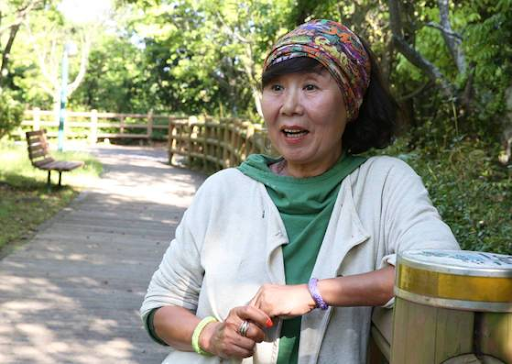
Chun Young-cho Source: Joongang Il-bo The name of an actual South Korean student activist, Young-cho (영초), became an issue too. Chun Young-cho was involved in the student-led democratization movement that the drama uses as its historical context, and her husband was falsely accused of being a North Korean spy and eventually tortured to death. JTBC, which co-produced the drama together with Disney+, responded to early criticism in the run-up to the broadcast that even though the female character has nothing to do with Chun Young-cho, her name would be changed (Korean link). JTBC then changed her name to Young-ro (영로). 4) Worries about the spread of historical distortions Some worry that people who are not familiar with Korean history might unintentionally misunderstand the democratic movement of Korea, especially because the actress who plays the female protagonist, Ji-soo, who is a member of the hit k-pop group Blackpink, has a lot of global fans all over the world who are expected to watch the drama. Fiction or Fact? As KOMMON has pointed out in one of our previous newsletters, this is not the first time that a Korean drama series was under fire for alleged historical inaccuracies. Even though the public has reacted sensitively to historical distortions before, the issue still remains. In March 2021, television network SBS had announced the cancelation of further broadcasts of the drama Joseon Exorcist (조선구마사), due to the way in which it portrayed the royal family and allegedly distorted history. (👉 KOMMON💌) During an online discussion titled “Historical fact and fiction of contents”, Chung Hyun-min (정현민), one writer of the drama Mung Bean Flower (녹두꽃), argued that it is difficult to meet the public’s high demand (Korean link) for historical research, due to high competition and bad production environments. However, there are voices that oppose the accusations of Snowdrop distorting history, too. Film critic Sim Young-seop (심영섭) considers calls to cancel the drama “violence”. He said that it is “censorship” and “oppression” (Korean link) to push corporations to stop sponsoring the drama or to stop broadcasting it. “Point out the ideological issue in this drama and criticize with logic,” he implores. South Korea wrestles not just with reconciling its 20th-century history with contemporary sensibilities, but also with how to present itself on a global stage. “Depicting history in a wrong way is to interpret historical distortion in a narrow sense,” Professor Kim Min-jung (김민정) from the Department of Creative Writings of Joongang University says,“However, not reflecting the spirit of the times can also be considered a historical distortion.”
Related KOMMON Newsletters This Week's Recommendations
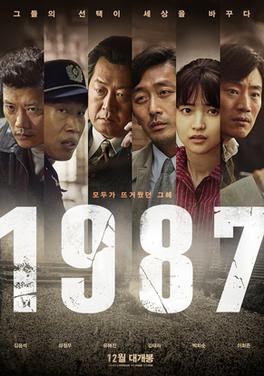
1987: When the Day Comes (1987, 2017) Available on Netflix (129 mins) Based on a true story, the movie showcases significant events that led to the June Democratic Uprising (6월 민주항쟁) in 1987. The story unfolds after a student activist named Park Jong-chul dies during an interrogation. Committed to covering up the incident, a commissioner named Park Cheo-won orders for the body to be cremated before an autopsy is carried out, and reports the death as a heart attack. A prosecutor named Choi Hwan, however, does not approve the cremation order and an autopsy is eventually carried out, despite the commissioners' efforts. At the hospital, the uncle of the deceased learns about the outcome of the autopsy and declares this fact outside the hospital building. The now-dismissed Prosecutor Choi then presents the evidence to a reporter, Yoon Sang-sam, in hopes of investigating and publicizing the case. Will Yoon succeed in sharing Jong-chul’s story despite the nationwide restriction on reporting his death?
|